

Smashed Avocado by Nicole Haddow: An Honest Review
Our honest Smashed Avocado review: Nicole Haddow's relatable Aussie first-home-buyer memoir, the smashed avocado debate, its strengths, and who it's for.
 By Timothy Hirou GaschereauPublished
 9 min read
Short version: this is a warm, readable, genuinely Australian story about buying a first home, and it's worth your time if you're in the emotional trenches of saving a deposit. It is not, however, the step-by-step property investing manual the subtitle might lead you to expect. It's part of our personal finance book reviews on Snowball Invest.
Quick answer
A relatable, journalist-written memoir about cracking the Melbourne property market, best read as emotional fuel rather than a financial playbook. Best for first-home buyers who feel stuck, behind, or just need to know someone else has been through it. Skip it if you want negative gearing strategies, portfolio tactics, or a numbers-heavy property guide. Our rating: 3.5 out of 5.
Want to read Smashed Avocado?
A millennial who ditched the rent trap and cracked the property market by 30, told with honesty and humour.
In this guide
- →What the book is about: the first-home story and the smashed avocado debate
- →The genuine strengths and the honest weaknesses
- →Who it's for, and who should skip it
- →What critics and readers say
- →The Australian angle: deposits, FHOG/FHSS and the structural housing problem
📖 What is Smashed Avocado about?
Smashed Avocado: How I Cracked the Property Market and You Can Too was published in 2019. Nicole Haddow is a journalist and communications professional who previously wrote the executive property section for the Australian Financial Review, and started the Smashed Avocado blog in 2018. The story: at 30, Haddow had unstable freelance income, no savings plan and credit card debt. Less than two years later, she owned a property in Melbourne.
How she did it: she moved back in with her parents to save a deposit (a significant privilege she's upfront about), cut spending and boosted income with side work, and navigated the full Australian buying process, auctions, mortgage brokers, buyers' agents and all. The book weaves in case studies and practical tips from these professionals, so it's not purely memoir. The title is a direct nod to Bernard Salt's 2016 column suggesting young people redirect their smashed-avocado brunch money toward a house deposit, a piece that went viral and became shorthand for blaming millennials for structural housing unaffordability. Haddow takes that debate head-on, and also touches on alternative entry strategies ( rentvesting, buying regionally, tiny homes, Airbnb income, flipping). It's broad in scope, even if Melbourne-centric in tone.
⚖️ Strengths and weaknesses
What it gets right
- ✓Genuinely Australian, not a US import dressed up: rooted in Melbourne's auction culture and Australian mortgage-broker processes.
- ✓Real emotional honesty: the stress, the FOMO, the self-doubt, and the moments where it felt impossible.
- ✓Professional case studies (brokers, buyers' agents, planners) add genuine practical value beyond a personal diary.
- ✓Accessible, journalist-clear writing that moves quickly, with no textbook stodginess.
- ✓Reframes the smashed-avocado debate honestly: the real issue is wages, prices and timing, not brunch.
Where it falls short
- ✕It's a memoir, not a manual: the subtitle promises more tactical content than it delivers.
- ✕Moving back with parents is a significant privilege that isn't on the table for many readers.
- ✕Published in 2019: prices, rates and lending conditions have moved substantially since.
- ✕Light on investment strategy: negative gearing, equity and portfolio-building are absent or barely touched.
- ✕Skews Melbourne and inner-city, so the practical specifics travel less well elsewhere.
👤 Who should read it, and who should skip it?
Read it if you
- ✓Are an emotionally stuck first-home buyer who knows the theory but feels paralysed by the scale of it.
- ✓Want an honest Australian story rather than a get-rich-quick manual.
- ✓Feel behind on property and need to hear that it's hard, the system isn't fair, and you can still do it.
Skip it if you
- ✕Are an experienced investor managing a portfolio or adding your third property.
- ✕Want a numbers-heavy strategy guide (more technical property books serve that better).
- ✕Are buying in a regional market or outside Melbourne, where the practical specifics fit less well.
🔍 What do critics say?
The book received widespread media attention on release in 2019 and was featured across Australian lifestyle and personal finance media. It even drew academic engagement: a 2021 paper in the journal Australian Geographer analysed it as a self-help text shaped by neoliberal ideas about housing and personal responsibility, arguing it frames the self as both problem and solution while leaving structural market issues intact. That's a critical reading, but it also confirms the book's cultural weight, and film and TV rights were optioned in 2020, another signal of mainstream appeal well beyond the personal finance shelf.
💬 What do readers say? Goodreads and Reddit
On Goodreads it holds around 3.7 out of 5, a solid if not glowing result. The pattern is consistent: Australian millennial women in particular describe feeling seen, with the recurring sentiment being something close to "I felt less alone reading this." Readers who wanted more actionable financial detail tend to rate it lower, and that split maps almost exactly onto the four-star-versus-three-star divide.
The emotional register of the whole book is honest, not sugar-coated, and ultimately optimistic: buying is hard, there are grim bits, the system isn't fair, but it's not impossible. It hasn't generated the kind of forum debate you'd see around The Barefoot Investor, which says little about its quality either way.
🇦🇺 The Australian angle
You can't talk about this book without the debate it's named after. In October 2016, demographer Bernard Salt pointed to young Australians spending around $22 a serve on smashed avocado at cafes, implying they should redirect that toward a house deposit. He later said the piece was satire of middle-aged moralising; the internet did not take it that way. The column became a lightning rod, framing a generation's inability to afford a home as a spending problem rather than a structural one, even as wages failed to keep pace with property prices. Our own look at housing affordability in Australia backs up Haddow's read on the numbers.
Haddow engages directly with this (she even sits down with Salt himself), and her conclusion, the book's central argument, is that the real barriers are structural: wage stagnation, the pace of property price growth, and the timing of when you entered the workforce relative to when prices took off. The smashed avocado is a red herring. The book also touches on the practical Australian landscape ( stamp duty, the First Home Owner Grant, the First Home Super Saver scheme, deposit strategies, Melbourne's auction culture), treating them as the real, local hurdles they are. For a more tactical property read, our Armchair Guide to Property Investing review is a good companion, and our Barefoot Investor review covers the broader money foundations.
💰 The verdict
Smashed Avocado is a genuinely good book for a specific reader: the Australian millennial or Gen X first-home buyer who is emotionally stuck, feels behind, and needs to hear an honest story rather than a polished success myth. It delivers that with warmth, good writing and real professional input woven throughout. It is not a financial blueprint: it won't tell you how to structure a property portfolio, use equity to buy your second property, or navigate negative gearing, so you'll need more technical resources alongside it. Read it for the mindset, supplement it with the numbers, and if you're in the emotional trenches of first-home buying in Australia, it will probably make you feel a lot less alone. Our rating: 3.5 out of 5.
Want to read Smashed Avocado?
Feeling stuck saving a deposit? Grab a copy for the honest, you-can-still-do-this reality check.
SnowLetter
Australia's money news and our best reads, once a week.
❓ Frequently asked questions
Who is Nicole Haddow?
+
Nicole Haddow is an Australian journalist and communications professional who previously wrote the executive property section for the Australian Financial Review. She started the Smashed Avocado blog in 2018 to help young Australians navigate the property market, and the book (her 2019 debut) grew out of it. She has since written other books and now lives in regional Victoria.
Is Smashed Avocado a property investing guide?
+
Not really. Despite the subtitle, it's primarily a personal memoir following Haddow's journey from credit card debt to first-home ownership in Melbourne, with tips from mortgage brokers, buyers' agents and financial planners woven in. It covers the emotional and practical experience of buying a first home, but doesn't go deep on investment strategy, portfolio building or wealth creation through property.
Is the book still relevant given property prices have changed since 2019?
+
The emotional journey, the mindset shifts, the process of working with mortgage brokers and buyers' agents, and the reframing of the smashed avocado debate are all still relevant. The specific market conditions have changed substantially since 2019, so treat any market-specific detail as illustrative rather than current. Read it as an emotional companion and a process guide, not a source of up-to-date market data.
How does it compare to The Barefoot Investor for property advice?
+
The Barefoot Investor is a broader personal finance guide (budgeting, emergency funds, super, debt) with property as one element among many. Smashed Avocado is entirely focused on the first-home-buying journey and is much more memoir-driven. Start with Barefoot for a complete system; read Smashed Avocado for the emotional and practical experience of buying your first home. They complement each other.
Is the book only relevant for Melbourne buyers?
+
Melbourne is the setting and the market Haddow navigates, so some detail (auction culture, suburb-by-suburb thinking, specific buyers' agents) is Melbourne-centric. But the emotional experience of saving a deposit, dealing with brokers, managing auction FOMO and working through first-purchase stress is universal across Australian capital cities. Regional buyers may find it less directly applicable.
Where can I buy Smashed Avocado?
+
It's available through Amazon AU and major Australian bookshops, in both paperback and eBook formats, and worth checking your local independent bookstore too.
📚 Get the book (and two companions)
Smashed Avocado
Nicole Haddow
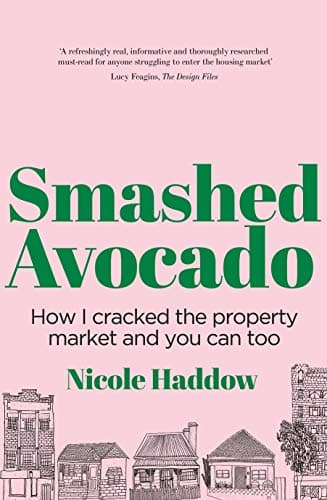
Smashed Avocado
A millennial who ditched the rent trap and cracked the property market by 30, told with honesty and humour. If you have ever been told your brunch is why you cannot buy a home, this Aussie story is your comeback.
The Barefoot Investor
Scott Pape
The Barefoot Investor
Australia's best-selling money book ever. A simple system for accounts, budgeting, debt and a real emergency fund in one.
The Armchair Guide to Property Investing
Ben Kingsley & Bryce Holdaway
The Armchair Guide to Property Investing
Two of Australia's most trusted property voices lay out a plain-English roadmap to building a portfolio on an average income. Practical, local, and refreshingly free of get-rich-quick hype.
Some links above are affiliate links. If you buy through them, Snowball Invest may earn a small commission at no extra cost to you. We only recommend books we'd suggest anyway.
Sources
Was this article useful?
Put it to your own numbers
Every calculator runs entirely in your browser, with nothing stored. See what these numbers look like for your own situation.
Explore the calculators →General information only. This article is educational and does not constitute personal financial advice. It does not account for your circumstances. Consider your own situation and seek advice from a licensed adviser before acting. Read our full disclaimer.

Timothy Hirou Gaschereau
Founder of Snowball Invest, not a financial adviser.
I write about what I'm learning myself, because nobody ever taught us how to take control of our own money. It's a skill, not a mystery, and it's never too late to learn it. The best day to start was yesterday, the second best is today.
LinkedIn →Related articles

I Will Teach You to Be Rich Review: An Australian Take
An honest Australian review of Ramit Sethi's I Will Teach You to Be Rich: what works, what doesn't, and how to adapt the system for super, offset accounts and ETFs.
Investopoly by Stuart Wemyss: An Honest Review
Our honest Investopoly review: Stuart Wemyss's 8 golden rules for building wealth in Australia, the strengths, the caveats, and who should read it.
The Joyful Frugalista by Serina Bird: An Honest Review
Our honest Joyful Frugalista review: Serina Bird's guilt-free, genuinely Australian take on frugal living, its strengths, its limits, and who should read it.