

Thinking, Fast and Slow by Daniel Kahneman: An Honest Review
Our honest Thinking, Fast and Slow review: Daniel Kahneman's landmark on the biases that sabotage your money decisions, its strengths, its caveats, and who it's for.
 By Timothy Hirou GaschereauPublished
 9 min read
Thinking, Fast and Slow is one of the most recommended titles in personal finance circles. Here's the honest take: it's dense, occasionally exhausting, and not a single page tells you which ETF to buy. It's also one of the most important books you can read if you want to understand why you make bad financial decisions. It's part of our personal finance book reviews on Snowball Invest.
Quick answer
A landmark work in behavioural psychology that every investor should at least attempt. It won't teach you how to build a portfolio, but it will show you exactly why your brain is wired to sabotage one. Dense in places and occasionally slow going, but the core ideas are genuinely life-changing. Well worth the effort for anyone serious about long-term investing. Our rating: 4 out of 5.
Want to read Thinking, Fast and Slow?
The Nobel laureate's classic on the two systems driving how we think, and why our fast, intuitive brain makes such expensive money mistakes.
In this guide
- →What the book is about: System 1 vs System 2 and the biases that follow
- →The genuine strengths and the honest weaknesses (including the replication crisis)
- →Who it's for, and who should read Housel instead
- →What critics and r/Bogleheads readers say
- →The Australian angle: why the biases hit ETF, super and property investors here too
📖 What is Thinking, Fast and Slow about?
Daniel Kahneman is not your typical finance author. He's a psychologist who won the 2002 Nobel Prize in Economic Sciences for his work on how humans actually make decisions under uncertainty, as opposed to how economists assumed we did. Published in 2011, the book distils a lifetime of research and has sold over 10 million copies worldwide. The central framework is System 1 versus System 2 thinking: System 1 is fast, automatic, intuitive and emotional (the part of your brain that panics when the ASX drops 5% in a day), while System 2 is slow, deliberate and logical (what you use to compare two mortgage offers). The trouble is System 2 is lazy, and we default to System 1 far more than we think.
The bulk of the book tours the cognitive biases that emerge from this setup:
- Loss aversion: we feel losses roughly twice as sharply as equivalent gains, which is why investors panic-sell in downturns.
- Anchoring: we latch onto the first number we see (like a property asking price) even when it's arbitrary.
- The availability heuristic: we judge how likely something is by how easily an example comes to mind, so a crash feels more probable right after you've read about one.
- Overconfidence: most people rate themselves above-average drivers, and most active fund managers believe they can beat the market. The data disagrees.
- The sunk cost fallacy: holding a losing stock because you "already put money in" is System 1 logic.
- Framing: "90% survival" and "10% mortality" are identical facts that feel completely different.
Kahneman also introduces prospect theory, developed with his long-time collaborator Amos Tversky, which describes how people evaluate gains and losses relative to a reference point rather than in absolute terms. This single idea reshaped economics and earned them the Nobel. What the book is not is a personal finance how-to: there are no portfolio templates or super fund comparisons. It's a deep, sometimes academic exploration of how the human mind works. If the chapter on overconfident stock-pickers convinces you that beating the market is a mug's game, our guide to what an index fund actually is is a sensible next stop.
⚖️ Strengths and weaknesses
What it gets right
- ✓Encyclopaedic breadth: from medical diagnosis to stock picking to holiday happiness, and it all connects.
- ✓Written by the source: Kahneman ran the studies, so the authority is real.
- ✓Surprisingly accessible for a 500-page psychology text, with short chapters and clear examples.
- ✓Immediately applicable: you'll finish chapters and recognise the biases playing out in your own life.
- ✓Foundational for investors: overconfidence, regression to the mean and the illusion of skill are directly relevant to managing money.
- ✓Prospect theory alone is worth the price: understanding why losses hurt more than gains feel good is hugely useful.
Where it falls short
- ✕It's long and it knows it: at around 500 pages it overstays its welcome in places.
- ✕Not a finance how-to: the investing applications are implicit, not explicit.
- ✕Some chapters aged poorly: the replication crisis hit the priming chapter hard, and Kahneman himself acknowledged in 2017 that he placed too much faith in underpowered studies there.
- ✕The priming chapter specifically draws the most criticism; read it with a sceptical eye.
- ✕Uneven density: the later chapters on risk and probability are noticeably harder going.
👤 Who should read it, and who should skip it?
Read it if you
- ✓Are an investor of any level, especially anyone who's panic-sold, chased a hot stock or held a loser 'just a bit longer'.
- ✓Are a passive investor: the chapters on expert overconfidence and the illusion of skill are the psychological case for index investing.
- ✓Make decisions under uncertainty (which is everyone), from job interviews to property negotiations.
- ✓Enjoy big ideas and liked Freakonomics, Nudge or Predictably Irrational, this is the deeper, more rigorous version.
Skip it if you
- ✕Want a quick, actionable finance guide (read The Psychology of Money instead).
- ✕Are put off by academic pacing; this is not a breezy weekend read.
- ✕Are looking for investing strategies: it explains why investors behave irrationally, not what to do about it in portfolio terms.
🔍 What do critics say?
The professional reception was overwhelmingly positive on publication, and the book's reputation has largely held up despite the replication concerns. Major reviewers across the New York Times, the Guardian and the Financial Times praised it as lucid, profound and genuinely masterful, distinguished by clarity and precision, and one of the definitive books on human rationality and irrationality. Not everyone was quite so effusive: some noted it can feel like a methodical march through what psychologists know. That's fair. The book earns its reputation, but it does make you work for it.
💬 What do readers say? Goodreads and Reddit
On Goodreads it holds around 4.2 out of 5 from hundreds of thousands of ratings, with nearly half giving it five stars, a remarkably strong signal for a 500-page psychology text. The Reddit picture is more nuanced, which is probably more useful.
On r/books the split is real: plenty call it a gem, just as many admit they tried and failed to finish it or lost the thread at the midpoint. On r/Bogleheads it comes up constantly as recommended reading for investor psychology, with the consensus that it's "not about investing, but several chapters apply directly," particularly overconfidence, regression to the mean and why active stock-picking is so hard. On r/investing it's treated as a market-psychology primer rather than a stock-picking guide.
🇦🇺 The Australian angle
The behavioural lessons need no translation for an Australian audience. Human psychology doesn't change at the border. Loss aversion is exactly what drives Australian investors to panic-sell ETFs or super units during an ASX downturn: the market drops 15%, System 1 screams danger, and people lock in losses that System 2 would have told them to ride out. Overconfidence is what leads property investors to assume their suburb is different, or share traders to believe their research edge is real. The availability heuristic explains why a dramatic news cycle about inflation or a rate rise can feel like an existential threat to your portfolio even when the long-term data says otherwise. If that description of System 1 screaming danger sounds familiar, our piece on financial anxiety digs into why market drops trigger such an outsized emotional response.
For Australians committed to a passive investing philosophy (a diversified ETF portfolio or a long-term super strategy), this book provides the psychological scaffolding that explains why that approach works. It's not just about low fees, it's about removing your own biased System 1 from the equation. For a shorter, finance-focused take on the same behavioural theme, our Psychology of Money review and our Behavior Gap review are gentler entry points.
💰 The verdict
It's not a perfect book. It's too long, the priming chapter has real problems, and it will never tell you where to put your money. But as a foundational text for understanding the psychology layer of investing, it's essential. Think of it this way: most investing mistakes aren't made because people don't know enough about finance, they're made because people don't know enough about themselves. This book fixes that. Read it slowly, be sceptical of the priming chapter, and pay close attention to everything Kahneman says about overconfidence and the illusion of skill. Our rating: 4 out of 5, a genuinely important behavioural finance book for any Australian investor who wants to understand their own worst enemy.
Want to read Thinking, Fast and Slow?
Want to understand the biases behind your worst money decisions? Grab a copy and read it a chapter at a time.
SnowLetter
Australia's money news and our best reads, once a week.
❓ Frequently asked questions
Is Thinking, Fast and Slow worth reading for investors?
+
Yes, with realistic expectations. It won't give you a portfolio strategy, but it shows exactly why your instincts are likely to lead you astray in markets. The chapters on overconfidence, loss aversion and the illusion of skill are directly relevant to anyone managing money. Think of it as the psychological foundation that makes a passive investing strategy make sense.
Is it beginner-friendly?
+
Mostly. The early chapters are accessible and engaging. The later sections on statistics and probability are denser, and some readers find the pacing tough around the two-thirds mark. If you're new to this kind of material, read one chapter at a time rather than powering through.
How long does it take to read?
+
It's around 500 pages. At a comfortable 20 to 30 pages a day, expect four to six weeks. Many readers take longer because they put it down and come back. That's fine, it's not a race.
Is the replication crisis a dealbreaker?
+
Not really. The priming chapter is the main problem area, and Kahneman himself acknowledged in 2017 that he placed too much faith in underpowered studies there. The core concepts (System 1 and System 2, loss aversion, prospect theory, anchoring and overconfidence) rest on much stronger foundations and have held up well. Read the priming chapter with scepticism, but don't let it put you off the rest.
How does it compare to other behavioural finance books?
+
The Psychology of Money by Morgan Housel is shorter, more readable and more directly focused on personal finance. Predictably Irrational by Dan Ariely covers similar bias territory in a lighter, more anecdotal style. Thinking, Fast and Slow is the most rigorous and comprehensive of the three, but also the most demanding. New to behavioural economics? Start with Housel. Want the full picture? Kahneman is the source.
Does it have an Australian edition?
+
There's no Australia-specific edition, but the standard paperback is widely available through Australian retailers and Amazon AU. The content is universal and needs no local adaptation.
📚 Get the book (and two behaviour companions)
Thinking, Fast and Slow
Daniel Kahneman
Thinking, Fast and Slow
The Nobel laureate's classic on the two systems driving how we think, and why our fast, intuitive brain makes such expensive money mistakes. It explains the behavioural traps behind nearly every bad investing decision.
The Psychology of Money
Morgan Housel
The Psychology of Money
19 short stories on how people actually think and feel about money, not just the maths of it.
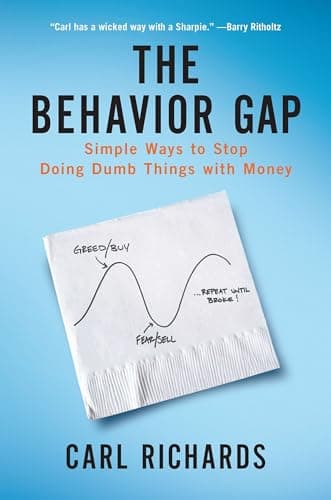
The Behavior Gap
Carl Richards
The Behavior Gap
Carl Richards uses simple napkin sketches to explain why we buy high, sell low, and generally get in our own way. Closing the gap between smart plans and messy human behaviour is worth more than any hot stock tip.
Some links above are affiliate links. If you buy through them, Snowball Invest may earn a small commission at no extra cost to you. We only recommend books we'd suggest anyway.
Sources
Was this article useful?
Put it to your own numbers
Every calculator runs entirely in your browser, with nothing stored. See what these numbers look like for your own situation.
Explore the calculators →General information only. This article is educational and does not constitute personal financial advice. It does not account for your circumstances. Consider your own situation and seek advice from a licensed adviser before acting. Read our full disclaimer.

Timothy Hirou Gaschereau
Founder of Snowball Invest, not a financial adviser.
I write about what I'm learning myself, because nobody ever taught us how to take control of our own money. It's a skill, not a mystery, and it's never too late to learn it. The best day to start was yesterday, the second best is today.
LinkedIn →Related articles

Same as Ever by Morgan Housel: An Honest Review
Our honest Same as Ever review: Morgan Housel's follow-up to The Psychology of Money, the timeless behaviour lessons, how it compares, and who it's for.

The Behavior Gap by Carl Richards: An Honest Review
Our honest Behavior Gap review: Carl Richards's napkin-sketch take on the emotional money mistakes that cost investors, and why it needs no Australian translation.

Atomic Habits Summary: The Four Laws, Explained Properly
The four laws of behaviour change, habit stacking, the two minute rule and identity based habits, distilled. Plus what each one looks like applied to your money.