

The Behavior Gap by Carl Richards: An Honest Review
Our honest Behavior Gap review: Carl Richards's napkin-sketch take on the emotional money mistakes that cost investors, and why it needs no Australian translation.
 By Timothy Hirou GaschereauPublished
 7 min read
If you've ever panic-sold during a market dip, or piled into crypto because everyone else was, this book was written about you. The behaviour-gap concept is simple, a little uncomfortable, and genuinely useful. Whether the book itself earns a spot on your shelf is a different question. It's part of our personal finance book reviews on Snowball Invest.
Quick answer
A short, refreshing mindset reset that's light on tactics but heavy on the one insight most investors actually need: your own behaviour is the biggest threat to your returns. Best for beginners and emotional investors who know what they should do but keep doing the opposite. Our rating: 3.5 out of 5.
Want to read The Behavior Gap?
Carl Richards uses simple napkin sketches to explain why we buy high, sell low, and generally get in our own way.
In this guide
- →What the book is about: the behaviour gap and the napkin-sketch method
- →The genuine strengths and the honest weaknesses
- →Who it's for, and who already knows this
- →What critics and r/Bogleheads readers say
- →The Australian angle: why it needs almost no translation
📖 What is The Behavior Gap about?
Carl Richards is a Certified Financial Planner and the creator of the long-running "Sketch Guy" column in The New York Times, where he used hand-drawn napkin diagrams to make money concepts accessible. That same approach drives this 2012 book. It's built around one central idea: the gap between the returns investors could earn and the lower returns they actually earn because of emotional decisions. Buying high when markets are booming, selling low when they crash, chasing last year's hot fund. Richards calls this the "behaviour gap," and argues that closing it has almost nothing to do with picking better stocks.
The book covers why emotional decisions cost us money (fear and greed being the two main culprits), focusing on what you can control, and aligning money with what actually matters (financial decisions aren't really about getting rich, they're about getting what you want from life). If that idea resonates, our guide to how to set financial goals turns it into an actual process rather than just a feeling. Each chapter is short, often illustrated with a simple diagram, and written in plain English. It sits firmly in the "mindset" camp rather than the "how-to" camp, which is both its strength and its limitation.
⚖️ Strengths and weaknesses
What it gets right
- ✓The napkin-sketch approach cuts through jargon: a circle, an arrow and a gap, and suddenly the concept clicks.
- ✓The behavioural insights are genuinely useful: the idea that your own behaviour is the biggest threat to your returns isn't obvious to most people.
- ✓Short and readable: it respects your time, with no padding and no repetitive case studies stretched across 400 pages.
- ✓Universal principles, no US tax complexity: no 401(k)s or Roth IRAs, so it applies directly to Australian investors.
Where it falls short
- ✕More philosophy than how-to: it tells you why you make mistakes, less about exactly what to do instead.
- ✕Some find it too brief and surface-level, with themes introduced then left largely unexplored.
- ✕Its blog-and-column origins show: chapters read as standalone essays rather than a building argument.
- ✕Overlaps heavily with The Psychology of Money, which covers similar ground with more depth.
👤 Who should read it, and who should skip it?
Read it if you
- ✓Are a beginner who has panic-sold, chased hot stocks or made decisions on fear or excitement rather than a plan.
- ✓Know what you should do but can't seem to do it (this book addresses the mindset directly).
- ✓Want a short, accessible read you can finish and actually absorb.
- ✓Want a confidence reset before starting or restarting an investing habit.
Skip it if you
- ✕Are already comfortable with behavioural finance (Kahneman, Housel, Thaler).
- ✕Want specific investment tactics, asset allocation guidance or anything to do with Australian tax.
- ✕Are looking for a comprehensive personal finance plan (this is one chapter of a larger education).
🔍 What do critics say?
Critical reception has been warm. Reviewers describe it as a solid, sensible guide to finding and keeping financial stability in an unstable world, highlighting Richards's focus on coping with fear and staying grounded, and his neat central thesis that all investment mistakes are really investor mistakes. It's also been embraced by serious index-investing communities: the Bogleheads forum has a dedicated thread collecting favourite takeaways, which is meaningful grassroots enthusiasm from a crowd known for rigorous, evidence-based thinking. Richards's credibility as a CFP and his decade-long NYT column meant these ideas were road-tested on a very large audience before print.
💬 What do readers say? Goodreads and Reddit
On Goodreads it holds around 3.8 out of 5, clustering in the three-to-four-star range, which reflects a consistent pattern: readers appreciate the concept and find the book accessible, but many feel it doesn't go far enough. Common praise: clarity, the cleverness of the sketches, and the refreshing honesty of the writing. Common criticism: too short, too high-level, and a chapter-by-chapter structure that can feel disjointed.
The honest summary is that this is a book people are glad they read, but not one they'd necessarily call essential. It does one thing well, and it does it clearly.
🇦🇺 The Australian angle
Good news for Australian readers: this is one of the few US personal finance books that needs almost no translation. There are no 401(k) references, no Roth IRA strategies, no US-specific tax advice. The behaviour gap is a universal human problem. Buying high and selling low happens just as readily on the ASX as on the NYSE, and panic-selling your ETF units during a correction costs you just as much here.
If anything, it's more relevant for Australians right now: we have a particular national fondness for property speculation, a recurring temptation to chase crypto when it's hot, and a tendency to pile into whatever ASX sector is making headlines. The emotional patterns Richards describes are alive and well in the Australian market. It pairs naturally with a low-cost ETF and super strategy, and complements the kind of education that helps you stop fiddling with your fund settings every time markets move. For a deeper single-book take on the same behavioural theme, our Psychology of Money review is the natural next read.
💰 The verdict
The Behavior Gap is a genuinely useful book for the right reader. It does one thing, explaining why we make emotional money mistakes and how to recognise them, and it does that one thing well. It won't give you a financial plan, tell you which ETFs to buy, or structure your super. What it will do is help you understand why you keep undermining your own best intentions with money, and that's a more valuable starting point than most people realise. As one of the better behavioural reads for beginners it earns its place; as a complete financial education it doesn't pretend to be one. Best used as a companion alongside more tactical Australian resources. Our rating: 3.5 out of 5.
Want to read The Behavior Gap?
Keep getting in your own way with money? Grab this short read and learn to spot the pattern.
SnowLetter
Australia's money news and our best reads, once a week.
❓ Frequently asked questions
Is The Behavior Gap worth reading?
+
Yes, for the right reader. If you're new to investing, prone to emotional decisions, or just want a short, clear explanation of why behaviour matters more than stock-picking, it's worth the few hours it takes. If you've already covered this ground with Morgan Housel or Daniel Kahneman, you'll find it familiar.
Who is Carl Richards?
+
Carl Richards is a Certified Financial Planner and the creator of the 'Sketch Guy' column in The New York Times, which ran weekly for around a decade. He's known for using simple hand-drawn napkin sketches to explain complex financial concepts. The Behavior Gap, published in 2012, is his first book.
Is The Behavior Gap relevant for Australian investors?
+
Very much so. The book contains no US-specific tax or account references, so nothing gets lost in translation. The behavioural principles (avoiding panic-selling, resisting the urge to chase performance, staying focused on your own goals) apply directly to Australian investors in ETFs, super and the broader ASX market.
How does it compare to The Psychology of Money?
+
Morgan Housel's The Psychology of Money covers similar behavioural finance territory but goes deeper, with more stories and nuance. If you can only read one, Housel is probably the stronger choice. If you want a shorter, more visual introduction to the same themes, Richards is a good starting point. The two complement each other well.
Is it beginner-friendly?
+
Yes. It's one of the most accessible behavioural finance books available. No financial background is required, the writing is plain, the chapters are short, and the hand-drawn sketches make abstract concepts concrete. A good first personal finance book for anyone who finds the genre intimidating.
How long does it take to read?
+
Most readers finish it in two to four hours. It's short, with brief chapters and plenty of white space, so you could comfortably get through it in a weekend afternoon.
📚 Get the book (and two behaviour companions)
The Behavior Gap
Carl Richards
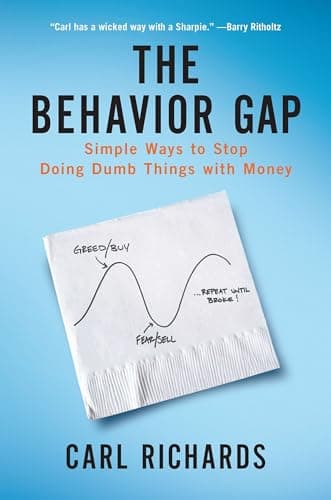
The Behavior Gap
Carl Richards uses simple napkin sketches to explain why we buy high, sell low, and generally get in our own way. Closing the gap between smart plans and messy human behaviour is worth more than any hot stock tip.
The Psychology of Money
Morgan Housel
The Psychology of Money
19 short stories on how people actually think and feel about money, not just the maths of it.
Just Keep Buying
Nick Maggiulli
Just Keep Buying
Data over vibes. Maggiulli crunches the numbers to show that consistently buying assets beats trying to time the market, and it is easier than you think.
Some links above are affiliate links. If you buy through them, Snowball Invest may earn a small commission at no extra cost to you. We only recommend books we'd suggest anyway.
Sources
Was this article useful?
Put it to your own numbers
Every calculator runs entirely in your browser, with nothing stored. See what these numbers look like for your own situation.
Explore the calculators →General information only. This article is educational and does not constitute personal financial advice. It does not account for your circumstances. Consider your own situation and seek advice from a licensed adviser before acting. Read our full disclaimer.

Timothy Hirou Gaschereau
Founder of Snowball Invest, not a financial adviser.
I write about what I'm learning myself, because nobody ever taught us how to take control of our own money. It's a skill, not a mystery, and it's never too late to learn it. The best day to start was yesterday, the second best is today.
LinkedIn →Related articles

Same as Ever by Morgan Housel: An Honest Review
Our honest Same as Ever review: Morgan Housel's follow-up to The Psychology of Money, the timeless behaviour lessons, how it compares, and who it's for.

Thinking, Fast and Slow by Daniel Kahneman: An Honest Review
Our honest Thinking, Fast and Slow review: Daniel Kahneman's landmark on the biases that sabotage your money decisions, its strengths, its caveats, and who it's for.

Atomic Habits Summary: The Four Laws, Explained Properly
The four laws of behaviour change, habit stacking, the two minute rule and identity based habits, distilled. Plus what each one looks like applied to your money.