

Same as Ever by Morgan Housel: An Honest Review
Our honest Same as Ever review: Morgan Housel's follow-up to The Psychology of Money, the timeless behaviour lessons, how it compares, and who it's for.
 By Timothy Hirou GaschereauPublished
 9 min read
Same as Ever is a genuinely enjoyable read and one of the better behavioural finance books of recent years. It's not quite as sharp as Morgan Housel's debut, but it's still well worth your time. His argument is simple: you can't predict the future, but you can understand the parts of human behaviour that never change, and those patterns are what actually drive financial outcomes. It's part of our personal finance book reviews on Snowball Invest.
Quick answer
A well-written, thought-provoking collection of behavioural lessons and the follow-up to The Psychology of Money. Not quite as focused as its predecessor, but still a standout. Best for anyone who loved The Psychology of Money and wants more of Housel's storytelling. Skip it if you want a step-by-step guide to investing or budgeting: this is a mindset book, not a how-to. Our rating: 4 out of 5.
Want to read Same as Ever?
Morgan Housel's follow-up to The Psychology of Money, on the timeless bits of human behaviour that never change. Story-driven and calming.
In this guide
- →What the book is about: the timeless behaviour patterns that drive money decisions
- →The genuine strengths and the honest weaknesses
- →Who it's for, and who wants the mechanics instead
- →What critics and r/financialindependence readers say
- →The Australian angle: universal lessons, zero local mechanics
📖 What is Same as Ever about?
The core idea is deceptively simple. Technology changes, markets change, politics changes, but human beings barely change at all. We still panic when markets fall, still compare ourselves to our neighbours, still overestimate our ability to predict what comes next. Published in 2023 by Harriman House as the follow-up to the runaway hit The Psychology of Money, Same as Ever is structured as roughly 23 short, story-driven chapters, each exploring one timeless behavioural pattern. Think of it less as a book and more as a collection of sharp essays, many of which started life on Housel's Collaborative Fund blog. Key themes include:
- Risk and overconfidence: we underestimate how often things go wrong and overestimate our ability to see it coming.
- The role of stories: people respond to narratives far more readily than to data; a compelling story beats a spreadsheet almost every time.
- Why calm breeds chaos: long periods of stability make people complacent, planting the seeds of the next crisis.
- The power of "enough": knowing when to stop is one of the most underrated financial skills there is.
- Compounding over time: the long-term payoff of patience is enormous but psychologically hard to stick with.
- Expectations versus reality: happiness is largely the gap between what you expected and what you got, so managing expectations is a financial skill.
This is a behavioural and mindset book through and through: no spreadsheets, no asset allocation frameworks, no tax tips. If The Psychology of Money was your entry point into thinking about money differently, Same as Ever is the natural next read, deepening the same ideas rather than replacing them.
⚖️ Strengths and weaknesses
What it gets right
- ✓Housel is one of the clearest writers in personal finance, with a rare gift for wrapping a complex idea in a story that sticks.
- ✓Short, self-contained chapters you can read on a lunch break and actually absorb.
- ✓Timeless framing: nothing here will feel dated in five years, by design.
- ✓Accessible writing with no jargon and no prerequisites.
- ✓Genuine insight: simple observations (like people being satisfied until they see what others have) that explain a lot of financial behaviour.
Where it falls short
- ✕Less focused than its predecessor: some chapters reach for a connection to the central theme, and a few anecdotes don't quite land.
- ✕Fewer new insights if you've read The Psychology of Money closely; the freshness factor is lower.
- ✕Light on practical steps: Housel is explicit it isn't a how-to, so don't expect actionable frameworks.
- ✕US-flavoured examples: the historical stories lean heavily on American events and figures.
👤 Who should read it, and who should skip it?
Read it if you
- ✓Enjoyed The Psychology of Money and want more of the same style.
- ✓Are an investor (ETFs, super, shares) who wants to understand your own behavioural biases.
- ✓Like short, story-driven chapters rather than dense textbooks.
- ✓Want to understand why smart people make consistently bad financial decisions.
Skip it if you
- ✕Are brand new to personal finance and need practical foundations first.
- ✕Want Australian-specific guidance on super, tax or ETF selection.
- ✕Found The Psychology of Money repetitive and weren't convinced by Housel's style.
- ✕Want a structured, chapter-by-chapter framework you can implement immediately.
🔍 What do critics say?
Critics acknowledge Housel makes genuinely good points throughout, but the recurring note is that they can get lost in a somewhat meandering structure and a looser focus than The Psychology of Money. Reviewers describe it as a collection of loosely organised stories around the theme of risk: some readers find it inspiring, others find it harder to follow. That's a fair summary. The book works best when Housel's storytelling is tight; when it meanders, it does meander, though even the weaker chapters tend to contain at least one idea worth sitting with.
💬 What do readers say? Goodreads and Reddit
On Goodreads it holds around 4.2 out of 5 from tens of thousands of ratings, a strong result for a behaviour book. Recurring praise: Housel's storytelling makes complex ideas accessible, the focus on timeless human behaviour over market predictions, and the short-chapter format. Recurring criticism: it can feel repetitive if you've read The Psychology of Money recently, some chapters feel like padding, and the loose structure makes it less cohesive than its predecessor.
The comparison to The Psychology of Money comes up constantly: the consensus is that the debut is more focused, more actionable and more impactful as a first read, with Same as Ever a worthy but slightly lesser follow-up. Think of it as a very good second album rather than a difficult second album: the quality is there, the surprise factor is lower.
🇦🇺 The Australian angle
The honest truth: Same as Ever contains zero Australian-specific content. No super, no franking credits, no ASX, no CGT discount, no HECS. But that's not really a problem, because the behavioural lessons are universal. The same panic-selling instinct that hit American investors in March 2020 hit Australian investors too, and the same overconfidence bias that leads people to chase last year's best-performing fund operates identically on the ASX. For Australian ETF investors and super members, the core lessons translate directly: don't panic-sell during a downturn, ignore overconfident forecasters, think in decades not quarters, and define "enough" for yourself.
Where it falls short for Australians is the practical mechanics, so pair it with local resources. Think of Same as Ever as the mindset layer, with the practical Australian layer on top. Our Psychology of Money review covers the essential first read, and our Die With Zero review is a thought-provoking companion on the spending side.
💰 The verdict
Yes, clearly worth reading. It's not a perfect book: the structure is looser than The Psychology of Money, some chapters meander, and if you want a practical investing guide you'll be disappointed. But as behavioural writing it's genuinely excellent, and Housel's ability to use stories to illustrate timeless truths about human nature is rare. For Australian investors in their 20s, 30s and 40s, the mindset reinforcement alone is worth it: understanding why you're tempted to panic-sell, why you're drawn to overconfident forecasts, and why "enough" is such a powerful concept has real financial value over a long investing lifetime. Read The Psychology of Money first if you haven't already, then read this one. Our rating: 4 out of 5.
Want to read Same as Ever?
Loved The Psychology of Money? Grab a copy of the follow-up for more of Housel's calm, story-driven wisdom.
SnowLetter
Australia's money news and our best reads, once a week.
❓ Frequently asked questions
Is Same as Ever better than The Psychology of Money?
+
Most readers, and we'd agree, say no. The Psychology of Money is more focused, more actionable and lands harder as a first read. Same as Ever is a strong follow-up that deepens similar themes, but it doesn't quite hit the same heights. Read The Psychology of Money first, then come back to this one.
Do I need to read The Psychology of Money first?
+
No, Same as Ever works as a standalone. But reading The Psychology of Money first gives you more context and makes the follow-up feel richer. If you're new to Housel's work, start there.
Is it suitable for beginners?
+
Yes, with one caveat. The writing is clear and jargon-free, so it's accessible to anyone. But it's a mindset book, not a practical guide, so if you're brand new to personal finance, pair it with a more foundational resource covering budgeting, investing and super.
How long does it take to read?
+
Most readers finish it in three to five hours. The 23 short chapters make it easy to read in chunks: a comfortable weekend read, or a couple of weeks of commute reading.
Is it available in Australia?
+
Yes, widely, through major Australian bookshops and Amazon AU in hardcover, paperback and eBook, with an audiobook on Audible.
What are the key takeaways?
+
Human behaviour doesn't change even when the world does; calm periods breed future crises; people respond to stories more than data; knowing when you have 'enough' is a superpower; and long-term compounding rewards patience in ways that are easy to underestimate.
📚 Get the book (and two companions)
Same as Ever
Morgan Housel
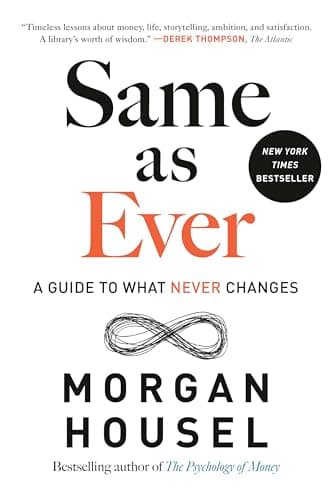
Same as Ever
Morgan Housel's follow-up to The Psychology of Money, on the timeless bits of human behaviour that never change. Story-driven, calming, and a natural next read once you've got the mindset bug.
The Psychology of Money
Morgan Housel
The Psychology of Money
19 short stories on how people actually think and feel about money, not just the maths of it.
Die With Zero
Bill Perkins
Die With Zero
Stop hoarding cash for a someday that never comes. Perkins makes the case for spending on experiences while you are still young enough to enjoy them.
Some links above are affiliate links. If you buy through them, Snowball Invest may earn a small commission at no extra cost to you. We only recommend books we'd suggest anyway.
Sources
Was this article useful?
Put it to your own numbers
Every calculator runs entirely in your browser, with nothing stored. See what these numbers look like for your own situation.
Explore the calculators →General information only. This article is educational and does not constitute personal financial advice. It does not account for your circumstances. Consider your own situation and seek advice from a licensed adviser before acting. Read our full disclaimer.

Timothy Hirou Gaschereau
Founder of Snowball Invest, not a financial adviser.
I write about what I'm learning myself, because nobody ever taught us how to take control of our own money. It's a skill, not a mystery, and it's never too late to learn it. The best day to start was yesterday, the second best is today.
LinkedIn →Related articles

The Behavior Gap by Carl Richards: An Honest Review
Our honest Behavior Gap review: Carl Richards's napkin-sketch take on the emotional money mistakes that cost investors, and why it needs no Australian translation.

Thinking, Fast and Slow by Daniel Kahneman: An Honest Review
Our honest Thinking, Fast and Slow review: Daniel Kahneman's landmark on the biases that sabotage your money decisions, its strengths, its caveats, and who it's for.

Atomic Habits Summary: The Four Laws, Explained Properly
The four laws of behaviour change, habit stacking, the two minute rule and identity based habits, distilled. Plus what each one looks like applied to your money.