

Financial Freedom by Grant Sabatier: An Honest Review
Our honest Financial Freedom review for Australians: Grant Sabatier's income-first FIRE playbook, the savings-rate maths, the US-centric bits, and the super-bridge angle.
 By Timothy Hirou GaschereauPublished
 10 min read
If you've ever Googled "how do I retire before 60," this book has probably come up. Financial Freedom by Grant Sabatier is one of the most recommended FIRE books of the last decade. But is it actually useful for Australians, or just another US-centric pep talk? Here's our honest take, part of our personal finance book reviews on Snowball Invest.
Quick answer
A punchy, income-focused FIRE primer that will change how you think about money and time, even if the US-specific mechanics need translating. Best for motivated earners in their 20s and 30s who want a genuine FIRE mindset shift. High on principles, low on Australian mechanics. Our rating: 4 out of 5.
Want to read Financial Freedom?
A modern FIRE playbook from a guy who went from nearly broke to financially independent in about five years. Strong on savings rate and income.
In this guide
- →What the book is about: the freedom number, savings rate and income growth
- →The genuine strengths and the honest weaknesses
- →Who it's for, and who should skip it
- →What critics and r/fiaustralia readers say
- →The Australian angle: super bridge, ASX ETFs and translating US accounts
📖 What is Financial Freedom about?
Grant Sabatier's story is the kind that makes you put down your coffee and reassess your life choices. In his mid-20s he had a couple of dollars in his bank account and was sleeping on his parents' couch. By 30, he'd built roughly $1.25 million in invested assets and declared himself financially independent, in just over five years. The book packages that experience into a repeatable framework, with a simple but powerful thesis: money is not the goal, time is. The aim is to accumulate enough invested assets that your portfolio covers your living expenses forever, so paid work becomes optional. The core ideas:
- Calculate your freedom number: annual living expenses multiplied by 25 (based on the 4% safe withdrawal rate). Spend $50,000 a year and you need about $1.25 million.
- Obsess over your savings rate, not your budget: saving 10% might take 40 years, 50% around 17, and 75% under 10.
- Grow your income aggressively: this is where Sabatier differs from frugality-first FIRE books. Cutting lattes is a rounding error; career moves, salary negotiations and side income are where the real leverage is.
- Invest the surplus in low-cost index funds: no stock picking, no market timing, just consistent automated investing.
- Optimise your biggest expenses: housing, transport and food, where most people's money actually goes.
- Think in seven stages: from "clarity" (knowing your numbers) through to financial independence and beyond, a useful map for knowing where you are.
It's not revolutionary if you've read widely in the FIRE space, but it's well-organised, readable and genuinely motivating, especially as a first serious personal finance book. Just note it's aimed at motivated younger earners, leans optimistic about income growth, and is written entirely from a US perspective.
⚖️ Strengths and weaknesses
What it gets right
- ✓Motivating and accessible: Sabatier's own story makes FIRE feel achievable rather than abstract.
- ✓Income growth, not just frugality: it spends serious time on earning more, which is more impactful for most readers.
- ✓The savings-rate framework is genuinely useful: seeing the maths on how a higher rate compresses your timeline is a real 'aha' moment.
- ✓Practical chapters on the big three expenses (housing, transport, food), not vague 'spend less' advice.
- ✓A solid introduction to index-fund investing for beginners.
Where it falls short
- ✕Heavily US-centric: full of 401(k)s, IRAs and US tax rules that Australians must translate.
- ✕Assumes above-average opportunity: the side-hustle emphasis works best with a marketable skill set and spare time and energy.
- ✕Some survivorship bias: his rapid success coincided with a strong US bull market, acknowledged but underplayed.
- ✕Repetitive in places, and the references to his own website feel a touch promotional.
- ✕Light on Australian mechanics: no super, franking credits or ASX investing.
👤 Who should read it, and who should skip it?
Read it if you
- ✓Are in your 20s or early 30s and new to the FIRE concept.
- ✓Feel stuck in the 'just cut expenses' trap and want to focus on earning more.
- ✓Want a mindset shift on money and time, not just a list of tactics.
- ✓Want an accessible first FIRE book.
Skip it if you
- ✕Are already deep into FIRE and want Australian-specific mechanics (super strategy, ETF selection, structures).
- ✕Have already read Your Money or Your Life and The Psychology of Money and want something genuinely new.
- ✕Want a book focused on making the most of a modest income rather than scaling up earnings.
🔍 What do critics say?
It sits at around 3.9 out of 5 on Goodreads from thousands of ratings, with most readers finding it solid and worthwhile but not life-changing. The common critical themes are predictable: a repetitive structure, US-centric mechanics, an assumption of a fairly privileged starting point, and investing advice some experienced readers find too basic. On the positive side, reviewers consistently praise the income-growth focus, the accessibility of the writing, and the motivational quality of Sabatier's story. Australian reviewers, fairly, note that a lot of the practical detail simply doesn't apply here.
💬 What do readers say? Goodreads and Reddit
FIRE communities generally view Financial Freedom as a practical, actionable introduction, especially for newcomers, and it's regularly recommended as part of a FIRE starter pack alongside Your Money or Your Life and Quit Like a Millionaire. The criticism that comes up most is the side-hustle emphasis, which can start to feel like a drumbeat after a while: the income-growth advice is valuable, but it's laid on thick.
On r/fiaustralia the consensus is consistent: useful for mindset and framework, but very US-focused on the mechanics. Australian readers tend to treat it as a motivational read and then look elsewhere for the implementation detail.
🇦🇺 The Australian angle
The savings-rate maths works exactly the same way here: your freedom number (annual expenses times 25) is just as valid, and the income-growth advice (negotiating your salary, building side income, strategic career moves) applies regardless of country. What needs translating is the account machinery. Roughly, a 401(k) or traditional IRA is conceptually similar to superannuation concessional contributions (before-tax money taxed lightly going in, taxed at withdrawal), while a Roth IRA has no perfect Australian equivalent (a long-held brokerage account, taxed at your marginal rate with a 50% CGT discount after 12 months, is the nearest cousin).
The biggest structural difference is the super bridge. Super is locked until preservation age (currently 60 for most people), so if you want to retire at 40 or 45 you need a separate, non-super investment portfolio to fund the gap years, typically low-cost, broad-market ASX ETFs held outside super alongside maximising super for the long term. While you're at it, check whether you have multiple super funds from old jobs and consolidate into one low-fee fund. For genuinely Australian FIRE mechanics, our Money School review and Quit Like a Millionaire review are stronger companions.
💰 The verdict
Financial Freedom is a genuinely good book, particularly if you're new to FIRE or stuck in a frugality-only mindset. The income-growth emphasis is its strongest contribution to the genre, and the savings-rate framework is the kind of simple, powerful maths that actually changes behaviour. For Australians, the honest caveat is to treat it as a mindset book, not an instruction manual: the US account types, tax rules and specific vehicles need to be set aside and replaced with Australian equivalents, so you'll want to supplement it with local resources to actually implement the strategy here. It sits comfortably alongside Your Money or Your Life and Quit Like a Millionaire as part of a solid FIRE foundation. It might not be the only financial freedom book you'll ever need, but it could be the one that makes you take the whole idea seriously for the first time. Our rating: 4 out of 5.
Want to read Financial Freedom?
Ready to think income-first about FIRE? Grab a copy, then translate the US accounts into super and ASX ETFs.
SnowLetter
Australia's money news and our best reads, once a week.
❓ Frequently asked questions
Is Financial Freedom by Grant Sabatier worth reading?
+
Yes, particularly if you're new to the FIRE movement or want a motivating, accessible introduction to financial independence. The income-growth focus and savings-rate framework are genuinely useful. Just be aware the US-specific mechanics will need translating for an Australian context.
What is the 'freedom number'?
+
The total invested portfolio you need to cover your living expenses indefinitely. The formula is simple: annual expenses multiplied by 25, based on the 4% safe withdrawal rate. Spend $60,000 a year and your freedom number is $1.5 million.
Is the book relevant for Australians?
+
The mindset and principles are highly relevant; the mechanics are not. US account types like 401(k)s and Roth IRAs have no direct Australian equivalent, and there's no mention of super, franking credits or ASX investing. Use the book for the framework, then look to Australian resources for implementation.
How does it compare to Your Money or Your Life?
+
Your Money or Your Life is more philosophical and focuses on aligning spending with values. Financial Freedom is more tactical and income-focused. They complement each other well. If you can only read one first, Your Money or Your Life is arguably more foundational, but Sabatier's book is more actionable for readers who want a step-by-step framework.
How did Sabatier reach financial independence?
+
He started with a couple of dollars in his account in his mid-20s and reached financial independence around 30 with roughly $1.25 million in invested assets. He did it by dramatically increasing his income through side businesses and career moves, saving and investing a very high proportion of his income, and investing consistently in low-cost index funds during a strong market period.
What are the best FIRE books for Australians?
+
A solid list includes Financial Freedom (mindset and income growth), Your Money or Your Life (values-based spending) and Quit Like a Millionaire (Canadian-authored, so closer to the Australian context). For genuinely Australian mechanics, Money School by Lacey Filipich, the r/fiaustralia community and ASIC MoneySmart are more useful than any single US book.
📚 Get the book (and two FIRE companions)
Financial Freedom
Grant Sabatier
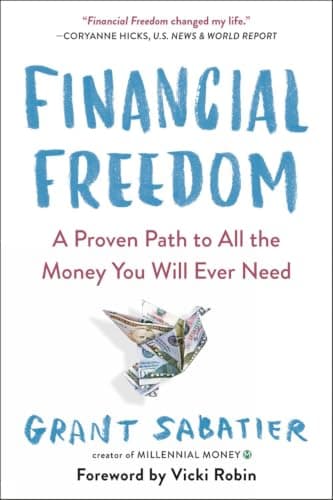
Financial Freedom
A modern FIRE playbook from a guy who went from nearly broke to financially independent in about five years. Strong on savings rate and growing your income, not just cutting lattes.
Quit Like a Millionaire
Kristy Shen & Bryce Leung
Quit Like a Millionaire
A no-nonsense FIRE memoir from a couple who retired in their 30s. Shen takes you from growing up poor to hitting financial independence, with the actual maths.
Money School
Lacey Filipich
Money School
Lacey Filipich shows how to buy back your time, not just budget your dollars, with a clear path from saving to financial independence. It is refreshingly Australian and genuinely doable, even if maths was never your thing.
Some links above are affiliate links. If you buy through them, Snowball Invest may earn a small commission at no extra cost to you. We only recommend books we'd suggest anyway.
Sources
Was this article useful?
Put it to your own numbers
Every calculator runs entirely in your browser, with nothing stored. See what these numbers look like for your own situation.
Explore the calculators →General information only. This article is educational and does not constitute personal financial advice. It does not account for your circumstances. Consider your own situation and seek advice from a licensed adviser before acting. Read our full disclaimer.

Timothy Hirou Gaschereau
Founder of Snowball Invest, not a financial adviser.
I write about what I'm learning myself, because nobody ever taught us how to take control of our own money. It's a skill, not a mystery, and it's never too late to learn it. The best day to start was yesterday, the second best is today.
LinkedIn →Related articles

Money School by Lacey Filipich: An Honest Review
Our honest Money School review: Lacey Filipich's Australian guide to financial independence and time freedom (FITR), the strengths, the dated bits, and who it's for.

Early Retirement Extreme by Jacob Lund Fisker: A Review
Our honest Early Retirement Extreme review: Jacob Lund Fisker's foundational FIRE manifesto, the systems-thinking philosophy, and the Australian super-bridge angle.

Your Money or Your Life Review: The FIRE Classic, Aussie Take
Our honest Your Money or Your Life review: the life energy concept, the 9-step program, and exactly what Australian readers need to know before buying.