

Early Retirement Extreme by Jacob Lund Fisker: A Review
Our honest Early Retirement Extreme review: Jacob Lund Fisker's foundational FIRE manifesto, the systems-thinking philosophy, and the Australian super-bridge angle.
 By Timothy Hirou GaschereauPublished
 10 min read
Early Retirement Extreme is one of the most important books in the FIRE movement, and also one of the most demanding. If you want the philosophical bedrock of financial independence, it's essential. If you want a step-by-step action plan, look elsewhere. It's part of our personal finance book reviews on Snowball Invest.
Quick answer
A dense, brilliant and genuinely original FIRE manifesto that will challenge everything you think you know about work and money. Best for people already interested in FIRE who want the deep philosophical "why", fans of systems thinking, and anyone questioning the default "work until 65" path. It reads more like a textbook than a bestseller. Our rating: 4 out of 5.
Want to read Early Retirement Extreme?
The dense, brilliant, systems-thinking manifesto that helped spark the whole FIRE movement. Mind-expanding, if you're up for the challenge.
In this guide
- →What the book is about: savings rate, self-sufficiency and systems thinking
- →The genuine strengths and the honest weaknesses
- →Who it's for, and who should start with an easier FIRE book
- →What critics and r/financialindependence readers say
- →The Australian angle: the super bridge, ASX ETFs and CGT
📖 What is Early Retirement Extreme about?
Published in 2010, Early Retirement Extreme is a foundational text of the modern FIRE movement, written by Jacob Lund Fisker, a Danish-born theoretical physicist who reached financial independence young after saving roughly 75% of his income for five years. The central argument is simple but radical: dramatically increase your savings rate and you can reach financial independence in under a decade rather than the conventional 40-plus years. But Fisker goes further than savings maths, arguing the real problem is how we've been conditioned to think about money, work and consumption. The philosophy is built around:
- Radical frugality as a path to freedom, not deprivation.
- Self-sufficiency as a hedge against volatility: the more skills you have, the less money you need.
- Systems thinking applied to your finances, treating your life like an engineered system to optimise.
- The "Renaissance person" ideal: a generalist with many skills (cooking, repair, health, finance, transport) rather than a specialised consumer who outsources everything.
The single most powerful lever in the framework is your savings rate: a higher rate builds your portfolio faster and reduces the annual spending it needs to support, both at once. The figures below are the well-known illustrative FIRE approximations (not Fisker's exact numbers):
| Savings rate | Approx. years to financial independence |
|---|---|
| 10% | ~40 years |
| 25% | ~32 years |
| 50% | ~17 years |
| 75% | ~7 years |
This is more manifesto than manual: philosophical, systems-and-engineering flavoured, and deliberately challenging. It predates and directly influenced the wider FIRE conversation, and it's denser and less accessible than most modern FIRE books. If you're after something warm and hand-holdy, this isn't it.
⚖️ Strengths and weaknesses
What it gets right
- ✓Intellectually rigorous: a physicist's precision applied to personal finance, and genuinely original.
- ✓Philosophically foundational: it challenges consumerism at a deeper level than almost any other money book.
- ✓The systems-thinking framework is unique, applying an engineering lens to lifestyle design.
- ✓Still relevant: the core ideas haven't aged, and economic volatility has only strengthened the self-sufficiency argument.
- ✓Highly quotable and rewards re-reading.
- ✓It makes you question everything: work, spending, identity, even the definition of retirement.
Where it falls short
- ✕Dense and academic writing style: some sections read like a textbook, complete with diagrams and frameworks.
- ✕Light on hand-holding: no checklists, no 30-day plans, no 'do this next Monday'.
- ✕US-centric: 401(k)s, Roth IRAs, HSAs and the US healthcare system throughout, all needing translation.
- ✕The extreme frugality isn't for everyone and isn't a realistic target for most.
- ✕Can feel preachy, almost as if anyone not pursuing extreme early retirement is sleepwalking.
- ✕The engineering metaphors get overdone if systems diagrams aren't your thing.
👤 Who should read it, and who should skip it?
Read it if you
- ✓Are already interested in FIRE and want to understand its philosophical roots.
- ✓Enjoy dense, idea-rich non-fiction that makes you stop and stare at the ceiling.
- ✓Are questioning the default 'work until 65' path and want someone to articulate why it's a choice.
- ✓Are drawn to systems thinking, minimalism or self-sufficiency.
- ✓Have read the accessible FIRE books and want to go deeper.
Skip it (for now) if you
- ✕Are a complete beginner who wants a practical, step-by-step money guide.
- ✕Want warm, encouraging, accessible writing.
- ✕Aren't ready to have your entire lifestyle questioned.
- ✕Are looking for Australian-specific guidance on super, ETFs or tax.
🔍 What do critics say?
Early Retirement Extreme is widely regarded as one of the founding texts of the modern FIRE movement, predating and clearly influencing the blogs and books that brought FIRE to a mass audience. Respected personal finance writers reviewed it positively, praising its intellectual rigour and philosophical depth while acknowledging the dense, textbook-like style won't suit every reader. Mainstream financial media largely ignored it on release (self-published, by an unknown physicist, with ideas well outside the "save 10% and retire at 65" consensus), but the FIRE community elevated it to near-canonical status over the following decade. It's the kind of book that gets passed around forums with a note saying "this one's different."
💬 What do readers say? Goodreads and Reddit
On Goodreads it holds a strong rating (around 4 out of 5) from several thousand readers, and the split is telling: most give it four or five stars, while a meaningful minority give it one or two. That's not a bad book, it's a polarising one. On Reddit (particularly r/financialindependence and r/leanfire) it's consistently recommended as essential reading for serious FIRE pursuers, with praise like mind-expanding and life-changing, and criticism that it's too dense, too extreme, or not practical enough.
On r/fiaustralia, members who discuss the book generally agree the philosophy translates well to an Australian context even if the US-specific mechanics need adaptation. The savings-rate maths doesn't care what country you're in.
🇦🇺 The Australian angle
The good news: the core philosophy of extreme savings and self-sufficiency is completely universal, and the savings-rate maths works the same whether you're in Melbourne or Minneapolis. The US-specific content needs translation:
| US in the book | Australian equivalent |
|---|---|
| 401(k) / Roth IRA | Superannuation |
| HSA (health savings account) | No direct equivalent (Medicare covers much of this) |
| Taxable brokerage account | Non-super brokerage account (Stake, Pearler, CommSec and others) |
The big one for Australians is the super access problem. Super is locked until preservation age (currently 60 for most people), so if you retire at 35 you can't touch it for a couple of decades. That means you need a non-super investment bridge: a portfolio of assets outside super, typically low-cost, ASX-listed ETFs, to fund your living expenses until you can access super. A couple of local tax points worth knowing (educational, not advice): the ATO offers a 50% CGT discount on assets held 12 months or more, and franking credits on Australian shares can reduce your tax bill, particularly at the lower income levels typical of early retirement.
And on frugality: Fisker's extreme version is a personal choice, not a requirement. Many Australians pursue lean FIRE or barista FIRE at more moderate savings rates, so you don't have to live on a shoestring to benefit from the framework. For genuinely Australian FIRE mechanics, our Money School review and our Financial Freedom review are strong companions.
💰 The verdict
Yes, with caveats. For anyone serious about financial independence, Early Retirement Extreme is essential reading: it's the philosophical bedrock of the FIRE movement, and it will genuinely change how you think about work, money and lifestyle. But go in with clear expectations. It's not a step-by-step guide, it won't tell you which ETFs to buy, and Australian readers will need to do some translation on the US-specific content, particularly around account types and the super access challenge. The core ideas, though, are as relevant here as anywhere. A genuine classic of the genre, held back slightly by its density and US-centricity. Read it, just don't expect it to be easy. Our rating: 4 out of 5.
Want to read Early Retirement Extreme?
Ready to have your assumptions about work and money dismantled? Grab a copy, and take your time with it.
SnowLetter
Australia's money news and our best reads, once a week.
❓ Frequently asked questions
Is Early Retirement Extreme still relevant today?
+
Yes. The core ideas (the savings-rate maths, the self-sufficiency philosophy, and the critique of consumerism) are timeless. If anything, economic uncertainty and rising costs of living have made Fisker's arguments about resilience and low fixed costs more compelling. The US-specific financial mechanics are dated, but the framework isn't.
How does it compare to The Simple Path to Wealth or Your Money or Your Life?
+
The Simple Path to Wealth is more accessible and practical, focused on index-fund investing with a clear action plan. Your Money or Your Life is also philosophical but warmer and more narrative-driven. Early Retirement Extreme is the most intellectually demanding of the three and the most radical on frugality. They're complementary: read ERE for the philosophy, Collins for the investing mechanics.
Is the extreme frugality realistic for Australians?
+
Not for most people, and Fisker would probably say that's fine, because the book is a framework, not a prescription. You can adopt the savings-rate mindset and systems-thinking approach without living on a shoestring. Many Australians pursuing FIRE aim for lean FIRE or barista FIRE at savings rates of 40 to 60%, ambitious but achievable without the extreme lifestyle Fisker describes.
Does Fisker still practise what he preaches?
+
By all available evidence, yes. He became financially independent young and retired from his profession in his early 30s. He stepped back from regular blogging but has remained publicly active on the topic and indicated he still lives by ERE principles.
Where can I buy it in Australia?
+
It's available on Amazon Australia in paperback and Kindle formats, and directly through Fisker's own site.
What should I read after it?
+
The Simple Path to Wealth by JL Collins (practical index-fund investing for FIRE), Your Money or Your Life by Vicki Robin (the original, more accessible philosophical FIRE text), Die With Zero by Bill Perkins (a useful counterpoint that challenges extreme frugality), and The Psychology of Money by Morgan Housel (excellent on the behavioural side).
📚 Get the book (and two FIRE companions)
Early Retirement Extreme
Jacob Lund Fisker
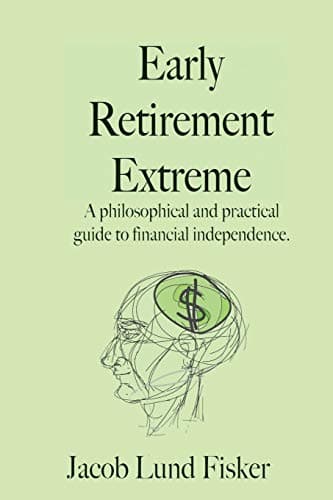
Early Retirement Extreme
The dense, brilliant, systems-thinking manifesto that helped spark the whole FIRE movement. More philosophy than checklist, and radical on frugality, but genuinely mind-expanding.
Your Money or Your Life
Vicki Robin
Your Money or Your Life
The book that basically kicked off the FIRE movement, reframing money as 'life energy' you trade your hours for. The nine-step program is pure gold, just swap the US retirement-account chapter for super.
The Simple Path to Wealth
JL Collins
The Simple Path to Wealth
The friendliest on-ramp to index investing there is, born from letters a dad wrote his daughter. It makes 'buy the whole market and chill' feel obvious, just map his US fund picks onto Aussie equivalents and super.
Some links above are affiliate links. If you buy through them, Snowball Invest may earn a small commission at no extra cost to you. We only recommend books we'd suggest anyway.
Sources
Was this article useful?
Put it to your own numbers
Every calculator runs entirely in your browser, with nothing stored. See what these numbers look like for your own situation.
Explore the calculators →General information only. This article is educational and does not constitute personal financial advice. It does not account for your circumstances. Consider your own situation and seek advice from a licensed adviser before acting. Read our full disclaimer.

Timothy Hirou Gaschereau
Founder of Snowball Invest, not a financial adviser.
I write about what I'm learning myself, because nobody ever taught us how to take control of our own money. It's a skill, not a mystery, and it's never too late to learn it. The best day to start was yesterday, the second best is today.
LinkedIn →Related articles

Your Money or Your Life Review: The FIRE Classic, Aussie Take
Our honest Your Money or Your Life review: the life energy concept, the 9-step program, and exactly what Australian readers need to know before buying.

Financial Freedom by Grant Sabatier: An Honest Review
Our honest Financial Freedom review for Australians: Grant Sabatier's income-first FIRE playbook, the savings-rate maths, the US-centric bits, and the super-bridge angle.
Die With Zero Review: A Mindset Shift, With a Big Aussie Caveat
Our honest Die With Zero review for Australians: the good ideas, the real weaknesses, and why super, the Age Pension and aged-care costs change the maths here.