
Anchoring Bias: Why the First Number You Hear Decides What You Pay
The first number you hear sets the price you think is fair, from auction guides to salary talks. How anchoring works in Australia, and how to beat it.
 By Timothy Hirou GaschereauPublished
 9 min read
A price guide says $900,000. The place sells for $1.05 million. You go home annoyed, and somewhere in the back of your mind you still feel like the buyer overpaid by $150,000, even though every comparable sale in the suburb said otherwise. That feeling is not judgement, it is an anchor. This is part of our wider guide to money mindset on Snowball Invest.
This article is general information only, not personal financial or legal advice. Property pricing rules differ by state and change over time, so confirm current requirements with your state regulator.
Quick answer
Anchoring bias is the tendency to lean far too heavily on the first number you encounter, then judge everything after it relative to that number. It works even when the anchor is obviously random. In Australia it shows up most expensively in property price guides, salary negotiations and the price you paid for a share, and the defence is to set your own number before you ever see theirs.
In this guide
- →The rigged wheel experiment that proved a random number changes your answer
- →Why price guides anchor you, and what changes in Victoria on 1 October 2026
- →Whether to name your salary figure first, and when it backfires
- →Six defences, starting with writing your own number down first
🎡 What is anchoring bias?
In 1974, Amos Tversky and Daniel Kahneman published a paper in Science called Judgment under Uncertainty: Heuristics and Biases. The experiment they used to demonstrate anchoring is still one of the most striking in behavioural science, largely because it is so obviously unfair.
They brought people into a room and spun a wheel of fortune in front of them. The wheel was rigged to land on either 10 or 65. Participants watched it spin, noted the number, and were then asked something completely unrelated: what share of United Nations member states are African nations?
The wheel had no bearing on the answer whatsoever. Everyone in the room could see it being spun. And still, the group who saw 65 guessed around 45%, while the group who saw 10 guessed around 25%. A meaningless number moved their judgement by roughly 20 percentage points.
🧲 Why it works even when the anchor is random
The short version is that your brain is built for speed, not accuracy.
Faced with an uncertain question, your mind grabs whatever number is nearby as a starting point, then adjusts up or down until the answer feels plausible. The catch is that people almost always stop adjusting too early, which leaves them sitting much closer to the anchor than to the truth.
There is a second mechanism underneath it. Once an anchor is in your head, your brain starts retrieving whatever supports it. See $850,000 on a listing and you will begin, without deciding to, assembling reasons why $850,000 sounds about right. It is not deceiving you. It is doing what it always does, which is looking for a story that hangs together.
Anchoring survives being warned about. It survives obviously random anchors. It even survives paying people to be accurate. Knowing about it is not the defence, having your own number first is.
🏠 Anchoring in Australian property
If you have stood at an auction and felt your stomach drop when the opening bid landed well above the advertised guide, you have felt this one directly.
Underquoting is when an agent advertises or quotes a price below the seller's asking price, the reserve, a rejected written offer, or the agent's own estimate of the selling price. It is a deliberate low anchor, designed to pull more buyers into the campaign.
In New South Wales it is an offence under the Property and Stock Agents Act 2002. NSW Fair Trading says it takes a zero tolerance approach: it can issue a penalty notice of $2,200, a court can fine an agent up to $22,000 if the matter is prosecuted, and the agent can lose the full commission and fees on every property they underquoted. Victoria prohibits misleading price representations too, enforced by Consumer Affairs Victoria.
🎯 The essential: Victoria is about to change the game. Consumer Affairs Victoria has confirmed that from 1 October 2026, agents must disclose the seller's reserve price seven days before an auction or fixed-sale date, publish the final sold price once a sale is unconditional, and use a new Property Price Statement in place of the Statement of Information. In anchoring terms, buyers get handed the seller's actual number instead of a marketing one.
Auctions concentrate the effect. The opening bid sets the reference point for the room, and every bid after it is judged as a step from there. A $700,000 opening makes $750,000 feel like a small move. The same $750,000, named first in a private negotiation, feels like a much bigger number.
The defence is unglamorous and it works: research comparable sales yourself before you go, not the ones the agent selected for you. A price guide is a marketing document, not a valuation. Our deposit guide is a better place to set your real number.
💼 Anchoring in salary negotiation
Here is the question that makes most people squirm: do you name your number first, or wait?
Whoever names a figure first usually sets the anchor. Say $95,000 and the conversation orbits $95,000. Let them open at $80,000 and you are now climbing uphill from their number, which is considerably harder work.
Name first when you have done the research. If you know the market rate for your role in your city, opening with a researched figure at the upper end means they adjust down from your anchor, and you still land where you wanted.
Let them open when you genuinely do not know the rate. Anchoring yourself too low is very hard to undo, and their budget may be higher than you would have guessed.
The practical middle ground is a range rather than a point. Something like: I am looking at $95,000 to $105,000, depending on the full package. The top of your range does the anchoring while the bottom gives them the satisfaction of having negotiated. Just remember the bottom of your range is a floor you have volunteered, so do not put anything there you would resent accepting. More on the mechanics in our guide to negotiating a pay rise.
🏷️ Anchoring in retail and sale pricing
Look at any television in any electronics shop. There will be a crossed-out price above the real one. That crossed-out number is the entire point of the tag. It exists to make the price below it feel like a win, whether or not anybody ever paid the higher figure.
The recommended retail price does the same job. A product with an RRP of $299 selling at $199 feels like a deal. The identical product at $199 with no RRP shown just feels like it costs $199. Nothing about the product changed, only the reference point.
Then there is the decoy. A gym offers $39 basic, $79 standard and $82 premium. Premium is not there to be bought. It is there so that standard, sitting three dollars below it, looks like obvious value. You will find the same shape in streaming tiers, phone plans and coffee subscriptions, and the middle option wins almost every time.
📊 Anchoring in investing
The most common anchor in investing is the price you paid. You buy at $4.20, it falls to $3.10, and you hold on, not because the company looks good from here but because $4.20 has lodged in your head as the real value. You are waiting to get back to even, which is a goal the company has never heard of.
That feeds straight into the disposition effect, the habit of selling winners early and holding losers far too long.
Round numbers are anchors too. I will sell when it hits $100 is a very common plan, and there is nothing special about $100 except that humans have ten fingers. The same goes for 52-week highs shown in your brokerage app. A share at $7.50 against a 52-week high of $12.00 looks cheap purely because of the number sitting next to it, even if $7.50 is still expensive on fundamentals.
🛡️ How to defend against it
- Write your own number down first. Before you look at the guide, the offer or the listing, do the research and commit to a figure. Now you have an anchor of your own.
- Pick your own comparables. In property, choose the recent sales yourself rather than accepting the shortlist you were handed.
- Name a range, not a point. Especially in salary talks, where it anchors high while leaving room to move.
- Slow it down. Anchoring feeds on fast, intuitive judgements. Asking for twenty-four hours is often enough to let the slower part of your thinking catch up.
- Generate a counter-anchor. Handed a high number, deliberately produce a low one. Not to be difficult, but so that both ends of the plausible range exist in your head rather than just theirs.
- Decide your walk-away before you start. A number you set while calm is worth far more than a number you defend while under pressure.
🚗 The same car, three different tags
Nothing about the vehicle changes across these three rows. Only the listing price does, and look what it does to what a buyer considers a fair offer.
| Listed at | Feels like a fair offer | Likely opening offer | What the anchor is doing |
|---|---|---|---|
| $45,000 | $40,000 to $42,000 | $40,000 | High anchor makes $42,000 feel like a win |
| $32,000 | $28,000 to $30,000 | $28,500 | Mid anchor sets a moderate haggling range |
| $28,000 | $25,000 to $26,500 | $25,000 | Low anchor drags the whole range down |
SnowLetter
Australia's money news and our best reads, once a week.
❓ Frequently asked questions
What is anchoring bias in simple terms?
+
Anchoring bias is when the first number you see or hear has an outsized influence on your judgement, even when it is irrelevant or arbitrary. It was identified by Amos Tversky and Daniel Kahneman in 1974 and is one of the most reliably replicated findings in behavioural psychology. It affects everything from the price you pay for a car to the salary you accept.
Is anchoring bias the same as the framing effect?
+
They are related but distinct. Anchoring is specifically about numerical reference points pulling your estimates toward them. Framing is broader, describing how the presentation of information changes your response to it. A product sold as 90% fat free and one sold as 10% fat carry identical information, but one feels better. Anchoring is the numbers-only corner of that idea.
Is underquoting illegal in Australia?
+
In New South Wales it is an offence under the Property and Stock Agents Act 2002. NSW Fair Trading can issue a penalty notice of $2,200, a court can fine an agent up to $22,000, and the agent can lose the full commission and fees on the property. Victoria also prohibits misleading price representations, and Consumer Affairs Victoria enforces it. Rules differ by state, so check with your state regulator.
What is changing for Victorian property prices in October 2026?
+
Consumer Affairs Victoria has confirmed that from 1 October 2026, agents must disclose the seller's reserve price seven days before an auction or fixed-sale date, publish the final sold price once a sale becomes unconditional, and use a new Property Price Statement that replaces the Statement of Information. In anchoring terms, it hands buyers the seller's real number instead of a marketing one.
Should I name my salary figure first?
+
Research on anchoring suggests whoever names a number first tends to set the reference point for the whole negotiation. Naming first works in your favour when you have researched the market rate for your role. If you genuinely do not know the rate, anchoring yourself too low is hard to recover from, so letting them open can be safer. A researched range is usually the best of both.
How do retailers use anchoring to influence what you spend?
+
The common techniques are was and now pricing with a crossed-out higher figure, a recommended retail price you are invited to compare against, and a decoy option priced just above the one they actually want you to buy. Each plants a high reference point before you judge the real price. Checking the price somewhere independent first is the simplest defence.
📚 Recommended reading
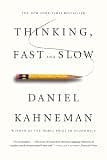
Thinking, Fast and Slow
Daniel Kahneman
Thinking, Fast and Slow
The Nobel laureate's classic on the two systems driving how we think, and why our fast, intuitive brain makes such expensive money mistakes. It explains the behavioural traps behind nearly every bad investing decision.
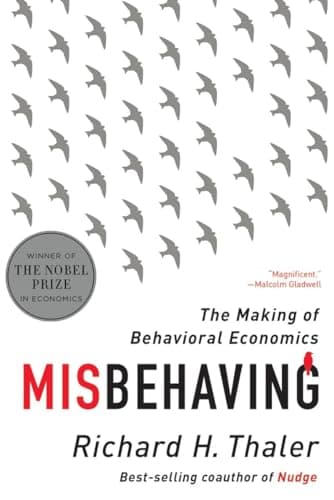
Misbehaving
Richard H. Thaler
Misbehaving
Nobel winner Richard Thaler shows why real humans are messy, emotional money-spenders, not the cool robots economics assumes. Understanding your own bias is the first step to calmer decisions with your cash and your super.
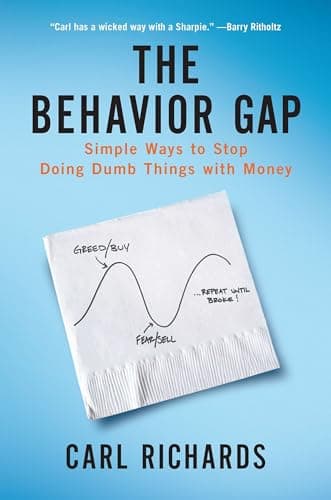
The Behavior Gap
Carl Richards
The Behavior Gap
Carl Richards uses simple napkin sketches to explain why we buy high, sell low, and generally get in our own way. Closing the gap between smart plans and messy human behaviour is worth more than any hot stock tip.
Some links above are affiliate links. If you buy through them, Snowball Invest may earn a small commission at no extra cost to you. We only recommend books we'd suggest anyway.
Sources
- 1. Tversky, A. and Kahneman, D. (1974). Judgment under Uncertainty: Heuristics and Biases. Science, 185(4157), 1124 to 1131.
- 2. Underquoting guidance for property professionals, NSW Government (penalties and the Property and Stock Agents Act 2002).
- 3. Understanding property prices and underquoting for buyers, Consumer Affairs Victoria (including the rules starting 1 October 2026).
- 4. Report 540: Investors in initial public offerings, Australian Securities and Investments Commission.
- 5. Negotiation and gender equity in Australian workplaces, Workplace Gender Equality Agency.
- 6. How to invest, Moneysmart, Australian Securities and Investments Commission.
Was this article useful?
Put it to your own numbers
Every calculator runs entirely in your browser, with nothing stored. See what these numbers look like for your own situation.
Explore the calculators →General information only. This article is educational and does not constitute personal financial advice. It does not account for your circumstances. Consider your own situation and seek advice from a licensed adviser before acting. Read our full disclaimer.

Timothy Hirou Gaschereau
Founder of Snowball Invest, not a financial adviser.
I write about what I'm learning myself, because nobody ever taught us how to take control of our own money. It's a skill, not a mystery, and it's never too late to learn it. The best day to start was yesterday, the second best is today.
LinkedIn →Related articles

Loss Aversion: Why Losing $100 Hurts More Than Gaining $100 Feels Good
Losing $100 feels about twice as bad as gaining $100 feels good. How loss aversion quietly shapes Australian money decisions, and how to work with it.
The Sunk Cost Fallacy: Why You Hold On to Losing Investments
The sunk cost fallacy keeps Australians in losing shares, bad funds and money-pit renovations. How to spot it, and the one question that breaks it.

The Endowment Effect: Why You Think Your Stuff Is Worth More Than It Is
The endowment effect makes you overvalue what you own. How it costs Australians money in investing, selling and everyday choices, and how to beat it.