

Misbehaving by Richard Thaler: An Honest Review
Our honest Misbehaving review: Richard Thaler's story of behavioural economics, the biases that wreck money decisions, and why it maps neatly onto Australian super.
 By Timothy Hirou GaschereauPublished
 9 min read
If you've ever wondered why smart people make terrible financial decisions, this is the book that explains the science behind it, and it's actually fun to read. Misbehaving is Richard Thaler's part-memoir, part-intellectual-history of how behavioural economics went from fringe curiosity to Nobel Prize-winning field. It won't tell you which ETF to buy, but it will change how you think about the gap between what you should do and what you actually do. It's part of our personal finance book reviews on Snowball Invest.
Quick answer
A genuinely entertaining and eye-opening account of why humans are predictably irrational with money and decisions. Best for curious readers, finance professionals, policy wonks, and anyone who loved Thinking, Fast and Slow or Predictably Irrational. Skip it if you want a step-by-step personal finance guide with Australian-specific strategies. Our rating: 4 out of 5.
Want to read Misbehaving?
Nobel winner Richard Thaler shows why real humans are messy, emotional money-spenders, not the cool robots economics assumes.
In this guide
- →What the book is about: the rise of behavioural economics and its key ideas
- →The genuine strengths and the honest weaknesses
- →Who it's for, and who wants a how-to instead
- →What critics and r/books readers say
- →The Australian angle: mental accounting, loss aversion and super as 'Save More Tomorrow'
📖 What is Misbehaving about?
The core argument is simple: traditional economics assumes people are rational, self-interested and consistent, and Thaler spent his career proving that's wrong. Misbehaving (2015) is his account of that fight, tracing the rise of behavioural economics from the 1970s to mainstream acceptance and weaving his own career together with the ideas that drove the field. Key concepts include:
- Mental accounting: we treat money differently depending on where it came from or what mental "bucket" we put it in.
- The endowment effect: we overvalue things simply because we own them.
- Loss aversion: losing $100 hurts roughly twice as much as gaining $100 feels good.
- Self-control problems: we know what we should do and still don't do it.
- Fairness: people will reject objectively good deals if they feel unfairly treated.
- Nudges and choice architecture: small design changes in how options are presented can dramatically shift behaviour, without restricting freedom to choose.
The book also covers the Save More Tomorrow program, a real retirement savings scheme Thaler co-designed that used behavioural insights to help workers save more, automatically. Thaler won the 2017 Nobel Prize in Economic Sciences for his contributions to behavioural economics and co-wrote Nudge, which became the blueprint for the UK's "Nudge Unit" and influenced policy worldwide. This is not a personal finance how-to, it's closer to a history of ideas, told with a lot of personality.
⚖️ Strengths and weaknesses
What it gets right
- ✓The writing is genuinely funny, with a dry, self-deprecating wit that makes a long book feel manageable.
- ✓The intellectual history is compelling: watching behavioural economics fight into the mainstream reads almost like a thriller.
- ✓The real-world applications land: Save More Tomorrow and the UK Nudge Unit show the ideas tested at scale with measurable results.
- ✓The concepts stick, illustrated through vivid, relatable examples rather than equations.
Where it falls short
- ✕It's a memoir as much as a field history, told from Thaler's perspective with Thaler at the centre.
- ✕The academic politics can drag: inside-baseball feuds between departments will lose general readers in places.
- ✕Critics have a point about selective history: it underplays some important predecessors and can portray opponents one-dimensionally.
- ✕Nudge ethics (should governments steer choices?) get raised but not deeply examined.
- ✕The finance chapters are thin relative to how much Thaler's work matters for investing.
👤 Who should read it, and who should skip it?
Read it if you
- ✓Want to understand why humans make bad financial decisions, not just that they do.
- ✓Are interested in the history of ideas and how economics evolved as a discipline.
- ✓Loved Thinking, Fast and Slow or Predictably Irrational (this is a natural next read).
- ✓Work in policy, finance, HR, product or marketing and want to understand nudges and choice architecture.
Skip it if you
- ✕Want a step-by-step personal finance guide (The Barefoot Investor or Investopoly are better fits for actionable Australian advice).
- ✕Find academic politics and university anecdotes tedious (there's a fair bit of both).
- ✕Want specific Australian strategies on super, ETFs or tax.
🔍 What do critics say?
The professional reception was broadly positive, with some pointed reservations. Major outlets framed it as the story of how the fictional "rational economic man" went extinct, praising it as a witty, insightful and accessible account of how psychological insights entered mainstream economics. The most substantive critique characterised the book as a personal intellectual history rather than a forward-looking, balanced account of the field, arguing it underplays important predecessors and can depict rational-choice opponents unfairly. That's a fair criticism worth keeping in mind as you read.
💬 What do readers say? Goodreads and Reddit
On Goodreads it holds around 4.2 out of 5 from tens of thousands of ratings, a strong result for a book that sits between memoir and academic history. Common praise: accessible, frequently hilarious, engaging anecdotes, an excellent entry point to behavioural economics. Common criticism: it reads too much like a memoir, is heavy on name-dropping, and can feel like Thaler overstates his own role in the field.
On Reddit the picture is similarly positive: r/books and r/Economics readers describe it as a surprisingly humorous, very readable history of behavioural economics and a strong introduction for non-specialists. The dissent is a minority view, mostly readers who came in expecting dense economic theory rather than narrative history.
🇦🇺 The Australian angle
The ideas are universal, but they map onto Australian financial life in specific ways:
- Mental accounting is everywhere here. Think how Australians treat a tax refund or a super co-contribution: intellectually it's just money, but behaviourally it feels like "bonus money", much easier to spend on a holiday than to redirect into an index fund.
- Australia's super system is basically Save More Tomorrow at national scale. The Super Guarantee forces automatic contributions before workers ever see the money, and Thaler's research showed automatic enrolment and escalation dramatically improve retirement outcomes. Understanding how superannuation actually works makes you a smarter participant in your own super.
- Loss aversion explains a lot of bad investor behaviour: panic-selling in a downturn, switching super funds after a bad quarter, anchoring to a property price that no longer reflects reality. If that sounds familiar, our piece on financial anxiety digs into why. Knowing the bias doesn't make you immune, but it does make you more likely to pause before acting.
- Choice architecture matters for everyday decisions too: how your super fund presents investment options, the order your bank lists accounts, your insurance default settings. All nudges, whether intended or not, and reading this makes you a more alert consumer of them.
For the deeper, more systematic take on the same psychology, our Thinking, Fast and Slow review is the natural companion, and for the actionable Australian steps, our Barefoot Investor review is a better fit.
💰 The verdict
Misbehaving is a smart, entertaining and genuinely important book. Thaler is a good writer, a funny one, and a credible authority, and the combination of memoir, intellectual history and real-world application makes for a compelling read, even if it's not a comprehensive or perfectly balanced one. The criticisms are real: it's more personal history than field history, the finance chapters could be stronger, and for nudge ethics in depth you'll need another book. But as an introduction to why humans are predictably irrational, and why that matters for money, policy and everyday decisions, it's hard to beat. Pair it with a practical Australian personal finance guide for the actionable steps and you've got a solid combination. Our rating: 4 out of 5.
Want to read Misbehaving?
Want the story behind why we're all bad with money? Grab a copy, it's a funnier read than any economics book has a right to be.
SnowLetter
Australia's money news and our best reads, once a week.
❓ Frequently asked questions
Is Misbehaving a good book for beginners?
+
Yes. You don't need an economics background to follow it. Thaler writes in plain English, uses everyday examples, and explains every concept before building on it. Most readers find it accessible from the first chapter.
How does it compare to Thinking, Fast and Slow?
+
They cover overlapping territory from different angles. Kahneman's book is denser, more systematic, and goes deeper into the psychology of decision-making. Misbehaving is lighter, funnier, and more focused on the history of behavioural economics as a discipline. If you've read one, the other is a natural companion: most find Kahneman more rigorous and Thaler more entertaining.
Is it relevant to Australian readers?
+
Very much so. Mental accounting, loss aversion and self-control problems affect Australian savers just as much as anyone. The book's ideas connect directly to how our super system works, why automatic contributions are so effective, and why investors panic-sell during downturns. The examples are mostly American, but the human behaviour is universal.
Do I need an economics background to read it?
+
No. Thaler explicitly wrote it for a general audience: he avoids equations, explains jargon when he uses it, and relies on stories and examples. Readers with no economics training consistently find it readable and engaging.
What is the 'Save More Tomorrow' idea?
+
A retirement savings program Thaler co-designed. Instead of asking workers to save more now (which triggers loss aversion because it feels like an immediate pay cut), it commits them to automatically increase their savings rate each time they get a pay rise. Because the increase happens before they adjust to the higher income, it doesn't feel like a loss. Australia's Super Guarantee runs on a similar principle: contributions are automatic and happen before you see the money.
Is Misbehaving the same as Nudge?
+
No, they're related but distinct. Nudge (co-written with Cass Sunstein) is specifically about choice architecture and how policy can steer people toward better decisions without restricting freedom. Misbehaving is broader: the story of how behavioural economics developed as a field, with Thaler's career as the through-line. Nudge is more prescriptive; Misbehaving is more historical.
📚 Get the book (and two behaviour companions)
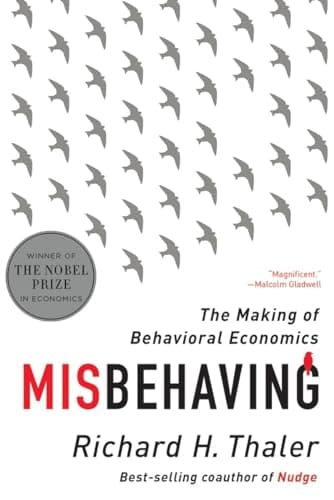
Misbehaving
Richard H. Thaler
Misbehaving
Nobel winner Richard Thaler shows why real humans are messy, emotional money-spenders, not the cool robots economics assumes. Understanding your own bias is the first step to calmer decisions with your cash and your super.
Thinking, Fast and Slow
Daniel Kahneman
Thinking, Fast and Slow
The Nobel laureate's classic on the two systems driving how we think, and why our fast, intuitive brain makes such expensive money mistakes. It explains the behavioural traps behind nearly every bad investing decision.
The Psychology of Money
Morgan Housel
The Psychology of Money
19 short stories on how people actually think and feel about money, not just the maths of it.
Some links above are affiliate links. If you buy through them, Snowball Invest may earn a small commission at no extra cost to you. We only recommend books we'd suggest anyway.
Sources
Was this article useful?
Put it to your own numbers
Every calculator runs entirely in your browser, with nothing stored. See what these numbers look like for your own situation.
Explore the calculators →General information only. This article is educational and does not constitute personal financial advice. It does not account for your circumstances. Consider your own situation and seek advice from a licensed adviser before acting. Read our full disclaimer.

Timothy Hirou Gaschereau
Founder of Snowball Invest, not a financial adviser.
I write about what I'm learning myself, because nobody ever taught us how to take control of our own money. It's a skill, not a mystery, and it's never too late to learn it. The best day to start was yesterday, the second best is today.
LinkedIn →Related articles

Atomic Habits Summary: The Four Laws, Explained Properly
The four laws of behaviour change, habit stacking, the two minute rule and identity based habits, distilled. Plus what each one looks like applied to your money.

Never Split the Difference Review: Does It Work in Australia?
Chris Voss's negotiation book is genuinely useful for pay rises, rent and car yards. The catch is that his most theatrical tactics land badly in an Australian room.

Rich Dad's Guide to Investing Review: Read It Critically
The reframe is genuinely useful: investing is a plan, not a product. The structures, the tax and the investor categories are American, and a lot of it does not cross the Pacific.