

The Quick-Start Guide to Investing: An Honest Review
Our honest review of The Quick-Start Guide to Investing by Glen James and Nick Bradley: a beginner-friendly Aussie investing guide, its strengths, and who it's for.
 By Timothy Hirou GaschereauPublished
 9 min read
If you've been putting off learning how to invest because everything you've read sounds like it was written by a lawyer for other lawyers, this book might be exactly what you need. The Quick-Start Guide to Investing is plain-spoken, practical, and built squarely for Australians who want to stop overthinking and actually start. It's part of our personal finance book reviews on Snowball Invest.
Quick answer
A no-nonsense, step-by-step investing guide for Australians that earns its place on the shelf. Best suited to beginners and early-stage investors; if you're already comfortable with ETFs and portfolio construction, you'll find the first half familiar ground. Our rating: 4 out of 5.
Want to read The Quick-Start Guide to Investing?
A short, friendly runway from 'never invested' to confidently buying shares and ETFs, tuned for Aussie beginners.
In this guide
- →What the book covers: from foundations to ETFs, portfolios and beyond
- →The genuine strengths and the honest weaknesses
- →Who it's for, and who can skim the first half
- →What critics and r/AusFinance readers say
- →The Australian angle: ASX, franking, tax structures and US markets
📖 What is The Quick-Start Guide to Investing about?
The book does what the title promises: it takes you from zero investing knowledge to a working understanding of how to build and manage a share portfolio, without drowning you in jargon. Glen James, a former financial adviser and host of the money money money podcast (formerly My Millennial Money), teams up with co-host Nick Bradley to cover a lot of ground.
It moves in a logical sequence. First it builds your foundations: getting your money mindset right, understanding why you're investing, and sorting the basics before you touch a brokerage app. Then the mechanics: how the share market works, how to choose a broker or app, compound interest, index funds, ETFs and REITs. From there it steps into portfolio construction, the core-and-satellite strategy, tax and ownership structures, and investing psychology. The final section covers more advanced territory, including trading, thematic investing and options. It covers both the ASX and US markets, a practical call given how many Australians now hold US-listed ETFs alongside their Australian shares.
⚖️ Strengths and weaknesses
What it gets right
- ✓Written for real Australians: local examples, super, franking and the ASX, not a US book with 'Australia' on the cover.
- ✓Beginner-friendly without being patronising: it explains the language of investing, then builds on it.
- ✓Surprisingly wide range for 256 pages: foundations, mechanics, ETFs, REITs, portfolio design, tax, psychology and advanced tactics.
- ✓Confidence-building structure: each section builds on the last, with recaps and activities to make it stick.
- ✓Great to share: the kind of book you finish and immediately want to hand to a mate who 'keeps meaning to start'.
Where it falls short
- ✕Experienced investors will find the early sections slow, covering ground they already know.
- ✕Advanced topics (options, thematic investing, trading) are introductions, not deep dives.
- ✕Mixed expectations show in the ratings: some lower scores come from readers who wanted more advanced content than the book aims to deliver.
- ✕No dedicated super chapter: given how central super is to Australian wealth-building, a fuller treatment would have helped.
👤 Who should read it, and who should skip it?
Read it if you
- ✓Are new to investing in Australia and want a clear, structured starting point.
- ✓Have been meaning to get into shares or ETFs but don't know where to begin.
- ✓Want to understand passive investing versus active stock-picking before you commit.
- ✓Already follow Glen James and want his framework in book form.
- ✓Are after a great first investing book to give to someone you care about.
Skip or skim the first half if you
- ✕Already have a working knowledge of index funds, ETFs and portfolio construction.
- ✕Are after advanced technical analysis or a deep guide to options trading.
- ✕Want a comprehensive superannuation strategy guide.
🔍 What do critics say?
The book has been well received in the Australian finance community as a clear, practical starting point. Its clarity is its greatest strength: it doesn't try to be clever or dense, it tries to be useful, and it succeeds. Glen James has built a reputation through the money money money podcast for making finance accessible without dumbing it down, and the book carries that same energy, with Nick Bradley's practical investor perspective adding real-world weight to the theory. The common critical note is simply that it's aimed at beginners, so more experienced readers won't find much new in the early chapters.
💬 What do readers say? Goodreads and Reddit
On Goodreads it sits around 3.9 out of 5, with most readers landing in the four and five-star tiers. The recurring themes: it covers the fundamentals clearly without being patronising, moves logically from beginner content to more advanced material, and leaves readers feeling more confident. Several mention it's the kind of book they'd keep and pass on to someone just starting out.
On Reddit, across r/AusFinance and r/fiaustralia, it's recommended as a solid practical starting point for newcomers, with the consensus that it's more practical than technical, which is exactly what most beginners need. Experienced investors there note it's not aimed at them, and that's fair.
🇦🇺 The Australian angle
This is where the book earns its stripes. A lot of the investing content Australians consume is written for Americans, which creates a constant translation problem. The Quick-Start Guide is written for the Australian context from the ground up. It covers ASX-listed shares and ETFs alongside US markets rather than treating the ASX as an afterthought, addresses franking credits and dividend imputation (uniquely Australian tax advantages that can meaningfully affect your returns), and touches on tax and ownership structures, including investing in your own name versus through a company or trust.
It pairs neatly with Glen James's earlier book: our Sort Your Money Out review covers the broader personal finance picture (budgeting, debt, savings), while this one goes deeper on the investing side specifically. Read them in that order and they complement each other well.
💰 The verdict
The Quick-Start Guide to Investing is a genuinely good book. It's not trying to be the most sophisticated investing text ever written. It's trying to get ordinary Australians off the sidelines and into the market with a clear, confident understanding of what they're doing, and on that measure it succeeds. If you're new to investing in Australia, or you know someone who is, it belongs on the shortlist. If you're already comfortable with the basics, the advanced chapters are worth a read, but you might find yourself skimming the first third. At around 256 pages it won't take you long, and the cost of the book is a lot less than the cost of making uninformed investing decisions. Our rating: 4 out of 5.
Want to read The Quick-Start Guide to Investing?
Ready to actually start? Grab a copy and work through it in a weekend or two.
SnowLetter
Australia's money news and our best reads, once a week.
❓ Frequently asked questions
What is The Quick-Start Guide to Investing about?
+
It's a step-by-step guide to share market investing for Australians, covering everything from financial foundations and choosing a broker to ETFs, index funds, REITs, portfolio building, investing psychology, tax, and more advanced tactics like trading and options. It's designed to take a complete beginner to a confident, informed investor.
Who wrote it?
+
It's co-authored by Glen James, a former financial adviser and host of the money money money podcast (formerly My Millennial Money), and Nick Bradley, his co-host on the same podcast network. It was published by Wiley in 2024.
Is it good for beginners?
+
Yes, strongly so. It's one of the clearer, more practical investing books for beginners in Australia. The language is plain, the structure is logical, and it builds confidence without oversimplifying. Readers with no prior investing knowledge get the most from it.
How does it compare to Sort Your Money Out?
+
Glen James's earlier book, Sort Your Money Out, focuses on the broader personal finance picture: budgeting, managing debt, savings habits and getting your foundations in order. The Quick-Start Guide picks up where that leaves off, going deeper on the mechanics of investing in shares, ETFs and building a portfolio. They complement each other, and reading Sort Your Money Out first isn't a bad idea.
Does it cover Australian-specific topics like super and ETFs?
+
Yes. It covers ASX-listed ETFs and shares, franking credits, and tax and ownership structures relevant to Australian investors, and touches on super as part of the broader picture. It also covers US markets, useful given how many Australians hold US-listed ETFs.
Where can I buy it?
+
It's available on Amazon AU and through major Australian bookshops, with Kindle and audiobook versions also available. Get the current edition for the most up-to-date figures.
📚 Get the book (and two Aussie companions)
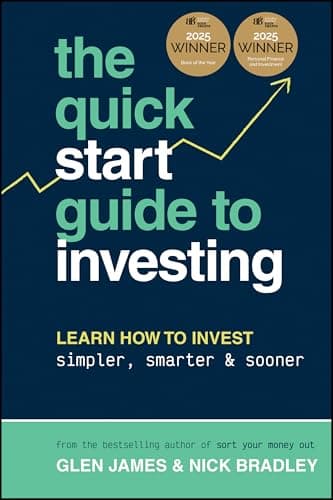
The Quick-Start Guide to Investing
Glen James & Nick Bradley
The Quick-Start Guide to Investing
A short, friendly runway from never invested to confidently buying shares and ETFs, tuned for Aussie beginners. Great if Sort Your Money Out left you keen to go deeper.
Sort Your Money Out and Get Invested
Glen James
Sort Your Money Out and Get Invested
From the host of the my millennial money podcast, a step-by-step Aussie plan to fix your spending, clear debt and actually start investing. Practical and refreshingly free of finance-bro nonsense.
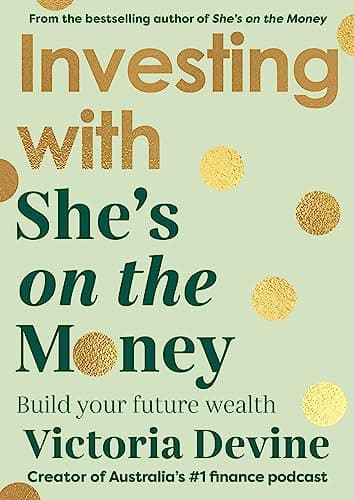
Investing with She's on the Money
Victoria Devine
Investing with She's on the Money
Victoria Devine breaks down shares, ETFs and super in plain English so investing stops feeling scary. Built for Australians, it is the nudge you need to actually get started.
Some links above are affiliate links. If you buy through them, Snowball Invest may earn a small commission at no extra cost to you. We only recommend books we'd suggest anyway.
Sources
Was this article useful?
Put it to your own numbers
Every calculator runs entirely in your browser, with nothing stored. See what these numbers look like for your own situation.
Explore the calculators →General information only. This article is educational and does not constitute personal financial advice. It does not account for your circumstances. Consider your own situation and seek advice from a licensed adviser before acting. Read our full disclaimer.

Timothy Hirou Gaschereau
Founder of Snowball Invest, not a financial adviser.
I write about what I'm learning myself, because nobody ever taught us how to take control of our own money. It's a skill, not a mystery, and it's never too late to learn it. The best day to start was yesterday, the second best is today.
LinkedIn →Related articles

Sort Your Money Out and Get Invested: An Honest Review
Our honest Sort Your Money Out and Get Invested review: Glen James's Sound Financial House framework, the strengths, the weaknesses, and who it's really for.

The Barefoot Investor Review: Honest, Unfiltered, Australian
Our honest Barefoot Investor review covers the bucket system, the 9 steps, the real criticisms, and whether Scott Pape's book is still worth it for Australians.

She's on the Money Review: Honest and Actually Useful
Our honest She's on the Money book review: what Victoria Devine gets right, where it falls short, and whether it's worth your time as an Australian reader.