

Investing with She's on the Money: An Honest Review
Our honest Investing with She's on the Money review: Victoria Devine's beginner-friendly Aussie investing guide, its strengths, its ceiling, and who it's for.
 By Timothy Hirou GaschereauPublished
 10 min read
Here's the honest one-liner: Investing with She's on the Money is a warm, genuinely Australian on-ramp to investing for total beginners, let down a bit by repetition and a ceiling that arrives sooner than you'd hope. If you've never bought a share in your life, it's a lovely place to start. If you've already got a Raiz account and an ETF or two, you'll outgrow it fast. It's part of our personal finance book reviews on Snowball Invest.
Quick answer
A genuinely helpful, jargon-free introduction to investing in Australia, built for people who feel like investing "isn't for them." Best for complete beginners in their 20s and 30s. Skip it if you already know an ETF from an index fund or you've read the first She's on the Money cover to cover. Our rating: 3.5 out of 5.
Want to read Investing with She's on the Money?
Victoria Devine's plain-English investing starter, built around the Australian system. A friendly first step off zero.
In this guide
- →What the book covers: mindset, risk profiles, shares, ETFs, super and more
- →The genuine strengths and the honest weaknesses
- →Who it's for, and who's better off elsewhere
- →What critics and r/AusFinance readers say
- →The Australian angle: ASX, VAS/VGS, super and franking
📖 What is Investing with She's on the Money about?
Investing with She's on the Money is Victoria Devine's second book, published by Penguin in 2023. It's the investing-focused sequel to her bestselling debut, She's on the Money, aimed squarely at Australians who feel like investing is "not for them."
Devine is a former financial adviser turned podcaster and media personality, host of the She's on the Money podcast (one of Australia's most listened-to finance shows), a Forbes 30 Under 30 Asia lister, and a finance columnist for The Age and the Sydney Morning Herald. The book's core premise is simple: investing isn't just for finance bros and property developers. It's for everyone, and especially for women, who face a structural disadvantage thanks to the gender pay gap and career interruptions that compound over time. The tone is warm and conversational, much like the podcast, and there are worksheets in every chapter. It's a book you're meant to write in, not just read.
What it covers, roughly in order:
- Money mindset and values. Before a single share is mentioned, Devine asks you to examine your relationship with money. This section is substantial, arguably too substantial for a book titled "investing."
- Risk profiles. A clear explanation of conservative, balanced and growth investor types, and how to work out which you are.
- Why you can't afford not to invest. Focused on the gender gap in retirement savings.
- The share market. How shares work, what the ASX is, and the role of diversification.
- ETFs and index funds. An intro to exchange-traded funds (including VAS and VGS) and why they suit most beginners.
- Micro-investing, super, property and ethical investing. Short, honest overviews of each, including a look at micro-investing apps and with super framed as investing most Australians are already doing.
- Building your own strategy. The final section ties it together into a plan that fits your goals and risk tolerance.
⚖️ Strengths and weaknesses
What it gets right
- ✓Genuinely accessible language: franking credits, compounding, dollar-cost averaging, all explained without condescension.
- ✓The Australian context is baked in, not bolted on: ASX, super, franking and local ETFs are first-class topics.
- ✓Psychology gets proper airtime: Devine's behavioural background shows in how she handles fear, inertia and loss aversion.
- ✓Practical activities throughout: do the worksheets and you finish with a real risk profile, goals and a rough strategy.
- ✓Confidence-building tone: it doesn't make you feel stupid for not knowing this already.
Where it falls short
- ✕Repetition: the values and mindset material from the first book gets recycled at length here.
- ✕The ceiling arrives quickly: past the fundamentals, the technical depth runs thin.
- ✕Chatty preamble: chapters tend to open with a page or two of padding before the substance.
- ✕No index: frustrating for a reference book you're meant to return to.
- ✕Lighter on the how than the what: it explains what to buy but is thinner on opening an account and placing a first trade.
👤 Who should read it, and who should skip it?
Read it if you
- ✓Have never invested anything and the whole topic feels overwhelming.
- ✓Love the She's on the Money podcast and want the concepts in a structured, written form.
- ✓Want an Australian-specific guide covering super, the ASX and local ETF options.
- ✓Are after a book to give a friend or partner who's been putting off starting.
- ✓Want to understand your risk profile and build a basic strategy from scratch.
Skip or supplement it if you
- ✕Have already read the first She's on the Money and feel comfortable with the basics.
- ✕Already hold ETFs or engaged super and want depth on strategy or tax.
- ✕Want technical detail on asset allocation, rebalancing or tax considerations.
- ✕Want step-by-step instructions for opening a brokerage account and placing your first trade.
🔍 What do critics say?
The critical consensus is warm but measured. Reviewers consistently praise the accessibility, the confidence-building tone and the genuinely local context, and Devine is widely regarded as one of the best communicators in Australian personal finance. The recurring criticism is just as consistent: too much space goes to mindset and values relative to actual investing mechanics, the editing could be tighter, and readers with any existing finance knowledge find it thin. It's treated as a strong beginner primer rather than a comprehensive investing guide.
💬 What do readers say? Goodreads and Reddit
On Goodreads it holds around 3.9 out of 5, a solid but not spectacular score, and the spread tells an honest story. The positive reviews cluster around accessibility and feeling more confident to start. The critical ones cluster around repetition, thin technical depth and the sense that the most useful investing content is concentrated near the end. A common thread: readers who wanted more depth afterwards reach for Girls That Invest as a complementary next read.
On r/AusFinance the book shows up in "which finance book should I read?" threads as a beginner recommendation: positive for that specific audience, measured for everyone else. If you're starting from zero it lands well; if you're a few steps in, it won't teach you much new.
🇦🇺 The Australian angle
This is where the book earns its keep. Most investing books in circulation are written for American readers, full of 401(k)s, Roth IRAs and the S&P 500. None of that helps directly when you're trying to sort your super fund, weigh VAS against VGS, or understand franking credits. Devine writes for Australians, full stop. The book covers:
- Superannuation as an investment vehicle most Australians are already using, often without realising it.
- The ASX and how Australian shares work, including dividend imputation and franking credits.
- Australian ETFs like VAS (Vanguard Australian Shares) and VGS (Vanguard International Shares), among the most commonly discussed options locally.
- The ASIC regulatory framework and what it means for how advice can and can't be given.
- Micro-investing apps available in Australia, with honest notes on their role as a starting point.
💰 The verdict
Investing with She's on the Money is a good book for the right reader. If you're a complete beginner, particularly one who's felt intimidated by investing or shut out of financial conversations, this is a warm, practical and genuinely Australian starting point. The accessible tone, the psychological framing and the local context all work in its favour. But it's not a book that grows with you. The repetition from the first book, the thin technical depth and the missing index mean that once you've taken your first steps, you'll quickly outgrow it. Think of it as a launchpad, not a destination. Our rating: 3.5 out of 5. Worth reading if you're starting from zero, and pair it with something more technical once the basics land.
Want to read Investing with She's on the Money?
Starting from zero and want a gentle, Aussie-specific first step? This is a friendly place to begin.
SnowLetter
Australia's money news and our best reads, once a week.
❓ Frequently asked questions
Is Investing with She's on the Money suitable for complete beginners?
+
Yes, this is its sweet spot. The book assumes no prior knowledge and builds from the ground up, from what a share actually is to how to think about a portfolio. If you've never invested anything and the topic feels foreign, it's a reasonable place to start.
How does it compare to the first She's on the Money book?
+
The first book is a broader personal finance guide covering budgeting, debt, savings and insurance. This sequel narrows the focus to investing. Many readers rate the first book slightly higher, partly because it covers more ground and partly because this one recycles some of the mindset material from book one before getting into new territory.
Is it relevant for men too?
+
The book is written with women as the primary audience, and some of the framing (around the gender pay gap and women's specific barriers to investing) reflects that. But the investing concepts themselves are universal, and male readers generally report finding it useful even if some references feel aimed elsewhere.
Does it cover ETFs and index funds?
+
Yes. ETFs and index funds get a dedicated section, including how they work, why they suit most beginners, and references to popular Australian options like VAS and VGS. It's an introduction rather than a deep dive, but enough to understand what you're looking at when you open a brokerage account.
Is it worth reading if you already invest?
+
Probably not as a primary resource. If you already have money in ETFs or super and you're comfortable with the basics, you'll likely find it too introductory. It's best used as a starting point, not a reference for experienced investors.
Where can you buy Investing with She's on the Money?
+
It's widely available across Australian booksellers and major retailers, as well as in eBook and audiobook formats. Note that the worksheets and activities are designed for the print edition, so the audiobook loses some of the practical value.
📚 Get the book (and two great companions)
Investing with She's on the Money
Victoria Devine
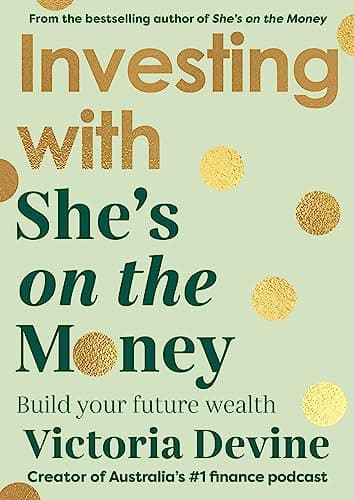
Investing with She's on the Money
Victoria Devine breaks down shares, ETFs and super in plain English so investing stops feeling scary. Built for Australians, it is the nudge you need to actually get started.
She's on the Money
Victoria Devine
She's on the Money
Written for millennials, walks through budgeting, clearing debt, saving, investing and buying property with real stories.
Girls That Invest
Simran Kaur
Girls That Invest
A no-jargon crash course from the podcaster behind Girls That Invest that makes the sharemarket feel doable, written especially for women starting out. The perfect first step before you buy your first ETF.
Some links above are affiliate links. If you buy through them, Snowball Invest may earn a small commission at no extra cost to you. We only recommend books we'd suggest anyway.
Sources
Was this article useful?
Put it to your own numbers
Every calculator runs entirely in your browser, with nothing stored. See what these numbers look like for your own situation.
Explore the calculators →General information only. This article is educational and does not constitute personal financial advice. It does not account for your circumstances. Consider your own situation and seek advice from a licensed adviser before acting. Read our full disclaimer.

Timothy Hirou Gaschereau
Founder of Snowball Invest, not a financial adviser.
I write about what I'm learning myself, because nobody ever taught us how to take control of our own money. It's a skill, not a mystery, and it's never too late to learn it. The best day to start was yesterday, the second best is today.
LinkedIn →Related articles

She's on the Money Review: Honest and Actually Useful
Our honest She's on the Money book review: what Victoria Devine gets right, where it falls short, and whether it's worth your time as an Australian reader.

Girls That Invest Book Review: An Honest Australian Take
Our honest Girls That Invest book review: what Simran Kaur's beginner guide does well, where it falls short, and what Australian readers need to know first.

Money Magnet by Steve McKnight: An Honest Review
Our honest Money Magnet review: Steve McKnight's holistic, values-driven Aussie wealth book, its strengths, its limits, and who should read it.