

When Can I Access My Super? Preservation Age Explained
The full preservation age table by birth year, when you can actually access your super, and the narrow exceptions that let you access it earlier.
 By Timothy Hirou GaschereauPublished
 9 min read
Try it yourself
Super is designed to be hard to touch early, that's the whole point of the system. But "hard to touch" isn't the same as "one fixed age for everyone", there are genuinely different rules depending on your birth year, your employment status, and how old you are right now. Here's exactly how it works, part of a wider guide to retirement and FIRE on Snowball Invest. If you're still fuzzy on how super works in the first place, start with the basics.
Quick answer
You can generally access your super once you reach your preservation age (60, for everyone born after 30 June 1964) and meet a condition of release, most commonly retiring. Once you turn 65, you can access it unconditionally regardless of whether you're still working. A small number of early access categories exist for genuine hardship or compassionate grounds.
In this guide
- →Your preservation age, and how it differs from actually retiring
- →How access at retirement actually works, including a common misconception
- →Transition to retirement, and the one unconditional cutoff at 65
- →The narrow legitimate early-access categories, and what happens to people who try to bypass them
📅 Your preservation age
Preservation age is simply the earliest age the rules allow you to touch your super at all, it isn't the same as actually retiring. It was gradually phased upward over time and, as of 1 July 2024, has fully settled at 60 for everyone still reaching it.
| Date of birth | Preservation age |
|---|---|
| Before 1 July 1960 | 55 |
| 1 July 1960 - 30 June 1961 | 56 |
| 1 July 1961 - 30 June 1962 | 57 |
| 1 July 1962 - 30 June 1963 | 58 |
| 1 July 1963 - 30 June 1964 | 59 |
| From 1 July 1964 | 60 |
If you were born on or after 1 July 1964, which covers everyone under 62 today, your preservation age is simply 60. The earlier bands only matter if you were born before that cutoff.
Before 60
Locked, no access
60-64
Access once you meet a condition of release (e.g. retire)
65+
Unconditional access, regardless of work status
If you're planning to stop working well before your preservation age, this table is really the starting point for a much bigger question: what funds your living costs in the years in between. Our guide to the bridge portfolio strategy covers how to size and structure that gap-year funding. Our FIRE number calculator is the starting point for working out what that whole portfolio needs to be.
🚪 Accessing it at retirement
Reaching preservation age alone doesn't unlock your super, you also need to meet a "condition of release". The most common one for people aged 60 to 64 is ending an employment arrangement, resigning, being made redundant, or otherwise ceasing work under an arrangement you were in, after you've reached preservation age. You don't have to swear off working forever, taking on different work later doesn't undo it.
A common misconception: you don't need to permanently stop working to access your super at 60. Ending one job after reaching preservation age is generally enough to satisfy the retirement condition of release, even if you go on to work somewhere else.
🔄 Still working? Transition to retirement
If you've reached preservation age but haven't met a full condition of release, a Transition to Retirement (TTR) income stream lets you draw a limited income from your super while you keep working, commonly used to reduce work hours gradually without a full income drop, or to restructure income for tax purposes. It's a genuinely different product to a normal retirement pension, with its own rules and limits, worth discussing with your fund directly if you're considering it.
🎂 Turning 65
Age 65 is the one unconditional cutoff in the system. Once you reach it, you can access your entire super balance regardless of your employment status, whether you're fully retired, still working full-time, or anything in between. No condition of release needs to be met at that point.
Knowing when you can touch your super is only half the picture, once you're eligible, the next question is how much you can actually take out. Our guide to how much super you can withdraw after 60 breaks down the caps and tax treatment for each situation.
⚠️ Accessing it early
Outside of preservation age and retirement, super can only be accessed early in a small number of tightly defined situations, each assessed on its own criteria, not something you can decide for yourself:
- Severe financial hardship, assessed against specific criteria around how long you've been receiving income support.
- Compassionate grounds, for specific expenses like medical treatment, palliative care, or preventing foreclosure on your home, approved by the ATO.
- Permanent incapacity or a terminal medical condition, verified by medical certification.
- First Home Super Saver Scheme, letting you withdraw eligible voluntary contributions to help fund a first home deposit.
- Permanently departing Australia as a former temporary resident.
Outside these specific categories, there's no general "emergency" early access, the system is deliberately strict about this, since the whole point is making sure the money is still there decades later.
🚨 The real cost of trying to access it illegally
🎯 The essential: Promoters advertising a way to "unlock" super outside these categories are running an illegal scheme, and the ATO actively tracks and penalises it, on both sides.
The narrow list above exists because there genuinely isn't a broader legal path, and the ATO actively pursues attempts to get around it. In one recent financial year, more than 280 self-managed super fund trustees were disqualified specifically for illegally releasing benefits to members who hadn't met a condition of release, alongside $2 million in administrative penalties and a further $4 million in additional tax raised, both up noticeably on the year before, a sign of enforcement activity actively increasing, not easing off.
The penalties are genuinely severe: administrative penalties apply per trustee per transaction, and more serious, deliberate breaches can carry fines running into the hundreds of thousands of dollars for an individual trustee, or over $2.5 million for a corporate trustee, plus up to five years' imprisonment in the worst cases. The ATO has specifically flagged that promoters of illegal early-access schemes target people already under financial stress, precisely the situation where the temptation to try one is highest, which makes it worth knowing the legitimate categories above cover genuine hardship already, through a process assessed by your fund or the ATO rather than a third party offering to "release" your super for a fee.
Knowing when you can access your super is one half of the plan. The other half is knowing whether what you'll have by then is actually going to be enough.
🎯 How Much Super Do You Need to Retire?
Real Australian benchmarks, plus how to work out your own number.
SnowLetter
Australia's money news and our best reads, once a week.
❓ Frequently asked questions
What's the difference between preservation age and retirement age?
+
Preservation age is the earliest age super rules allow you to touch your super at all, currently 60 for everyone. Retirement age isn't a fixed number, it's just whenever you actually stop working, which for most people happens at or after their preservation age.
Can I access my super at 60 if I keep working?
+
Only through a Transition to Retirement (TTR) income stream, which lets you draw a limited income from super while still working, full unrestricted access at 60 requires an actual condition of release, like ceasing an employment arrangement.
Do I have to stop working completely to access my super?
+
Not necessarily. If you're between preservation age and 65, ending one employment arrangement (even if you start a different job later) can satisfy the retirement condition of release, though rules and interpretation vary and it's worth confirming with your fund.
What happens to my super if I never formally retire?
+
Once you turn 65, you can access your super unconditionally regardless of your work status, retired or not, so there's no scenario where it stays locked away forever.
Can I access my super early if I'm in financial trouble?
+
In limited circumstances, yes, severe financial hardship and compassionate grounds are both recognised categories, but they come with strict eligibility criteria and are assessed by your fund or the ATO, not something you can self-approve.
📚 Recommended reading
Retirement Made Simple
Noel Whittaker

Retirement Made Simple
Australia's godfather of personal finance demystifies super, the pension and making your savings last. The plain-English retirement handbook every Aussie should read before they stop working.
Super Made Simple
Noel Whittaker
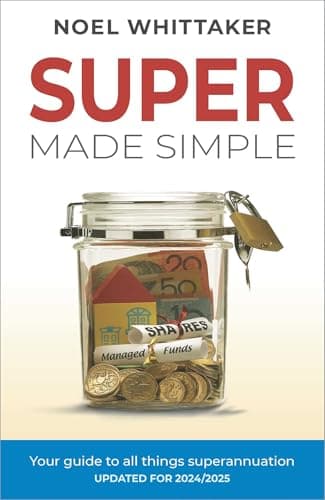
Super Made Simple
A focused, up-to-date guide to actually understanding your superannuation, from one of Australia's most trusted finance writers.
Die With Zero
Bill Perkins

Die With Zero
Stop hoarding cash for a someday that never comes. Perkins makes the case for spending on experiences while you are still young enough to enjoy them.
Some links above are affiliate links. If you buy through them, Snowball Invest may earn a small commission at no extra cost to you. We only recommend books we'd suggest anyway.
Sources
Was this article useful?
Put it to your own numbers
Every calculator runs entirely in your browser, with nothing stored. See what these numbers look like for your own situation.
Try the Retirement Income calculator →General information only. This article is educational and does not constitute personal financial advice. It does not account for your circumstances. Consider your own situation and seek advice from a licensed adviser before acting. Read our full disclaimer.

Timothy Hirou Gaschereau
Founder of Snowball Invest, not a financial adviser.
I write about what I'm learning myself, because nobody ever taught us how to take control of our own money. It's a skill, not a mystery, and it's never too late to learn it. The best day to start was yesterday, the second best is today.
LinkedIn →Related articles

Salary Sacrifice Super: How It Works (And Is It Worth It?)
How salary sacrificing into super actually reduces your tax bill, the concessional cap limit to watch, and whether it's worth it for your situation.

Carry-Forward Concessional Contributions: The Catch-Up Rule Explained
Missed super contributions during part-time work or time off? How the carry-forward concessional contributions rule lets you catch up, and what it saves.

How Much Super Do You Need to Retire in Australia?
Real Australian retirement benchmarks, not a guess, how the Age Pension fits in, and how to work out your own number for a comfortable retirement.