

How Much Super Can You Withdraw After 60?
No fixed cap, but the rules depend on whether you've retired, you're still working, or you're on a TTR. Here's exactly how it works in 2026-27.
 By Timothy Hirou GaschereauPublished
 10 min read
Try it yourself
This article is general information only, not financial, tax or legal advice. It doesn't account for your personal circumstances, so please speak with a licensed financial adviser before making decisions about your super. This is part of a wider guide to retirement and FIRE on Snowball Invest. If you're not sure whether you can touch your super at all yet, start with our guide to when you can access your super.
Quick answer
If you've fully retired after 60, there's no cap, you can withdraw your entire super balance as a lump sum, tax-free. If you're still working at 60 to 64, you can access a transition to retirement (TTR) income stream, capped at 10% of your balance per year. At 65, you get unrestricted access regardless of whether you're still working. Withdrawals from a taxed super fund are completely tax-free after 60.
In this guide
- →The three different situations "after 60" can mean, and why the rules differ so much between them
- →How much you can actually withdraw in each situation, including the TTR 4-10% band
- →Three worked examples showing the real numbers
- →What the Transfer Balance Cap actually limits (it isn't your withdrawals)
- →Why withdrawals from a taxed fund are tax-free after 60, and the untaxed fund exception
🧭 Which of the three situations are you in?
If you've fully retired after 60, you can withdraw as much as you want, the whole balance if you choose. There's no government cap on the amount.
But "after 60" isn't one situation, it's three genuinely different ones, and the rules change completely depending on which one you're in. That's where most people get confused. Here's how to figure out which box you're in, and what it means for your money.
| Situation | What you can withdraw |
|---|---|
| Retired (or ceased a job) after 60 | Unlimited, lump sum, income stream, or both |
| 60-64, still employed, no condition of release met | Nothing directly, only via a TTR income stream |
| On a TTR income stream | 4% to 10% of balance per year, income stream only |
| 65 or over | Unlimited, regardless of employment status |
Ceased a job on or after 60?
Yes
Full access
Lump sum, income stream, or both. No cap.
No, so are you 65+?
Yes: full access, work or not
No: TTR income stream only, 4% to 10% a year
🚪 You've retired (or left your last job)
Once you cease an employment arrangement on or after age 60, you've met what the ATO calls a condition of release. Your super is fully accessible, this is the full condition of release, and it means:
- No cap on lump sum withdrawals, you can take the whole balance if you want.
- You can take it as a lump sum, an account-based pension (income stream), or a combination of both.
- Withdrawals from a taxed fund are completely tax-free, they're non-assessable, non-exempt income, so they don't appear on your tax return at all.
One thing worth knowing: some funds apply their own minimum balance rules for lump sum withdrawals (for example, requiring you to leave a few thousand dollars in the account to keep it open). That's a fund rule, not an ATO rule, so check with your fund directly.
What if you go back to work? Ceasing one job after 60 still satisfies the condition of release for the super you'd built up to that point. Any new contributions after you return to work are preserved again until you meet another condition of release.
💼 You're 60-64 and still working
Turning 60 doesn't automatically unlock your super. If you're still employed and haven't left a job, you haven't met a condition of release yet. Your options at this stage:
- Start a TTR income stream (more on this below), capped at 10% of your balance per year, income stream payments only.
- Wait until you cease an employment arrangement, which triggers full access.
- Wait until you turn 65, at that point you get unrestricted access regardless of whether you're still working.
The key point: you can't just pull money out of super because you've hit 60 while you're still employed. The age alone doesn't do it, you need an actual condition of release, or a TTR income stream.
🔄 You're on a transition to retirement income stream
A transition to retirement income stream (TTR, or TRIS) is available from preservation age (60) while you're still working. It lets you draw a regular income from your super without having to retire. We cover the full strategy, including the tax nuance most explainers get wrong, in our dedicated transition to retirement guide. The rules that affect how much you can withdraw:
- Maximum drawdown: 10% of your account balance per financial year, calculated as at 1 July each year.
- Minimum drawdown: 4% per year for members under 65.
- No lump sums, a TTR is an income stream only. You can't convert it to cash while you're still in the TTR arrangement and still working.
- Payments from a TTR from a taxed fund are tax-free after 60.
🎯 The essential: The 10% cap is a hard ceiling set by the ATO. If your balance is $200,000, you can draw up to $20,000 this financial year, no more.
Once you meet a full condition of release (retire, turn 65, or become permanently incapacitated), the TTR automatically converts to a standard retirement-phase income stream and the 10% cap disappears.
🧮 Three people, three situations
Sandra, 62, fully retired. Sandra has $320,000 in super. She retired last year, meaning she ceased an employment arrangement after 60, full condition of release met. She can withdraw the entire $320,000 as a lump sum if she wants, tax-free. Or she can move it into an account-based pension and draw it down as regular income, or a mix of both. There's no cap on how much she can take.
Marcus, 61, still working full-time. Marcus has $280,000 in super and is still employed. He hasn't ceased any employment arrangement, so he can't access his super freely. His option: start a TTR income stream and draw up to $28,000 this year (10% of $280,000). He can't take a lump sum. The income stream payments are tax-free because he's over 60 and in a taxed fund.
Priya, 63, semi-retired. Priya has $410,000 in super. She left her main job after turning 60, then picked up some casual shifts. That cessation of her main employment arrangement after 60 satisfied the condition of release. She has full access, the casual work doesn't reset the clock. She could withdraw a lump sum, start an account-based pension, or both. Any new super from the casual work stays preserved until she meets another condition of release.
🏛️ What about the Transfer Balance Cap?
The Transfer Balance Cap (TBC) is often confused with a withdrawal cap. It isn't one. The TBC limits how much super you can move into a tax-free retirement phase account (like an account-based pension). It doesn't cap how much you can withdraw.
For 2026-27, the general TBC is $2.1 million, indexed up from $2.0 million on 1 July 2026. Here's what that means in practice:
- You can move up to the TBC amount into a retirement-phase income stream where earnings are tax-free.
- Amounts above the TBC stay in accumulation phase (taxed at up to 15% on earnings), or you can simply withdraw them.
- If you started a retirement-phase income stream before the most recent indexation date, your personal TBC may be lower than the current general cap, depending on your transfer balance history. Check your personal cap via ATO online services through myGov.
So if you have $1.5 million in super and you're fully retired, the TBC doesn't affect you at all. It only becomes relevant for larger balances.
If you're already drawing an account-based pension and want to understand what happens to it, and to your spouse's own TBC, when you die, see our guide to reversionary pensions.
📊 Retirement Income Calculator
Run your own numbers and see how different drawdown strategies play out over time.
💰 Tax-free after 60, what that actually means
From a taxed fund, which is the vast majority of Australians, here's the deal:
- Lump sums: completely tax-free, no withholding, no declaration in your tax return.
- Income stream payments: also tax-free, they're non-assessable, non-exempt income.
- If your only income is from a taxed super source after 60, you generally don't even need to lodge a tax return for those payments.
This is a genuinely big deal. A $300,000 lump sum from a taxed fund after 60 costs you nothing in tax. Zero.
The exception: untaxed funds. Some state government and public sector funds are untaxed funds, meaning contributions were never taxed going in, so different rules apply. Lump sums from an untaxed fund are taxed at 15% up to the untaxed plan cap ($1,935,000 in 2026-27), then 45% above that. Income stream payments from an untaxed fund are taxed at marginal rates with a 10% tax offset. Most Australians are in taxed funds (industry funds, retail funds, most SMSFs), if you're in a state government or public sector scheme, check with your fund.
SnowLetter
Australia's money news and our best reads, once a week.
❓ Frequently asked questions
Can I withdraw all my super at 60?
+
Yes, if you've fully retired after 60 (or ceased an employment arrangement after 60), you can withdraw your entire balance as a lump sum. There's no government cap on the amount. Some funds have their own minimum balance requirements to keep the account open, so check with your fund.
Is there a minimum amount I have to leave in my super?
+
The ATO doesn't require you to leave any minimum in your super. Some funds do, for example to keep an account open or maintain insurance cover. That varies by fund, not by law.
Can I withdraw super at 60 and still work?
+
It depends. If you've ceased an employment arrangement after 60, you can access the super built up to that point, even if you later go back to work. If you're still continuously employed and haven't left a job, you can only access super via a TTR income stream, capped at 10% per year. At 65, you can withdraw freely regardless of employment status.
How much can I withdraw from a TTR income stream?
+
Between 4% and 10% of your account balance per financial year. The balance is measured as at 1 July each year, or your account opening balance in the first year. No lump sums, income stream payments only.
Do I pay tax on super withdrawals after 60?
+
Not from a taxed fund. Lump sums and income stream payments from a taxed super fund are tax-free after 60, they're non-assessable, non-exempt income and don't count toward your taxable income. Untaxed funds, mostly some public sector schemes, are taxed differently.
What's the difference between a lump sum and an income stream?
+
A lump sum is a one-off cash payment, you take out a chunk (or all) of your super at once. An income stream, or account-based pension, pays you regular amounts, weekly, fortnightly, monthly or annually, while your remaining balance stays invested. You can also do both, take a lump sum for a specific purpose and put the rest into an income stream. Once money leaves super as a lump sum, it's no longer super, any earnings on it are taxed under normal investment rules.
📚 Recommended reading
Retirement Made Simple
Noel Whittaker

Retirement Made Simple
Australia's godfather of personal finance demystifies super, the pension and making your savings last. The plain-English retirement handbook every Aussie should read before they stop working.
Super Made Simple
Noel Whittaker
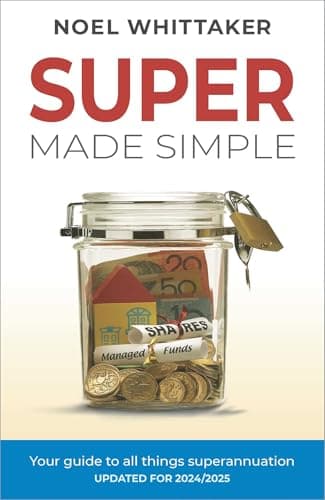
Super Made Simple
A focused, up-to-date guide to actually understanding your superannuation, from one of Australia's most trusted finance writers.
Die With Zero
Bill Perkins
Die With Zero
Stop hoarding cash for a someday that never comes. Perkins makes the case for spending on experiences while you are still young enough to enjoy them.
Some links above are affiliate links. If you buy through them, Snowball Invest may earn a small commission at no extra cost to you. We only recommend books we'd suggest anyway.
Sources
- 1. Retirement withdrawal: lump sum or income stream, Australian Taxation Office
- 2. Super withdrawal options (conditions of release), Australian Taxation Office
- 3. Key superannuation rates and thresholds: payments from super, Australian Taxation Office
- 4. Transfer balance cap, Australian Taxation Office
- 5. Transition to retirement, Australian Taxation Office
- 6. Tax and super, Moneysmart, Australian Securities and Investments Commission
- 7. Getting your super, Moneysmart, Australian Securities and Investments Commission
Was this article useful?
Put it to your own numbers
Every calculator runs entirely in your browser, with nothing stored. See what these numbers look like for your own situation.
Try the Retirement Income calculator →General information only. This article is educational and does not constitute personal financial advice. It does not account for your circumstances. Consider your own situation and seek advice from a licensed adviser before acting. Read our full disclaimer.

Timothy Hirou Gaschereau
Founder of Snowball Invest, not a financial adviser.
I write about what I'm learning myself, because nobody ever taught us how to take control of our own money. It's a skill, not a mystery, and it's never too late to learn it. The best day to start was yesterday, the second best is today.
LinkedIn →Related articles

Salary Sacrifice Super: How It Works (And Is It Worth It?)
How salary sacrificing into super actually reduces your tax bill, the concessional cap limit to watch, and whether it's worth it for your situation.

Carry-Forward Concessional Contributions: The Catch-Up Rule Explained
Missed super contributions during part-time work or time off? How the carry-forward concessional contributions rule lets you catch up, and what it saves.

How Much Super Do You Need to Retire in Australia?
Real Australian retirement benchmarks, not a guess, how the Age Pension fits in, and how to work out your own number for a comfortable retirement.