

Transition to Retirement (TTR): How the Strategy Actually Works
How a transition to retirement strategy actually works, the two common ways people use it, a worked example, and the tax nuance most explainers get wrong.
 By Timothy Hirou GaschereauPublished
 9 min read
Try it yourself
A transition to retirement (TTR) strategy gets pitched as a simple way to ease into retirement, but the mechanics, and the tax treatment specifically, are more nuanced than most explainers let on. This is part of a wider guide to retirement and FIRE on Snowball Invest.
Quick answer
A TTR strategy lets you draw an income stream from your super once you've reached preservation age (60, for everyone under current rules), while still working. It's used either to top up income while reducing work hours, or to support a salary sacrifice strategy while working full-time. Pension payments are tax-free from 60, but earnings on the assets supporting the pension are still taxed at up to 15%, not tax-free like a full retirement pension.
In this guide
- →What a TTR strategy actually is, and the two ways people use it
- →The tax treatment, including the 2017 legislative change behind the most common misconception
- →Withdrawal limits, and a full worked example
- →The real risks and trade-offs, including the Age Pension interaction
- →Who a TTR strategy genuinely doesn't suit
🔄 What a TTR strategy actually is
Once you've reached your preservation age, currently 60 for everyone under the rules as they stand today, you can move part of your super into a transition-to-retirement income stream while still employed, without needing to fully retire or meet any other condition of release. The rest of your super stays in accumulation phase, still receiving employer Superannuation Guarantee contributions as normal.
🔀 The two ways people actually use it
1. Reducing work hours. Someone cutting back from five days a week to three can draw a TTR pension to top up the income lost from fewer hours, easing into retirement gradually rather than stopping abruptly.
2. Boosting super while working full-time. A less obvious use: keep working full-time, salary sacrifice a larger portion of pay into super (taxed at up to 15% rather than your marginal rate), then draw a TTR pension to replace the take-home pay lost to the extra sacrifice. Total income stays roughly the same, but a larger share moves through the concessionally taxed super system instead of being taxed at a higher marginal rate.
Our salary sacrifice calculator can show you roughly how much extra could move into super this way before you model the TTR side of the loop.
📊 Salary Sacrifice Super Explained
The mechanism a TTR strategy is often paired with, in more detail.
💰 The tax treatment (and a common misconception)
🎯 The essential: The tax-free-earnings myth around TTR has a specific legislative cause, a 2017 law change that most casual explanations never mention.
TTR pension payments themselves are tax-free once you're 60 or over, the ATO doesn't require any tax to be withheld. That part is straightforward, and it's where most explanations of TTR stop.
What's frequently missed: since 1 July 2017, earnings on the assets supporting a TTR pension, interest, dividends, capital gains, are taxed at up to 15%, the same as in an ordinary accumulation super account, not tax-free the way earnings in a full retirement-phase pension are. Before that 2017 change, TTR earnings were tax-free too, which is likely where the misconception persists. A TTR pension only moves into full tax-free retirement phase once you actually meet a further condition of release, permanent retirement, turning 65, or similar.
The change came via the Treasury Laws Amendment (Fair and Sustainable Superannuation) Act 2016, part of a broader package of reforms that also introduced the transfer balance cap on how much can move into tax-free retirement phase, $1.6 million at the time, now $2,100,000 for 2026-27. The explanatory memorandum accompanying the bill was explicit about the intent: TTR income streams were being used by people still working, and still building their balance, specifically to access a tax exemption meant for genuine retirees no longer earning income, which the amendment was designed to close. Understanding that the 15% earnings tax was a deliberate policy correction, not an oversight or a temporary rule, is useful context for why it's unlikely to be reversed.
📏 How much you can withdraw
A TTR income stream has both a floor and a ceiling: total payments in a financial year must be at least the standard age-band minimum (4% under 65, rising with age), and no more than 10%. Unlike super accessed after a full condition of release, a TTR pension generally can't be taken as a one-off lump sum while it remains in transition phase, it has to come out as these ongoing, capped payments. See our full minimum pension drawdown rates table for the exact percentage at every age.
That 4%-10% band is just one of three very different situations super withdrawal rules can put you in after 60. Our guide to how much super you can withdraw after 60 walks through all three, including worked examples.
🧮 A worked example
Someone earning $110,000 a year, aged 61, decides to salary sacrifice an extra $15,000 into super. Without a TTR pension, that would reduce their take-home pay by roughly the after-tax value of $15,000 at their marginal rate. Instead, they draw a TTR pension of a similar amount to replace the lost take-home pay. The $15,000 sacrificed is taxed at 15% going into super (a $2,250 contributions tax) instead of their marginal rate, which is likely above 30% on that portion of income, a genuine tax saving, while overall take-home income stays about the same.
⚠️ The real risks and trade-offs
What it genuinely offers
- ✓A real tax saving for people salary sacrificing at a marginal rate above 15%
- ✓A gradual, flexible way to ease into retirement rather than stopping abruptly
- ✓Tax-free pension payments from age 60
What it costs or risks
- ✕Earnings on the TTR-supporting assets are taxed at up to 15%, not tax-free
- ✕Drawing down super earlier means less time for that portion to compound before full retirement
- ✕Added complexity, and potentially advice costs, to set up and manage correctly
- ✕Can affect eligibility for some government benefits depending on individual circumstances
🏛️ The Age Pension interaction
This is the detail that catches people out most: once super is converted into any income stream, including a TTR pension, the account balance becomes assessable under Centrelink's Age Pension assets and income tests, regardless of your age. Super still sitting in ordinary accumulation phase is generally exempt from those tests until you reach Age Pension age, so starting a TTR pension earlier than necessary can bring assessable assets forward sooner than they otherwise would be counted.
This mostly matters for people close enough to Age Pension age that a part-pension is a realistic consideration. For someone in their early 60s who's still years away from Age Pension age and has no near-term interest in the pension, it's a smaller factor. Our Age Pension guide covers exactly how the assets and income tests work.
🙅 Who a TTR strategy doesn't suit
It offers the least benefit to anyone on a marginal tax rate close to or below the 15% concessional rate applied to extra super contributions, the tax gap the strategy exploits simply isn't large enough to be worth the added complexity. It also suits people poorly who value simplicity over a modest tax saving, or who are uncomfortable with money moving through an extra account and an extra set of rules for a relatively small net benefit.
SnowLetter
Australia's money news and our best reads, once a week.
❓ Frequently asked questions
Do I have to reduce my working hours to start a TTR pension?
+
No. You can keep working full-time and use a TTR pension purely to support a salary sacrifice strategy, drawing a supplementary income to offset the reduced take-home pay from sacrificing more into super. Reducing hours is one common use case, not a requirement.
Is a TTR pension the same as a normal retirement pension?
+
No, and this is the most commonly misunderstood part. A TTR pension is paid from super while you're still working, before you've permanently retired, and unlike a full retirement-phase pension, the earnings on assets supporting it are taxed at up to 15%, not tax-free.
Can I access my TTR pension as a lump sum?
+
Generally no, while it remains in transition-to-retirement phase, a TTR income stream can only be taken as regular pension payments within the 4%-10% range, not as an ad hoc lump sum, unlike super accessed after meeting a full condition of release.
Does a TTR strategy make sense for everyone over 60 still working?
+
Not automatically. It works best for people on a high enough marginal tax rate that the 15% concessional tax on extra salary-sacrificed contributions is a genuine saving, and who have enough cash flow flexibility to manage the extra complexity. It's worth running the actual numbers, or getting advice, rather than assuming it helps by default.
📚 Recommended reading
Retirement Made Simple
Noel Whittaker

Retirement Made Simple
Australia's godfather of personal finance demystifies super, the pension and making your savings last. The plain-English retirement handbook every Aussie should read before they stop working.
Super Made Simple
Noel Whittaker
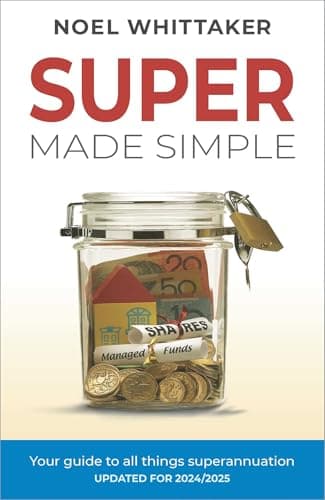
Super Made Simple
A focused, up-to-date guide to actually understanding your superannuation, from one of Australia's most trusted finance writers.
The Automatic Millionaire
David Bach
The Automatic Millionaire
The big idea is to make saving and investing automatic so willpower never gets a vote, plus the famous latte factor on how small daily leaks sink your wealth. Just read the US account bits as super and salary sacrifice.
Some links above are affiliate links. If you buy through them, Snowball Invest may earn a small commission at no extra cost to you. We only recommend books we'd suggest anyway.
Sources
- 1. Transition to retirement, Australian Taxation Office
- 2. Transition to retirement income streams (TRIS), Australian Taxation Office
- 3. Transition to retirement, Moneysmart, Australian Securities and Investments Commission
- 4. Treasury Laws Amendment (Fair and Sustainable Superannuation) Act 2016, explanatory memorandum, Federal Register of Legislation
Was this article useful?
Put it to your own numbers
Every calculator runs entirely in your browser, with nothing stored. See what these numbers look like for your own situation.
Try the Salary Sacrifice calculator →General information only. This article is educational and does not constitute personal financial advice. It does not account for your circumstances. Consider your own situation and seek advice from a licensed adviser before acting. Read our full disclaimer.

Timothy Hirou Gaschereau
Founder of Snowball Invest, not a financial adviser.
I write about what I'm learning myself, because nobody ever taught us how to take control of our own money. It's a skill, not a mystery, and it's never too late to learn it. The best day to start was yesterday, the second best is today.
LinkedIn →Related articles

Concessional vs Non-Concessional Super: The Plain-English Guide
Concessional or non-concessional super contributions? The real difference, the 2025-26 caps, the tax treatment, and which one suits you, in plain English.

When Is Salary Sacrifice NOT Worth It in Australia?
Salary sacrifice into super is not always the smart move. Here are six situations where it is not worth it in Australia, and what to do instead.

Minimum Pension Drawdown Rates by Age (Australia 2026-27)
The official 2026-27 minimum pension drawdown rates by age, how they're calculated, the TTR 10% cap, and what happens if your fund misses the minimum.