

What is salary sacrifice?
Quick answer
Salary sacrifice is a formal arrangement where you agree with your employer to give up part of your pre-tax salary in exchange for a benefit of equal value, most often extra superannuation contributions. Because the sacrificed amount never counts as taxable income, you pay less income tax.
How salary sacrifice works
The arrangement has to be set up before you earn the income, you can't salary sacrifice money you've already been paid. Once it's in place, you and your employer agree in writing to reduce your cash salary by a set amount, your employer provides a benefit of equivalent value, extra super, a car, a device, and your taxable income is calculated on the reduced salary. You pay less tax, and the benefit itself is provided by the employer rather than handed to you as cash.
The broader umbrella term is salary packaging, salary sacrifice into super is one popular version of it.
What you can salary sacrifice
Not everything qualifies, and not everything is tax-free.
- Super contributions. The most common use, and covered in detail below.
- Cars via novated lease. You lease a car through your employer and pay running costs from pre-tax salary, eligible electric vehicles can be fully exempt from Fringe Benefits Tax.
- Laptops, phones and work devices. Generally exempt from FBT when the item is mainly used for work, though the rules around this are subject to change, so check current settings before assuming.
Not every benefit is FBT-free. If a benefit attracts Fringe Benefits Tax, a flat 47% rate, your employer may pass that cost on to you, which can wipe out the tax saving entirely. Always confirm the FBT treatment before signing up to anything beyond super.
Salary sacrifice to super, the most common use
When you salary sacrifice into super, those contributions become concessional contributions, before-tax money taxed at a flat 15% inside the fund, regardless of your personal marginal rate. If you're earning above roughly $45,000, your marginal rate is at least 30% plus the Medicare levy, so you're swapping a higher rate for a lower one. The more you earn, the bigger the saving.
The concessional contributions cap for 2026-27 is $32,500. That covers all before-tax contributions combined, your employer's compulsory Super Guarantee (12% of your ordinary time earnings), any salary sacrifice, and any personal contributions you claim as a deduction. Your salary sacrifice room is $32,500 minus your employer's SG contributions. Go over the cap and the excess gets added to your assessable income and taxed at your marginal rate, plus an extra charge, worth avoiding but not the end of the world if it happens once.
If your total super balance was under $500,000 at the end of the last financial year, you may be able to use unused cap space from the previous five years, a useful catch-up strategy if you've had a quiet few years for contributions.
A worked example
Sarah earns $90,000 a year and decides to salary sacrifice $10,000 into super. Her taxable income drops from $90,000 to $80,000. Her marginal rate on that income band is 30% plus the 2% Medicare levy, 32% combined, so she saves $3,200 in tax on that $10,000. Inside super, the $10,000 is taxed at 15%, or $1,500. Net saving: $3,200 minus $1,500, roughly $1,700 a year, and the money is still hers, locked in super until preservation age.
Her employer already pays SG of 12% on $90,000, $10,800. Add her $10,000 salary sacrifice and her total concessional contributions sit at $20,800, comfortably under the $32,500 cap.
Things to watch out for
- Salary-sacrificed super shows up as a reportable employer super contribution on your income statement, and gets added back into income for tests like the Medicare Levy Surcharge, HECS-HELP repayment thresholds and family payment income tests. You reduce your tax, but your adjusted income for these tests stays higher.
- Salary sacrifice is voluntary for employers, ask HR before assuming it's available.
- Super contributions are locked away until preservation age, currently 60 for most people, if cash flow is tight, that's worth weighing up.
📚 Recommended reading
Super Made Simple
Noel Whittaker
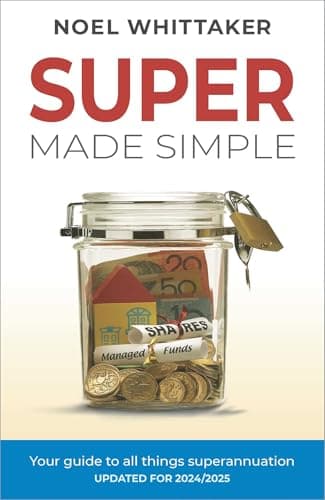
Super Made Simple
A focused, up-to-date guide to actually understanding your superannuation, from one of Australia's most trusted finance writers.
The Barefoot Investor
Scott Pape

The Barefoot Investor
Australia's best-selling money book ever. A simple system for accounts, budgeting, debt and a real emergency fund in one.
Some links above are affiliate links. If you buy through them, Snowball Invest may earn a small commission at no extra cost to you. We only recommend books we'd suggest anyway.
🏦 Salary Sacrifice Calculator
Model exactly how much tax you'd save based on your income and contribution amount.
Salary sacrificing into super, in full
The tax math worked out in detail, with your own numbers to run against it.
Frequently asked questions
How much can I salary sacrifice in Australia?
For super, your total concessional contributions, employer Super Guarantee plus salary sacrifice plus any personal deductible contributions, can't exceed $32,500 in 2026-27. For most employees, your salary sacrifice room is $32,500 minus whatever your employer already contributes as compulsory super. Confirm the current cap at ato.gov.au, it's indexed and moves over time.
Does salary sacrifice reduce my taxable income?
Yes. The sacrificed amount comes out of your salary before income tax is calculated, so your taxable income drops by that amount. For super specifically, the amount also shows up as a reportable employer super contribution, which can affect income-tested government benefits and surcharges like the Medicare Levy Surcharge.
Is salary sacrifice worth it?
For most people earning above roughly $45,000 and sacrificing into super, generally yes, the maths tends to work in your favour because you're swapping a higher marginal tax rate for the flat 15% super pays. The higher your income, the bigger the gap. Run your own numbers with our Salary Sacrifice Calculator before deciding.
What's the difference between salary sacrifice and salary packaging?
They're essentially the same thing. Salary packaging is the broader term, structuring your total pay as a mix of cash salary and non-cash benefits. Salary sacrifice is the mechanism you use to do it. Most Australians use the two terms interchangeably.
Does salary sacrifice affect my Super Guarantee?
It shouldn't. Employers are required to calculate compulsory Super Guarantee contributions on your ordinary time earnings, not your post-sacrifice salary. So salary sacrificing shouldn't reduce your SG entitlement, but it's worth confirming with your employer when you set the arrangement up.
Related terms
Disclaimer
This is general information only, not personal financial or tax advice. Contribution caps and tax rates are indicative and change from year to year, confirm the current figures at ato.gov.au or speak with a financial adviser before setting up an arrangement with your employer.