

What is Superannuation?
Quick answer
Superannuation is Australia's compulsory retirement savings system. Your employer pays a set percentage of your ordinary earnings into a super fund on your behalf, it's invested and taxed concessionally, and you can generally access it once you reach your preservation age.
How super actually works
Every payday, your employer is legally required to pay a percentage of your ordinary earnings into a super fund of your choice, on top of your salary, not out of it. That's called the Super Guarantee (SG), and it currently sits at 12%. The fund invests that money, usually in a mix of shares, property, bonds and cash, and it compounds for decades until you retire. It's not optional and it's not something you can substitute with a personal savings account, it's baked into how Australian employment works.
From 1 July 2026, most employers must pay SG contributions each payday rather than quarterly, and your fund needs to receive it within a handful of business days. Called "payday super", it's meant to stop unpaid super sitting with employers for months and gives you a clearer, near real-time picture of your balance.
Why the tax treatment is the whole point
The reason people salary sacrifice extra into super rather than just saving in a bank account is tax. Contributions your employer makes, plus anything you salary sacrifice, are taxed at a flat 15% inside the fund, regardless of your income. Compare that to your marginal tax rate outside super, which can run up to 45% plus the Medicare levy. Investment earnings inside the fund are also taxed at a maximum of 15% while you're building your balance, and once you move money into a retirement income stream (up to the transfer balance cap), earnings on that portion become tax-free.
If your income is $37,000 or less, the government effectively refunds the 15% contributions tax through the Low Income Super Tax Offset (LISTO), up to $500 paid straight into your account. You don't need to apply, it's calculated automatically when you lodge your tax return.
How much you can put in
There are yearly caps on how much you can contribute at the concessional (before-tax) tax rate. Concessional contributions cover your employer's SG, anything you salary sacrifice, and personal contributions you claim as a deduction, all combined. Non-concessional contributions are after-tax money you add from savings, no deduction, but the fund still only taxes the earnings at 15%.
These caps are indexed and move most years, so treat the figures below as a snapshot rather than gospel, and check ato.gov.au before relying on them for a real decision.
- Concessional (before-tax) cap: $32,500 for 2026-27
- Non-concessional (after-tax) cap: $130,000 for 2026-27
- Transfer balance cap (the most you can move into the tax-free retirement phase): $2.1 million for 2026-27
If you haven't used your full concessional cap in a previous year and your total super balance was under $500,000 at the last 30 June, you may be able to carry forward the unused amount for up to five years. Go over a cap and the excess generally gets added back to your assessable income and taxed at your marginal rate, with an offset for the 15% already paid, so it's not usually catastrophic, but it is extra paperwork worth avoiding.
Division 296: the new tax on very large balances
Division 296 is an additional tax that applies to people with a total superannuation balance above $3 million, across all their funds. The legislation passed both houses of federal parliament in March 2026 and commenced from 1 July 2026, so it's now in effect. In its final form it taxes realised earnings, not unrealised paper gains, an important change from the version originally proposed. An extra 15% applies to the portion of your earnings attributable to the slice of your balance between $3 million and $10 million (a 30% effective rate on that portion), and a further 10% on top applies above $10 million (40% effective). It's a member-level tax based on your personal balance, not something that touches an ordinary fund or an ordinary balance, so it affects a small number of Australians. If you're anywhere near the $3 million threshold, it's worth a conversation with an accountant, some of the finer administrative detail was still being finalised by the ATO after the law passed.
Division 296 is a different tax to Division 293 tax, which is a much more common one that hits high-income earners on their contributions, not their overall balance.
Types of super funds
Not all funds are the same, and fees and performance can vary enough to change your retirement outcome by tens of thousands of dollars. The broad categories are industry funds (run for members, not profit), retail funds (run by financial institutions), corporate funds (employer-specific), and self-managed super funds, where you run the fund yourself with up to six members and take on the compliance responsibility that comes with it. Worth a look at least once a year: your fund's fees compared to a couple of alternatives.
When you can actually access it
Your super is preserved, meaning locked away until you meet a condition of release. For anyone born on or after 1 July 1964, preservation age is 60. Once you reach 60 and retire, or turn 65 regardless of work status, you can access it tax-free. There are limited earlier-access grounds too, like severe financial hardship, terminal illness, or a first home deposit through the First Home Super Saver Scheme. If you're still working past preservation age, a Transition to Retirement strategy can let you draw a limited income stream without fully retiring.
A few myths worth clearing up
"It's locked away forever" isn't true, you can access it from 60 in normal circumstances, and earlier in specific hardship cases. "The employer contribution is enough" often isn't, especially with career breaks or part-time stretches, which is why voluntary contributions matter for a lot of people. And "all funds are basically the same" is wrong too, a fund charging 1.5% in fees against one charging 0.5% can cost a genuinely large amount over a 30-year career.
📚 Recommended reading
Super Made Simple
Noel Whittaker
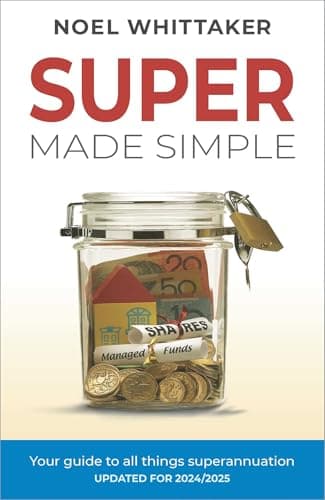
Super Made Simple
A focused, up-to-date guide to actually understanding your superannuation, from one of Australia's most trusted finance writers.
Girls That Invest
Simran Kaur

Girls That Invest
A no-jargon crash course from the podcaster behind Girls That Invest that makes the sharemarket feel doable, written especially for women starting out. The perfect first step before you buy your first ETF.
Some links above are affiliate links. If you buy through them, Snowball Invest may earn a small commission at no extra cost to you. We only recommend books we'd suggest anyway.
🧮 Salary Sacrifice Super Calculator
See how much tax you'd save by salary sacrificing extra into super at your income.
What is superannuation, in full
Choosing a fund, the government's performance test for bad funds, and what happens to your super when you change jobs.
Frequently asked questions
What is the Super Guarantee rate right now?
12% of your ordinary time earnings, the rate it's been at since 1 July 2025. There's no further legislated increase scheduled beyond that under current law.
What are the super contribution caps for 2026-27?
The concessional (before-tax) cap is $32,500 and the non-concessional (after-tax) cap is $130,000. Both are indexed and typically move most years, so check ato.gov.au for the exact current figure before making a large contribution.
What is payday super?
From 1 July 2026, employers generally have to pay your super each payday rather than quarterly, with funds required to receive it within a set number of business days. It's designed to stop unpaid super accumulating unnoticed.
What is Division 296 and does it affect me?
It's an extra tax on realised super earnings for people with a total super balance above $3 million. It passed parliament and commenced 1 July 2026. Unless your balance is well into seven figures, it doesn't apply to you.
When can I access my super?
Generally from your preservation age (60 for anyone born on or after 1 July 1964) once you retire, or from 65 regardless of work status. Earlier access is limited to specific circumstances like severe financial hardship or terminal illness.
What happens if I go over a contribution cap?
Excess concessional contributions are added back to your assessable income and taxed at your marginal rate, with a 15% offset for tax already paid in the fund. Excess non-concessional contributions can be taxed more heavily unless withdrawn. The ATO will contact you if this happens, it isn't something you need to self-monitor down to the dollar.
Sources
- 1. Key superannuation rates and thresholds, contributions caps, Australian Taxation Office
- 2. Super contributions, Moneysmart, Australian Securities and Investments Commission
- 3. Higher taxes on large super balances: key changes now legislated, Hall & Wilcox
- 4. Division 296 tax has passed parliament and will take effect from 1 July 2026, Grant Thornton Australia
Disclaimer
This is general information only, not financial or tax advice. Contribution caps, thresholds and tax rates mentioned here are indicative for 2026-27 and are indexed most years, they change. Confirm current figures at ato.gov.au or with a licensed financial adviser before making a contribution decision.