

What is an SMSF?
Quick answer
An SMSF, or Self-Managed Super Fund, is a private super fund you run yourself rather than through a retail or industry fund. You get full control over the investments, but you also take on the legal and compliance responsibility that a professional trustee would normally carry.
What SMSF stands for, and who regulates it
SMSF stands for Self-Managed Super Fund. It's regulated by the Australian Taxation Office, not APRA, which oversees retail and industry funds. That distinction matters in practice, the ATO isn't managing your fund day to day the way a professional trustee would, you are.
SMSFs are a meaningful slice of Australia's retirement savings system. ATO quarterly statistics put the number of SMSFs at over 670,000, holding upward of $1 trillion in combined assets, as at early 2026. Those figures update every quarter, so treat them as a rough scale indicator rather than a fixed number, and check the ATO's own SMSF statistics page for the latest published quarter.
How it actually works
With a regular fund, you contribute and a professional trustee manages the money. With an SMSF, you are both the member and the trustee. You choose the investments, keep the records, arrange the annual independent audit, and stay on top of super law compliance. An SMSF can have up to six members, and every member generally needs to be a trustee (or a director of the corporate trustee), so everyone genuinely shares the legal responsibility, not just the money.
You'll choose between two trustee structures when setting one up: individual trustees, where each member is personally a trustee (simpler and cheaper up front, but asset ownership may need updating whenever membership changes), or a corporate trustee, a special-purpose company where members are directors (more flexible for succession and membership changes, with its own small annual ASIC fee). Most advisers lean toward a corporate trustee for funds expecting to hold property or expecting membership to change over time.
What you can invest in
This is the main draw for people who set one up: ASX shares and ETFs, residential and commercial property (including borrowing to buy property through a limited recourse borrowing arrangement), term deposits, international shares, bonds, and even cryptocurrency with the right care. Every investment still has to satisfy the sole purpose test, the fund exists solely to provide retirement benefits to its members. You can't live in a property the fund owns, or otherwise get personal use out of fund assets today, even indirectly.
The mandatory annual audit, and what it costs
Every SMSF must be independently audited each year by an ASIC-registered SMSF auditor before you can lodge the fund's annual return, covering both the financial statements and compliance with super law.
Running an SMSF isn't free, and the costs are fixed regardless of your balance, which is the main reason size matters. Between the ATO supervisory levy, the independent audit, accounting and administration, and (if relevant) the small annual ASIC fee for a corporate trustee, a simple fund typically runs somewhere in the low thousands a year, more for a fund holding property or a borrowing arrangement. ATO data has put the median total running costs (including investment, insurance and borrowing costs, not just admin) somewhere around $9,000 to $10,000 a year, with admin and operating costs alone closer to half that. These figures come from ATO annual return statistics and shift from year to year, so treat them as a general order of magnitude and check the ATO's latest SMSF statistics release for the current number.
How much you need to start one
There's no legal minimum balance, ASIC dropped its old $500,000 rule-of-thumb guidance back in 2022. That said, ASIC is still clear that your starting balance is a key factor in whether an SMSF is cost-effective. In practice, once fixed running costs are weighed against a low-cost industry fund, balances well under roughly $200,000 tend to make the maths harder to justify, unless you're expecting a large contribution soon after setup or you're doing a lot of the admin yourself. It's genuinely worth running the numbers rather than assuming either way.
Same contribution caps as any other fund
An SMSF isn't a way to contribute more than anyone else, the same caps apply: concessional (before-tax) contributions up to $32,500 a year and non-concessional (after-tax) contributions up to $130,000 a year for 2026-27. Both figures are indexed and move most years, so check the current cap before making a large contribution.
Division 296 and large balances
From 1 July 2026, members with a total super balance above $3 million, across all their funds, face an additional tax on realised earnings attributable to the amount above that threshold, legislated as Division 296. It's a member-level tax based on your personal balance, not a fund-level tax, so most SMSF trustees with typical balances won't be affected. If your balance is approaching that range, it's a genuine factor to plan around.
Getting it wrong has real consequences
The ATO takes SMSF compliance seriously. Breaching the rules can mean administrative penalties per breach, the fund losing its concessional tax treatment (a non-complying fund can be taxed at 45% on its assets), or trustee disqualification. Using an accountant or adviser to help run the fund doesn't shift that legal responsibility away from you as trustee.
Is it actually right for you
An SMSF tends to suit people with a large enough balance for the fixed costs to make sense, a genuine desire for control over specific investments not available through a retail or industry fund (direct property being the classic example), and a willingness to spend real time on administration, trustees commonly spend several hours a month on their fund. If you want a set-and-forget retirement account, or your balance is modest and you're happy with a good industry fund's options, an SMSF is probably solving a problem you don't have.
📚 Recommended reading
Super Made Simple
Noel Whittaker
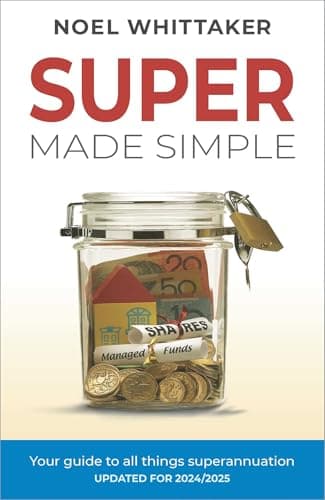
Super Made Simple
A focused, up-to-date guide to actually understanding your superannuation, from one of Australia's most trusted finance writers.
The Barefoot Investor
Scott Pape

The Barefoot Investor
Australia's best-selling money book ever. A simple system for accounts, budgeting, debt and a real emergency fund in one.
Some links above are affiliate links. If you buy through them, Snowball Invest may earn a small commission at no extra cost to you. We only recommend books we'd suggest anyway.
Frequently asked questions
Who regulates SMSFs?
The ATO regulates SMSFs. APRA regulates retail and industry super funds instead, and ASIC regulates financial advisers giving advice about setting one up.
Can I use my SMSF to buy a house to live in?
No. The sole purpose test rules out any personal use of fund assets. You can't live in a property your SMSF owns or otherwise benefit personally from fund assets today, breaching this carries serious penalties.
Can an SMSF borrow to buy property?
Yes, through a limited recourse borrowing arrangement (LRBA), a specific structure with strict rules where the property is held in a separate bare trust until the loan is repaid. It adds real complexity and cost, so it's not the right fit for every fund.
Do I need a financial adviser to set up an SMSF?
Not legally, but it's strongly recommended. Advisers are required to assess whether an SMSF genuinely suits your circumstances before recommending one, and the obligations are worth understanding properly before you commit either way.
How is an SMSF different from an industry super fund?
An industry fund is run by professional trustees for many members and has lower fixed costs at small balances plus automatic insurance. An SMSF is run by you (and up to five others), offering broader investment choice and control at the cost of significantly more time, expertise and compliance responsibility.
Can I wind up an SMSF later if I change my mind?
Yes, but it takes time and has costs, you need to sell or transfer assets, pay out member benefits, lodge a final return, and complete a final audit. Worth having a rough exit plan in mind from the start.
Related terms
Sources
Disclaimer
This is general information only, not financial, tax or legal advice. SMSF statistics, running costs and contribution caps mentioned here are indicative and change over time. Confirm current figures at ato.gov.au or moneysmart.gov.au, and get advice from a licensed financial adviser before setting up or running an SMSF.