

What is the Super Guarantee?
Quick answer
The Super Guarantee (SG) is the minimum percentage of your ordinary earnings your employer must pay into your super fund, on top of your salary rather than out of it. It's sat at 12% since 1 July 2025, the final legislated rate, and from 1 July 2026 employers must pay it every payday instead of quarterly.
What it is
Superannuation is Australia's compulsory retirement savings system, and the Super Guarantee is the law behind it, the minimum your employer is legally required to contribute on your behalf. It started at 3% back in 1992 and has climbed steadily since, reaching 12% on 1 July 2025, which is the final step under current legislation. There's no further increase scheduled beyond that.
Payday super: what changed from 1 July 2026
This is the biggest recent change to how SG actually gets paid. From 1 July 2026, most employers must pay your super every payday rather than waiting until the end of the quarter, and your fund generally needs to receive it within a handful of business days. It's designed to stop unpaid super sitting with employers for months at a time, and it gives you a much closer to real-time view of your balance rather than a quarterly surprise. Alongside this shift, the maximum super contribution base, the earnings ceiling above which employers aren't required to pay SG, moved from a quarterly figure ($62,500 a quarter in 2025-26) to a single annual cap of $270,830 for 2026-27.
Who's entitled
If you're 18 or older, you're entitled to SG regardless of how many hours you work, full-time, part-time and casual employees are all covered on the same basis. Under 18, you need to be working more than 30 hours a week to qualify. There's no minimum earnings threshold either, the old $450 a month rule was scrapped back on 1 July 2022. Some contractors count too, if your contract is mainly for your labour rather than a result or deliverable, you may legally be an employee for SG purposes even if you invoice as a sole trader.
What counts as ordinary time earnings
SG is calculated on your ordinary time earnings (OTE), which includes your base salary or wages for ordinary hours, paid leave, allowances for your normal duties, bonuses and commissions, shift loadings and over-award payments. It doesn't include overtime, or most termination payments and lump sums. Whether a job ad's headline salary includes super or sits on top of it changes what you actually take home, our Salary & Take-Home Pay Calculator lets you toggle that and see the difference.
A worked example
Jordan earns a $80,000 base salary with no overtime, so their annual OTE is $80,000. SG at 12% works out to $9,600 a year, or $2,400 a quarter, paid on top of the $80,000, not out of it. If Jordan also earns $5,000 in overtime that year, that portion is excluded from the SG calculation entirely, it only applies to ordinary earnings.
If your employer doesn't pay
Employers who miss a payment have to lodge a Superannuation Guarantee Charge (SGC) statement and pay three things: the unpaid super shortfall (calculated on a broader measure of salary and wages than OTE), nominal interest of 10% a year, and an administration fee of $20 per employee per quarter. Unlike a normal super contribution, the SGC itself isn't tax-deductible for the employer, which is part of why it's treated as a genuine penalty rather than just a late payment. If you suspect your employer isn't paying, you can report it through the ATO's tip-off channel.
Common misconceptions
"Super is included in my salary." Depends entirely on your contract, some packages are quoted inclusive of super, others have it paid on top, always check which one you're looking at. "Casual workers don't get super." Wrong, anyone 18 or over gets SG on their OTE regardless of employment type. "My employer can delay paying as long as it eventually arrives." No, there are strict due dates, and the SGC applies the moment a payment is late, regardless of intent. "Salary sacrificing reduces my employer's SG obligation." It shouldn't, SG is legally calculated on your ordinary time earnings before any salary sacrifice is deducted, so sacrificing more of your own pay shouldn't shrink your employer's compulsory contribution. Worth confirming with your employer regardless when you set an arrangement up.
📚 Recommended reading
Super Made Simple
Noel Whittaker
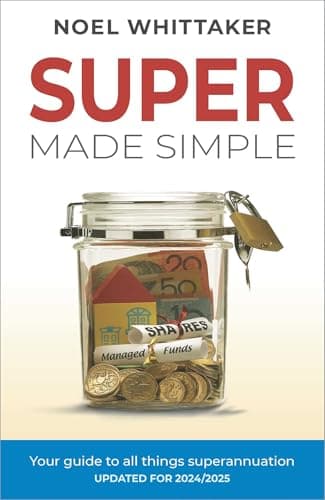
Super Made Simple
A focused, up-to-date guide to actually understanding your superannuation, from one of Australia's most trusted finance writers.
The Barefoot Investor
Scott Pape

The Barefoot Investor
Australia's best-selling money book ever. A simple system for accounts, budgeting, debt and a real emergency fund in one.
Some links above are affiliate links. If you buy through them, Snowball Invest may earn a small commission at no extra cost to you. We only recommend books we'd suggest anyway.
💵 Salary & Take-Home Pay Calculator
See exactly how much Super Guarantee you're entitled to, and whether your package includes it.
🏦 Salary Sacrifice Calculator
Model extra voluntary super contributions on top of your employer's compulsory SG.
What Is Superannuation? A Complete Beginner's Guide
The full picture of how super works, including contributions, tax and what happens when you change jobs.
Frequently asked questions
Is the Super Guarantee rate going up again after 12%?
No. 12% is the final legislated rate under current law, reached on 1 July 2025, with no further scheduled increase.
Do I get super as a casual employee?
Yes. Anyone 18 or over gets the Super Guarantee on their ordinary time earnings regardless of how many hours they work or whether they're casual, part-time or full-time.
What's the difference between the Super Guarantee and salary sacrifice?
The Super Guarantee is your employer's compulsory minimum contribution, paid on top of your salary. Salary sacrifice is voluntary, it's extra super you choose to redirect from your own pre-tax pay, arranged separately with your employer.
What if I think my employer hasn't paid my super?
Check your super fund's contribution history first, most funds show this in their app or online portal. If contributions look missing or short, raise it with your employer, and if it's still not resolved, report it to the ATO.
Related terms
Sources
Disclaimer
This is general information only, not financial or tax advice. Super Guarantee rates, thresholds and payday super mechanics are set by the government and reviewed regularly, the figures here reflect our understanding as of publication. Confirm current figures at ato.gov.au or with a licensed financial adviser before relying on them for a real decision.