

What is Concessional Contributions?
Quick answer
Concessional contributions are before-tax money going into your super, employer Super Guarantee, salary sacrifice, or personal contributions you claim a deduction for, taxed at a flat 15% inside the fund instead of your usual marginal rate. For 2026-27 the cap is $32,500 a year, covering all three types combined. If your marginal tax rate sits above 15%, which it does for almost everyone earning over roughly $18,200, every dollar you route through concessional contributions saves you tax, up to that cap.
What "concessional" means
Concessional, at a concession, a discount. Instead of being taxed at your marginal income tax rate, these contributions are taxed at a flat 15% once they land in your fund. On a $90,000 salary, where your combined marginal rate including the Medicare levy sits around 32%, a concessional contribution is taxed at 15% instead, a 17 cent saving on every dollar. The higher your income, the bigger that gap gets, up to the point Division 293 kicks in (more on that below).
The three types
- Employer Super Guarantee (SG). Compulsory, 12% of your ordinary time earnings for 2026-27, paid automatically by your employer, see our superannuation glossary page for how the broader system works.
- Salary sacrifice. You agree with your employer to redirect part of your pre-tax salary into super before income tax is calculated on it. See our salary sacrifice glossary page and Salary Sacrifice Calculator for the mechanics.
- Personal deductible contributions. If you're self-employed, a contractor, or your employer doesn't offer salary sacrifice, you can contribute from your own bank account and claim a tax deduction. You need to lodge a notice of intent to claim a deduction (ATO form NAT 71121) with your fund before lodging your tax return, and get it acknowledged first, otherwise the ATO treats it as a non-concessional contribution instead.
A common mix-up
Salary sacrifice is one type of concessional contribution, not the whole category. Employer SG and personal deductible contributions are the other two, and all three share the same annual cap. If your employer already pays $12,000 in SG on a $100,000 salary, that $12,000 comes out of your $32,500 cap before you've salary sacrificed a single dollar, leaving $20,500 of room, not the full cap.
The 2026-27 cap
The concessional contributions cap for 2026-27 is $32,500, up from $30,000 the year before, and it covers everything: SG, salary sacrifice, and personal deductible contributions combined, regardless of your age. It's indexed to average weekly ordinary time earnings and moves in $2,500 steps roughly every couple of years, so confirm the current figure at ato.gov.au before relying on it for a real decision. This is separate from the non-concessional (after-tax) contributions cap, which covers money you add from your own savings rather than before-tax income.
What it's worth, roughly
For 2026-27, Australian resident tax brackets are 0% up to $18,200, 15% from $18,201-$45,000, 30% from $45,001-$135,000, 37% from $135,001-$190,000 and 45% above $190,000, plus the 2% Medicare levy on most of that. Compare those combined rates against the flat 15% super pays and the saving becomes clear the higher you earn: on the $45,001-$135,000 band, you're swapping a 32% combined rate for 15%, roughly a 17 cent saving per dollar. On the top band, above $190,000, that gap widens to around 32 cents per dollar, though Division 293 (below) claws some of that back for higher earners.
Worked example: on a $90,000 salary, sacrificing an extra $10,000 into super instead of taking it as income saves roughly $1,700 in tax that year, the gap between the 32% combined marginal rate and the 15% contributions tax.
Division 293 tax, for high earners
If your income plus concessional contributions goes over $250,000, a threshold that's stayed fixed since 2017 with no indexation, the ATO applies an extra 15% tax on the contributions above that threshold, effectively 30% instead of 15% on that portion. Say you earn $240,000 and contribute the full $32,500 cap, that's $272,500 combined, $22,500 over the threshold, and 15% of that is $3,375 in extra tax. The ATO works this out and notifies you after your return is lodged, it's not something you calculate yourself upfront. See our Division 293 tax glossary page for a full worked example and how the tax is actually paid.
Carry-forward: catching up after a quiet year
If you haven't used your full cap in a previous year, you may be able to contribute more than the standard annual cap by using unused space carried forward from up to the previous five financial years, provided your total super balance was under $500,000 at the last 30 June. Unused amounts are used oldest first and expire after five years, so cap space from 2020-21 can no longer be carried forward from 1 July 2026 onward. It's a useful lever after a career break, a stretch of part-time work, or a lean year for a self-employed contributor. Run the numbers on our Salary Sacrifice Calculator before committing to a top-up amount.
Going over the cap
Excess concessional contributions get added to your assessable income and taxed at your marginal rate, with a 15% offset since the fund has already paid tax on it, so you're not double taxed, just topped up to your marginal rate. On a 32% marginal rate, a $5,000 excess costs an extra 17% of $5,000, or $850. The ATO sends an excess concessional contributions determination once it's worked out, and you can elect to release some of the excess from your fund to help pay the resulting tax bill.
📚 Recommended reading
Super Made Simple
Noel Whittaker
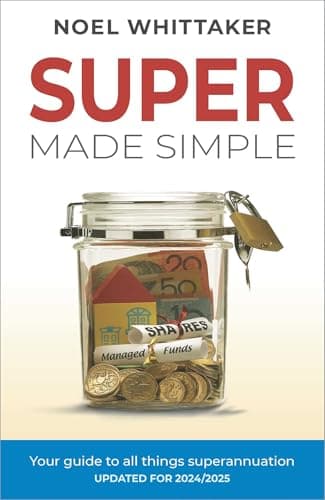
Super Made Simple
A focused, up-to-date guide to actually understanding your superannuation, from one of Australia's most trusted finance writers.
The Barefoot Investor
Scott Pape

The Barefoot Investor
Australia's best-selling money book ever. A simple system for accounts, budgeting, debt and a real emergency fund in one.
Some links above are affiliate links. If you buy through them, Snowball Invest may earn a small commission at no extra cost to you. We only recommend books we'd suggest anyway.
🏦 Salary Sacrifice Calculator
Model your own concessional contributions and see the real tax saving based on your income.
Concessional contributions cap, in full
What counts, how SG affects your room, exceeding the cap, and using carry-forward with a worked example.
Frequently asked questions
What's the difference between concessional and non-concessional contributions?
Concessional contributions are before-tax money, taxed at a flat 15% inside your fund. Non-concessional contributions are after-tax money you add from your own savings, with no further contributions tax. The non-concessional cap for 2026-27 is $130,000, though it drops to nil if your total super balance is at or above the general transfer balance cap, $2.1 million for 2026-27.
Can I claim a tax deduction for personal super contributions?
Yes, if you're eligible. Make the contribution from your own bank account, then lodge a notice of intent to claim a deduction (ATO form NAT 71121) with your fund before you lodge your tax return, and wait for the fund to acknowledge it. Skip that step and the contribution is treated as non-concessional instead.
What happens if I exceed the concessional cap?
The excess gets added to your assessable income and taxed at your marginal rate, with a 15% tax offset so you're not taxed twice on the same dollars. The ATO sends you an excess concessional contributions determination after you lodge your return, and you can elect to release some of the excess from your fund to help cover the extra tax.
Does employer Super Guarantee count toward my concessional cap?
Yes. Compulsory employer Super Guarantee (12% of your ordinary time earnings in 2026-27) counts toward the same $32,500 cap as salary sacrifice and personal deductible contributions. All three share one limit, not three separate ones.
Can I use the carry-forward rule after a career break?
Yes, if your total super balance was under $500,000 at the end of the previous financial year. You can carry forward unused concessional cap space from up to the previous five financial years, useful if you've had time off work, gone part-time, or been self-employed with lower contributions than usual.
Related terms
Sources
Disclaimer
This is general information only, not personal financial or tax advice. Contribution caps, tax rates and thresholds are indexed and can change each financial year, confirm the current figures at ato.gov.au or with a licensed financial adviser before making a contribution decision.