

Carry-Forward Concessional Contributions: The Catch-Up Rule Explained
Missed super contributions during part-time work or time off? How the carry-forward concessional contributions rule lets you catch up, and what it saves.
 By Timothy Hirou GaschereauPublished
 8 min read
Try it yourself
Most Australians don't max out their super contributions every year. Life gets in the way, part-time work, parental leave, a career break, a rough patch. The ATO doesn't just let that unused cap space disappear though, you can carry it forward and use it later. This is part of a wider guide to retirement and FIRE on Snowball Invest.
Quick answer
The carry-forward rule lets you roll unused concessional contributions cap space from the past five financial years into the current year, so you can make a bigger before-tax super contribution. You need a total super balance under $500,000 at 30 June of the previous financial year to be eligible. With the 2026-27 cap at $32,500 and five full years of unused space, you could theoretically contribute up to $175,000 in concessional contributions this year. No form is needed, the ATO applies it automatically.
In this guide
- →What concessional contributions are, and how the carry-forward rule works
- →The $500,000 total super balance rule that gates eligibility
- →How much carry-forward space you could actually have, year by year
- →A worked example showing the real tax saving
- →How to actually use it, step by step
🔄 What the carry-forward rule is
🎯 The essential: Unused concessional cap space from the past five years rolls forward automatically, oldest first, and expires if you don't use it within that window.
Concessional contributions are before-tax contributions to your super. They include employer contributions (the Super Guarantee, currently 12% of your ordinary earnings), contributions you arrange via salary sacrifice, and personal contributions you claim as a tax deduction. They're taxed at a concessional rate of just 15% inside your super fund, rather than your marginal tax rate, which could be 30%, 37% or even 45%.
The concessional contributions cap for 2026-27 is $32,500. Contribute more than that in a single year and you'll generally pay extra tax on the excess. But if you've got unused cap space from previous years, you may be able to go well above that limit, legally.
That's the carry-forward rule (sometimes called the catch-up rule). Here's the core mechanic:
- Each year, if your concessional contributions fall short of the annual cap, the unused portion accumulates.
- You can draw on that accumulated space in a future year to make a larger concessional contribution.
- The oldest unused cap is applied first, the ATO uses a first-in, first-out approach.
- Unused amounts expire after five years. If you don't use the space within five years of it accumulating, it's gone.
The rule has been available since 1 July 2018, so the earliest year that can feed into your 2026-27 carry-forward pool is 2021-22. There's no form to fill in, you just make the contribution, and the ATO applies carry-forward automatically when you exceed the annual cap, provided you're eligible.
🚪 Who can use it: the $500,000 rule
Your total super balance (TSB) must be under $500,000 at 30 June of the previous financial year. For 2026-27, that means your TSB at 30 June 2026 needs to be below $500,000. This threshold isn't indexed, it's been fixed at $500,000 since the rule began in 2018-19.
Your TSB is the combined value of all your super accounts, accumulation and pension phase, plus any rollovers in transit between funds at that date.
The rule is designed for people who've had interrupted super contributions, those who took time off to raise kids, worked part-time for a stretch, studied, or dealt with illness. It's also useful for anyone who simply had lower income in earlier years and couldn't afford to top up their super.
If your TSB goes above $500,000 at 30 June, you lose access to carry-forward for that year. But if it drops back below $500,000 at a future 30 June, you become eligible again.
🧮 How much carry-forward space could you have
The table below shows the annual concessional cap for each of the five years that feed into the 2026-27 carry-forward pool. If you made zero concessional contributions in any of these years, the full cap amount is available to carry forward.
| Financial year | Annual concessional cap | Last year to use this space |
|---|---|---|
| 2021-22 | $27,500 | 2026-27 (expires this year) |
| 2022-23 | $27,500 | 2027-28 |
| 2023-24 | $27,500 | 2028-29 |
| 2024-25 | $30,000 | 2029-30 |
| 2025-26 | $30,000 | 2030-31 |
| 2026-27 (current year cap) | $32,500 | - |
Important: the 2021-22 unused cap expires at 30 June 2027. If you haven't used it by then, it's gone, so this year is your last chance to access it.
Theoretical maximum for 2026-27: if you made zero concessional contributions in all five prior years and your TSB is under $500,000, you could contribute up to $175,000 in concessional contributions this year ($32,500 current year cap plus $142,500 in carry-forward space from 2021-22 through 2025-26).
To work out your actual available carry-forward space, log in to myGov, link to the ATO, then go to Super, Information, Carry forward concessional contributions. Your personalised figure is right there.
Five years of unused cap stack up automatically, ready to use in one big contribution later.
👩 Worked example: Sarah's catch-up contribution
Sarah is 42. For five years she worked part-time on a $60,000 salary, so her employer's Super Guarantee contributions (at 11% for those years, now 12%) were roughly $6,600 per year. She made no extra contributions. Her TSB at 30 June 2026 is $185,000, well under the $500,000 threshold.
Here's her accumulated carry-forward space heading into 2026-27:
| Financial year | Annual cap | Employer SG paid in | Unused cap |
|---|---|---|---|
| 2021-22 | $27,500 | $6,600 | $20,900 |
| 2022-23 | $27,500 | $6,600 | $20,900 |
| 2023-24 | $27,500 | $6,600 | $20,900 |
| 2024-25 | $30,000 | $6,600 | $23,400 |
| 2025-26 | $30,000 | $6,600 | $23,400 |
| Total carry-forward available | $109,500 |
In 2026-27, Sarah returns to full-time work on a $120,000 salary. Her employer will contribute around $14,400 in SG contributions. She decides to make a personal deductible contribution of $80,000 on top of that.
Her total concessional contributions for the year: $14,400 + $80,000 = $94,400. That's $61,900 above the standard $32,500 cap, but she has $109,500 in carry-forward space available, so she's well within her limit.
Sarah's marginal tax rate is 30% (plus 2% Medicare levy, a 32% effective rate on income in that bracket). Her $80,000 personal contribution is taxed at 15% inside super instead of 32% on her income:
| Without catch-up | With catch-up | |
|---|---|---|
| Extra $80,000 taxed at marginal rate (32%) | $25,600 tax | - |
| $80,000 taxed at 15% in super | - | $12,000 tax |
| Tax saving | ~$13,600 |
Tax rates vary by income. Higher earners may also pay Division 293 tax, an additional 15% on concessional contributions above $250,000 in income, so this example is illustrative and your own situation will differ.
🏖️ Retirement Income Calculator
See how a catch-up contribution like Sarah's plays out for your own retirement income.
🛠️ How to actually use it
Step 1: check your available carry-forward balance. Log in to myGov, ATO online services, Super, Information, Carry forward concessional contributions. This shows your unused cap amounts year by year and confirms whether you're eligible based on your TSB.
Step 2: make the contribution. You have two main options: arrange salary sacrifice with your employer to redirect pre-tax salary directly into your super fund, or make a personal deductible contribution by transferring money from your bank account into your fund and claiming a tax deduction in your tax return. Both count as concessional contributions, and both trigger the carry-forward rule automatically if you exceed the standard cap. Use our salary sacrifice calculator to model what a catch-up contribution actually costs your take-home pay.
Step 3: lodge a Notice of Intent (for personal deductible contributions). If you're making a personal contribution and want to claim a tax deduction, you must lodge a Notice of Intent to Claim or Vary a Deduction for Personal Super Contributions with your super fund before you lodge your tax return (or before you withdraw or roll over the funds, whichever comes first). Your fund will confirm receipt, then you claim the deduction in your tax return.
Step 4: let the ATO do its thing. You don't need to notify the ATO or your super fund about carry-forward. Once your contributions exceed the annual cap, the ATO automatically applies your unused cap amounts from prior years, oldest first, when it processes your tax return.
If you're also making after-tax (non-concessional) contributions, it's worth checking whether you're eligible for the super co-contribution, a free government top-up of up to $500 for lower-to-middle income earners. It's a separate scheme to carry-forward, but the two can work well together.
SnowLetter
Australia's money news and our best reads, once a week.
❓ Frequently asked questions
Can I use carry-forward contributions if my super balance is over $500,000?
+
No. If your total super balance was $500,000 or more at 30 June of the previous financial year, you can't access carry-forward concessional contributions that year. The threshold is fixed, it doesn't move with inflation. If your balance later drops below $500,000 at a future 30 June, you become eligible again for that year.
Do unused concessional contributions roll over automatically?
+
Yes, the accumulation of unused cap space is automatic. You don't need to do anything to bank unused amounts. The ATO tracks it based on contributions reported by your super fund, and you can view your accumulated unused cap at any time via myGov.
What happens if I exceed the concessional contributions cap?
+
If you go over your cap, including any carry-forward space you're eligible to use, the excess is included in your assessable income and taxed at your marginal rate. You get a 15% tax offset to account for the contributions tax already paid inside your fund, and your fund may release money to help you pay the tax bill. Excess concessional contributions also count towards your non-concessional contributions cap, so it's worth getting the numbers right before you contribute.
Can I use carry-forward contributions through salary sacrifice?
+
Yes. Salary sacrificing into super is one of the most straightforward ways to use carry-forward space. Your employer directs pre-tax salary into your fund, and if your total concessional contributions for the year exceed the standard cap, the ATO automatically applies your carry-forward balance. Just make sure your total concessional contributions, employer SG plus salary sacrifice, don't exceed your available cap.
Does the carry-forward rule apply to non-concessional contributions?
+
No. The carry-forward rule only applies to concessional (before-tax) contributions. Non-concessional contributions have their own separate mechanism, the bring-forward rule, which lets you contribute up to three years' worth of after-tax contributions in a single year, with its own eligibility thresholds.
📚 Recommended reading
Super Made Simple
Noel Whittaker
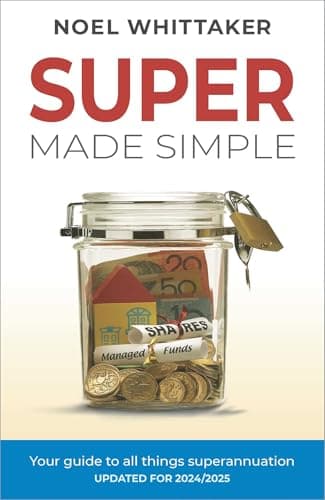
Super Made Simple
A focused, up-to-date guide to actually understanding your superannuation, from one of Australia's most trusted finance writers.
Retirement Made Simple
Noel Whittaker

Retirement Made Simple
Australia's godfather of personal finance demystifies super, the pension and making your savings last. The plain-English retirement handbook every Aussie should read before they stop working.
Die With Zero
Bill Perkins
Die With Zero
Stop hoarding cash for a someday that never comes. Perkins makes the case for spending on experiences while you are still young enough to enjoy them.
Some links above are affiliate links. If you buy through them, Snowball Invest may earn a small commission at no extra cost to you. We only recommend books we'd suggest anyway.
Sources
Was this article useful?
Put it to your own numbers
Every calculator runs entirely in your browser, with nothing stored. See what these numbers look like for your own situation.
Try the Super Contributions calculator →General information only. This article is educational and does not constitute personal financial advice. It does not account for your circumstances. Consider your own situation and seek advice from a licensed adviser before acting. Read our full disclaimer.

Timothy Hirou Gaschereau
Founder of Snowball Invest, not a financial adviser.
I write about what I'm learning myself, because nobody ever taught us how to take control of our own money. It's a skill, not a mystery, and it's never too late to learn it. The best day to start was yesterday, the second best is today.
LinkedIn →Related articles

Salary Sacrifice Super: How It Works (And Is It Worth It?)
How salary sacrificing into super actually reduces your tax bill, the concessional cap limit to watch, and whether it's worth it for your situation.

Concessional vs Non-Concessional Super: The Plain-English Guide
Concessional or non-concessional super contributions? The real difference, the 2025-26 caps, the tax treatment, and which one suits you, in plain English.

How Much Super Do You Need to Retire in Australia?
Real Australian retirement benchmarks, not a guess, how the Age Pension fits in, and how to work out your own number for a comfortable retirement.