

Unshakeable by Tony Robbins: An Honest Review
Our honest Unshakeable review for Australians: Tony Robbins and Peter Mallouk's stay-invested, low-fee playbook, its US-centric limits, and the super-fee angle.
 By Timothy Hirou GaschereauPublished
 9 min read
The short version: Unshakeable gets the big ideas right (stay invested, keep fees low, don't panic) but it's US-centric, a bit repetitive, and won't tell experienced investors anything they don't already know. Worth a read if you're new to investing or prone to selling when markets drop. It's part of our personal finance book reviews on Snowball Invest.
Quick answer
A short, accessible investing book by Tony Robbins and financial adviser Peter Mallouk, aimed squarely at everyday investors who need a mindset reset, not a technical deep-dive. If you check your portfolio every time the ASX dips and feel the urge to sell everything, this book is for you. If you've read widely on index investing, most of it will be familiar, and Australians will need to translate the US-specific content. Our rating: 3.5 out of 5.
Want to read Unshakeable?
Tony Robbins distils interviews with top investors into calm rules for staying invested when markets get scary.
In this guide
- →What the book is about: stay invested, low fees, index funds and psychology
- →The genuine strengths and the honest weaknesses
- →Who it's for, and who already knows this
- →What critics and r/Bogleheads readers say
- →The Australian angle: super fees, ASX ETFs and don't-panic-sell
📖 What is Unshakeable about?
Unshakeable is the shorter, more accessible follow-up to Tony Robbins's earlier 600-page tome Money: Master the Game. Published in 2017 and clocking in at around 250 pages, it was co-authored with Peter Mallouk, a US-based financial adviser, and distils the big ideas from Robbins's interviews with some of the world's most prominent investors into a readable playbook. The core messages are straightforward:
- Stay calm and stay invested during corrections and crashes; they're normal, and panic-selling is the real wealth destroyer.
- Fees matter enormously: even a 1% difference in annual fees compounds into a huge gap over decades, so avoid expensive actively managed funds.
- Low-cost index funds are the smart choice for most investors, outperforming the majority of active funds over the long run.
- Asset allocation and diversification protect you and smooth out volatility.
- Investor psychology is the biggest obstacle: fear, greed and recency bias cause more damage than any crash.
- Insights from top investors are woven throughout, giving the book credibility beyond Robbins's own voice.
It's a breezy read; most people finish it in a weekend.
⚖️ Strengths and weaknesses
What it gets right
- ✓Short and accessible: it won't intimidate anyone, and the plain-English writing moves quickly.
- ✓The core message on fees is powerful, hammering home how much investors lose to high-fee active funds over a lifetime.
- ✓Behavioural finance is handled well: the sections on why we panic-sell and how to override those instincts genuinely earn their keep.
- ✓Index fund and diversification principles are reinforced clearly, explaining the 'why' compellingly.
- ✓Ideal for nervous investors, and a solid first book to hand someone terrified of investing.
- ✓Peter Mallouk adds real credibility as a credentialled practitioner, not just a self-help author.
Where it falls short
- ✕Heavily US-centric: Roth IRAs, 401(k)s and US tax rules that don't apply in Australia.
- ✕Repetitive, especially if you've read Money: Master the Game, which covers much of the same ground.
- ✕The promotional tone is a real issue: it can read as a long advertisement for the co-author's advisory firm, whose fees are high relative to low-cost alternatives.
- ✕The preachy motivational style won't suit everyone (Robbins is a life coach at heart).
- ✕Light on actionable detail for experienced investors, who'll mostly nod along.
- ✕The classic 'miss the 10 best days' anti-timing argument is more nuanced than the book suggests, and critics note it cuts both ways.
👤 Who should read it, and who should skip it?
Read it if you
- ✓Are a first-time investor who wants a confidence boost and a clear framework before you start.
- ✓Panic-sold during a downturn (the COVID crash, anyone?) and want to understand why that was a mistake.
- ✓Are a nervous investor who needs permission to stay the course rather than chase the news cycle.
- ✓Want to understand why fees matter before choosing a super fund or ETF.
Skip it if you
- ✕Are an experienced investor who already understands index funds, diversification and behavioural finance.
- ✕Have already read Money: Master the Game and found it thorough.
- ✕Want specific, local guidance on super, ETFs or the Australian tax system.
🔍 What do critics say?
Critical reception has been mixed but generally positive. The most pointed and well-known critique framed the book as "the right diagnosis, the wrong prescription": Robbins correctly identifies the major problems in the financial industry (conflicts of interest, emotional errors, high fees, the value of low-cost funds), but the recommended implementation, using the co-author's advisory service, is expensive relative to low-cost automated alternatives. The fair conclusion: buy the book, take the advice to heart, but shop around for a cheaper way to implement it. On the positive side, the book was a major bestseller and reflects genuine reader enthusiasm, even where the critical reception was more measured.
💬 What do readers say? Goodreads and Reddit
On Goodreads it holds around 4 out of 5 from tens of thousands of ratings, with the large majority giving it four or five stars, a solid score for a finance book. The Reddit picture is more nuanced: r/personalfinance tends to find it oversimplified rather than revolutionary, and r/Bogleheads notes it largely repackages mainstream index-investing advice (index funds, avoid fees, diversify, don't time the market), though some call it exceptional as a first introduction.
The pattern is consistent everywhere: beginners love it, experienced investors find it thin. If you've never encountered these ideas, it can genuinely change how you invest; if you have, it's a fast refresher rather than new material.
🇦🇺 The Australian angle
The honest summary for Australian readers:
- The core message translates perfectly. Stay invested, keep fees low, use broad market index funds, don't panic-sell. That applies just as much to an Australian buying ASX ETFs as to an American with a 401(k), and the behavioural lessons are universal.
- The account types don't translate at all. Every time Robbins mentions a Roth IRA or 401(k), mentally substitute "superannuation" or "concessional contributions." The tax advantages and rules are different.
- The fee message is especially relevant here. Many Australians are still in higher-fee super funds, and ASIC's MoneySmart has repeatedly shown how even small fee differences compound into tens of thousands of dollars over a working life. Robbins's fee-awareness message lands hard in that context.
- Low-cost ASX ETFs are the local equivalent of what Robbins champions, broad market funds tracking indices like the S&P/ASX 200 or global markets, from providers such as Vanguard, BetaShares and iShares.
- The "don't panic-sell" lesson is timeless, whether it's the GFC, the COVID crash of March 2020, or the next correction nobody can predict. Our piece on financial anxiety covers why that instinct feels so strong in the moment.
For the low-fee index philosophy from its original source, our Little Book of Common Sense Investing review goes deeper, and for the behaviour side, our Psychology of Money review is a stronger, less promotional read.
💰 The verdict
Unshakeable is a genuinely useful book for the right reader. The core message is sound: stay invested, keep fees low, use index funds, and don't let fear drive your decisions. For a nervous first-time investor or someone who's been burned by panic-selling, it could be one of the most valuable short reads they pick up. But it has real limitations: experienced investors will find little new, Australians will spend a chunk of it mentally translating US-specific content, and the promotional undertone is hard to ignore once you notice it. Read it if you're new to investing or need a mindset reset; skip it if you're already across the basics or you've read Money: Master the Game. Our rating: 3.5 out of 5.
Want to read Unshakeable?
Prone to panic when markets drop? Grab a copy for the mindset reset, and take the low-fee message to heart.
SnowLetter
Australia's money news and our best reads, once a week.
❓ Frequently asked questions
Is Unshakeable worth reading for Australians?
+
Yes, with caveats. The core principles (stay invested, keep fees low, use index funds, don't panic) apply directly to Australian investors. But the book is heavily US-centric, with references to account types like Roth IRAs and 401(k)s that don't exist here, so you'll need to translate those into Australian equivalents like super and concessional contributions. Go in knowing that and it's a worthwhile read, especially for beginners.
How does it compare to Money: Master the Game?
+
Unshakeable is essentially a condensed, more accessible version. Where Money runs to around 600 pages and goes deep on strategy and interviews, Unshakeable is around 250 pages and focuses more on mindset and core principles. If you've read Money: Master the Game, Unshakeable covers much of the same ground. If you haven't read either, Unshakeable is the better starting point.
Who is Peter Mallouk?
+
Peter Mallouk is a US-based financial adviser and co-author of Unshakeable. He founded and leads Creative Planning, one of the larger registered investment advisory firms in the US, and has been recognised as a top adviser by industry publications. His involvement gives the book's investing content more practical credibility than a solo Robbins project would carry.
Is the investing advice sound?
+
The broad principles are solid and well-supported: low-cost index funds outperform most active funds over time, fees compound significantly, diversification reduces risk, and emotional decision-making is the biggest threat to returns. Where critics push back is on the implementation, specifically the nudge toward a particular advisory service whose fees are high relative to low-cost alternatives. The diagnosis is good; the prescription is debatable.
What is the main message?
+
That financial freedom comes from staying calm and invested through market volatility, keeping fees as low as possible, using diversified low-cost index funds, and not letting fear or greed drive your decisions. Robbins argues that corrections and crashes are normal and predictable in their occurrence (if not their timing), and represent opportunities rather than disasters for long-term investors who stay the course.
Is it good for beginners?
+
Yes, it's one of the better beginner investing books: short, plain-English, and focused on the mindset and principles that matter most for new investors. The behavioural finance sections are particularly useful. Just be aware the US-specific content won't apply directly here, and experienced investors will find it too basic.
📚 Get the book (and two stronger companions)
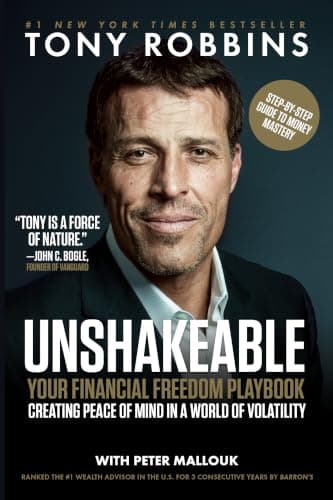
Unshakeable
Tony Robbins
Unshakeable
Tony Robbins distils interviews with top investors into calm rules for staying invested when markets get scary. Skip his US fund and tax specifics and keep the mindset: low fees, long horizon, and don't panic-sell your super.
The Psychology of Money
Morgan Housel
The Psychology of Money
19 short stories on how people actually think and feel about money, not just the maths of it.
Some links above are affiliate links. If you buy through them, Snowball Invest may earn a small commission at no extra cost to you. We only recommend books we'd suggest anyway.
Sources
Was this article useful?
Put it to your own numbers
Every calculator runs entirely in your browser, with nothing stored. See what these numbers look like for your own situation.
Explore the calculators →General information only. This article is educational and does not constitute personal financial advice. It does not account for your circumstances. Consider your own situation and seek advice from a licensed adviser before acting. Read our full disclaimer.

Timothy Hirou Gaschereau
Founder of Snowball Invest, not a financial adviser.
I write about what I'm learning myself, because nobody ever taught us how to take control of our own money. It's a skill, not a mystery, and it's never too late to learn it. The best day to start was yesterday, the second best is today.
LinkedIn →Related articles

Millionaire Teacher by Andrew Hallam: An Honest Review
Our honest Millionaire Teacher review: Andrew Hallam's nine rules of index investing, the strengths, the caveats, and how it translates for Australian investors.

Money Master the Game by Tony Robbins: An Honest Review
Our honest Money Master the Game review for Australians: Tony Robbins's 7-step plan, the sound core message on fees and index funds, and the US-heavy padding.

The Simple Path to Wealth Review: JL Collins for Australians
Our honest Simple Path to Wealth review for Australians: what JL Collins gets right, what doesn't apply here, and how to use the philosophy with local ETFs and super.