

The $1000 Project by Canna Campbell: An Honest Review
Our honest review of The $1000 Project by Canna Campbell: the $1,000 parcel method, dividend investing, the strengths, the limits, and who it's for.
 By Timothy Hirou GaschereauPublished
 9 min read
Short version: a warm, motivating read for Australian beginners who need a push to start investing, built around one genuinely clever idea. If you're already past the basics, you'll outgrow it fast. Canna Campbell, the Sydney-based financial planner behind SugarMamaTV, published this through Penguin in 2018. It's part of our personal finance book reviews on Snowball Invest.
Quick answer
A motivational mindset book with a genuinely Australian focus, built around a clever behavioural trick: save or earn money in $1,000 parcels, then invest each one into dividend-paying ASX shares or ETFs. Best for beginners who feel overwhelmed and need a simple framework to start. Not an investing manual, but a great first step. Our rating: 3.5 out of 5.
Want to read The $1000 Project?
Canna Campbell's cult-favourite challenge: saving and investing in $1,000 chunks that quietly transform your finances.
In this guide
- →What the book is about: the $1,000 parcel method and dividend investing
- →The genuine strengths and the honest weaknesses
- →Who it's for, and who's better off elsewhere
- →What critics and readers say
- →The Australian angle: ASX shares, franking credits and super
📖 What is The $1000 Project about?
The premise is simple. You save or earn money in discrete $1,000 blocks (Canna calls them "parcels") by cutting expenses, picking up side hustles, or redirecting windfalls. When a parcel hits $1,000, you invest it. Repeat until you've built a portfolio that generates meaningful passive income. Canna reports using this method to save around $32,000 in twelve months, aiming to build a portfolio of blue-chip Australian shares and ETFs that generates passive dividend income (the book's maths assumes roughly a 5% dividend yield).
The book also touches on debt recycling, super optimisation and, above all, the psychology of small wins. That last part is where it really shines. The $1,000 milestone is small enough to feel achievable but big enough to matter, and it's a neat real-world example of setting a financial goal you can actually track. It's a behavioural design trick, and it works. Canna Campbell is a licensed financial planner and founder of the advisory firm SASS Financial, and she launched SugarMamaTV after spotting a gap in accessible, relatable financial education for everyday Australians. The book draws directly from that work and from running the project herself. One caveat up front: it was published in 2018, so super caps, tax thresholds and market conditions have shifted. Always verify current figures with the ATO and ASIC MoneySmart before acting on any numbers in it.
⚖️ Strengths and weaknesses
What it gets right
- ✓Genuinely Australian: ASX blue-chip shares, dividend investing, franking credits and super, not a US export needing translation.
- ✓The $1,000 parcel concept is psychologically smart: a specific target, a separate account, and a clear action when you hit it.
- ✓Canna's voice is warm and relatable: she writes the way she talks, encouraging and jargon-free.
- ✓The side hustle and expense-cutting ideas are actionable and make you want to try them.
- ✓It covers dividend reinvestment and compounding clearly, a genuine lightbulb moment for beginners.
- ✓A great entry point: if you've been meaning to start for years and haven't, this might get you moving.
Where it falls short
- ✕Light on investment mechanics: it assumes a 5% yield without explaining how to select shares or ETFs, or evaluate risk.
- ✕Some readers find it repetitive: the core idea is introduced early and revisited often.
- ✕It's dated: 2018 super caps and thresholds have changed, so check every number.
- ✕The $1,000 parcel can feel slow or impractical for readers on low incomes or carrying significant debt.
- ✕Debt management gets a light touch, with no structured repayment framework.
- ✕Not for intermediate or advanced investors who already know ETFs, franking and super.
👤 Who should read it, and who should skip it?
Read it if you
- ✓Are a complete beginner who feels overwhelmed and needs a simple, motivating framework.
- ✓Have been putting off starting for months or years and need a psychological push.
- ✓Are a fan of Canna Campbell's SugarMamaTV content and want the ideas in book form.
- ✓Want an Australian-specific starting point, not a US book that doesn't apply here.
Skip it if you
- ✕Already understand ASX dividend investing, ETFs and portfolio construction.
- ✕Have significant high-interest debt and need a structured repayment plan first.
- ✕Want deep investment mechanics, share-selection criteria or portfolio theory.
- ✕Need an up-to-date reference (the 2018 figures need checking).
🔍 What do critics say?
Australian personal finance media and reviewers broadly welcomed the book as an accessible, motivating starting point, often described as a kind of "diet and exercise plan for your finances" thanks to its habit-building angle and quick, visible wins. The recurring critical notes: some find the content repetitive, some want more specificity on share selection, and a few feel the framing can be insensitive to readers in genuinely difficult financial situations by making financial freedom look more straightforward than it is for many people.
💬 What do readers say?
Reader reception is generally positive, especially among beginners, who praise how easy it is to read and how motivating the framework feels. The book's biggest fans tend to be people it actually got moving: the $1,000 milestone gave them a concrete target and a reason to follow through. The more critical reviews come from readers who already knew the basics and wanted more on the how, particularly share and ETF selection.
Treat it as a motivational framework, not a complete financial system. It's very good at getting you started and building a savings-and-investing habit. It's not designed to teach you how to build a robust, diversified portfolio, so pair it with a mechanics-focused resource once the habit is in place.
🇦🇺 The Australian angle
This is where the book genuinely earns its place. Most popular personal finance books are written for an American audience, with a different tax system and different investment vehicles. Canna Campbell writes specifically about ASX blue-chip shares, dividend income and what she cheerfully calls "juicy franking credits." That last point matters: when an Australian company pays tax on its profits, it can attach those credits to the dividends it pays shareholders, and depending on your marginal tax rate those credits can meaningfully boost your after-tax return, sometimes even generating a refund. And if the compounding lightbulb moment is what got you, our guide to how compound interest works spells out the maths.
The book also covers super optimisation, another distinctly Australian topic. Just be aware the super figures are from 2018 and several thresholds have changed since, so treat that content as a conceptual introduction and verify every number with the ATO or ASIC MoneySmart. For the dividend-income side specifically, our Motivated Money review goes deeper on the philosophy of living off a growing dividend stream.
💰 The verdict
The $1000 Project is a warm, motivating entry point for Australian beginners. The $1,000 parcel idea is genuinely clever, and the Australian focus (real talk about ASX shares, dividend income, franking credits and super) is a real differentiator from the US-centric books that dominate the shelf. But it's a mindset book more than an investing manual. It will get you started; it won't teach you how to build a robust portfolio, evaluate risk or select ETFs, and intermediate readers will outgrow it quickly. Our recommendation: read it if you need the motivation to take that first step, then pair it with a more mechanics-focused resource to get the full picture. Our rating: 3.5 out of 5.
Want to read The $1000 Project?
Need a nudge to actually start? Grab a copy and save your first $1,000 parcel.
SnowLetter
Australia's money news and our best reads, once a week.
❓ Frequently asked questions
Is The $1000 Project worth reading for Australian investors?
+
Yes, for beginners. It's one of the few personal finance books written specifically for an Australian context, covering ASX shares, dividend investing, franking credits and super. If you're already comfortable with those topics, you'll find it light on new information.
What is the $1,000 parcel method?
+
The core idea is to save or earn money in discrete $1,000 blocks outside your regular income (by cutting expenses, side hustles or redirecting windfalls), then invest each block into dividend-paying assets. The goal is to build a portfolio that generates passive income over time. Canna reports using this method to save around $32,000 in a year.
Does the book cover franking credits and superannuation?
+
Yes, both. It explains how Australian dividend income can come with franking credits (tax offsets attached to dividends from companies that have already paid Australian company tax) and gives general guidance on making super work harder. Note the figures are from 2018 and should be verified with the ATO and ASIC MoneySmart.
Is Canna Campbell a licensed financial adviser?
+
Yes. Canna Campbell is a licensed financial planner and the founder of the advisory firm SASS Financial, as well as the founder of SugarMamaTV. That professional background sits behind the book's content, though the book itself is educational rather than personalised advice.
How does it compare to The Barefoot Investor?
+
Both are Australian-specific and beginner-friendly. The Barefoot Investor goes deeper on practical money management, banking structure and debt elimination. The $1000 Project is more focused on the psychology of saving and the mechanics of dividend investing. They complement each other well.
Is the book still relevant today?
+
The core concept, the psychology of small wins, and the Australian focus on dividend investing and franking credits are all still relevant. The specific numbers (super caps, tax thresholds, assumed yields) are dated and need verifying with current ATO and ASIC MoneySmart guidance. Treat it as a motivational and conceptual framework, not a current tax or investment reference.
📚 Get the book (and two Aussie companions)
The $1000 Project
Canna Campbell
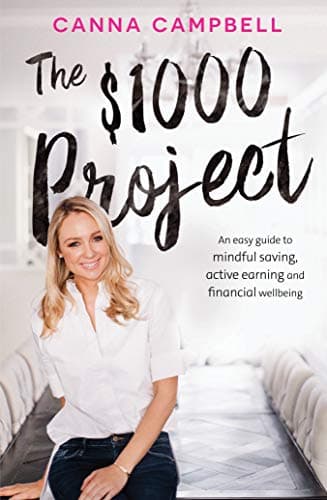
The $1000 Project
Canna Campbell's cult-favourite challenge shows how saving and investing in $1000 chunks can quietly transform your finances. Motivating, doable, and built for real Aussie budgets.
Motivated Money
Peter Thornhill
Motivated Money
Peter Thornhill's cult-favourite case for living off fully franked dividends instead of chasing capital gains. A calm, contrarian Aussie take that has quietly built a big following of long-term investors.
The Barefoot Investor
Scott Pape
The Barefoot Investor
Australia's best-selling money book ever. A simple system for accounts, budgeting, debt and a real emergency fund in one.
Some links above are affiliate links. If you buy through them, Snowball Invest may earn a small commission at no extra cost to you. We only recommend books we'd suggest anyway.
Sources
Was this article useful?
Put it to your own numbers
Every calculator runs entirely in your browser, with nothing stored. See what these numbers look like for your own situation.
Explore the calculators →General information only. This article is educational and does not constitute personal financial advice. It does not account for your circumstances. Consider your own situation and seek advice from a licensed adviser before acting. Read our full disclaimer.

Timothy Hirou Gaschereau
Founder of Snowball Invest, not a financial adviser.
I write about what I'm learning myself, because nobody ever taught us how to take control of our own money. It's a skill, not a mystery, and it's never too late to learn it. The best day to start was yesterday, the second best is today.
LinkedIn →Related articles

Rich Dad Poor Dad Review: The Good, the Bad, and the Australian Reality
Our honest Rich Dad Poor Dad review: what Robert Kiyosaki gets right, the real criticisms, and why Australians need to read it with a very specific filter.

The Simple Path to Wealth Review: JL Collins for Australians
Our honest Simple Path to Wealth review for Australians: what JL Collins gets right, what doesn't apply here, and how to use the philosophy with local ETFs and super.

Motivated Money by Peter Thornhill: An Honest Review
Our honest Motivated Money review: Peter Thornhill's dividend-income philosophy, the strengths, the real criticisms, and who this Aussie investing classic is for.