

Rich Dad Poor Dad Review: The Good, the Bad, and the Australian Reality
Our honest Rich Dad Poor Dad review: what Robert Kiyosaki gets right, the real criticisms, and why Australians need to read it with a very specific filter.
 By Timothy Hirou GaschereauPublished
 11 min read
Rich Dad Poor Dad has sold tens of millions of copies and changed how a lot of people think about money. It's also one of the most criticised finance books ever written. So is it actually good advice, especially for Australians? Here's the honest, both-sides verdict. It's part of our personal finance book reviews on Snowball Invest.
Quick answer
Read it once, with your critical-thinking hat firmly on. Rich Dad Poor Dad is a genuinely useful mindset book dressed up as a financial manual. The mindset shift is real. The specific advice is vague, often unverifiable, and built entirely around US tax law that does not exist here. Our rating: 3 out of 5.
Want to read Rich Dad Poor Dad?
Worth a single read for the mindset shift. Borrow it from the library or grab a cheap copy.
In this guide
- →What the book is actually about, and the assets vs liabilities idea
- →What it gets right, and the real, well-documented criticisms
- →Who it's for, and who should skip it
- →What critics and readers say, on Goodreads and Reddit
- →The Australian angle: which parts translate, and which really don't
📖 What is Rich Dad Poor Dad actually about?
Published in 1997, the book is built on a story: Kiyosaki had two father figures. His biological father (Poor Dad) was highly educated, worked hard, and believed a good job and a steady salary were the path to security. His mentor (Rich Dad) was a self-made businessman who believed the wealthy don't work for money, they make money work for them.
The core framework rests on one distinction: assets put money in your pocket, liabilities take money out. A house you live in is a liability. A rental property generating income is an asset. Your salary is not wealth. Wealth is what keeps growing when you stop working. From there Kiyosaki builds the "Rat Race" idea: most people earn a salary, pay tax, spend on liabilities, and never build real wealth. The escape route, he argues, is financial education, passive income, and thinking like an owner rather than an employee. It's a punchy idea. Whether the execution holds up is a different question.
Kiyosaki's escape hatch: buy assets that pay you whether you clock on or not.
⚖️ Strengths and weaknesses
For all its flaws, the book lands some genuinely useful punches, and it also has serious, well-documented problems. Both are worth knowing.
What it gets right
- ✓The mindset shift from employee to owner is a genuine wake-up call for a lot of readers.
- ✓Assets vs liabilities is the clearest beginner framework around, even if oversimplified.
- ✓It's right that schools teach almost nothing about investing, tax or compounding.
- ✓'Pay yourself first' is old advice, but the book makes it stick for beginners.
- ✓It gets people who never questioned the 'get a job, save, retire' script to start thinking.
Where it falls short
- ✕The advice is vague to the point of uselessness: 'buy assets', but which, how, with what?
- ✕The 'Rich Dad' character is likely fictional, per John T. Reed's detailed analysis.
- ✕The real-estate anecdotes (no money down, huge returns) are unverifiable and likely embellished.
- ✕It dismisses index investing and steady employment, which the evidence does not support.
- ✕Much of the tax strategy is US-specific and simply does not exist in Australia.
- ✕The brand has run pricey seminars that drew regulatory scrutiny and consumer warnings.
👤 Who should read it, and who should skip it?
Read it if
- ✓You're new to financial thinking and have never questioned the conventional script.
- ✓You're 16 to 25 and building your financial worldview from scratch.
- ✓You want a mindset reset and a reason to start caring about how money works.
- ✓You've heard about it for years and want to understand the fuss.
Skip it or read it critically if
- ✕You want specific, actionable investing steps you can follow this week.
- ✕You're already financially literate on investing, tax and compounding.
- ✕You want Australian-specific advice on super, ETFs or property.
- ✕You've already read it once and got the mindset shift. No need for a second lap.
🔍 What do critics say about Rich Dad Poor Dad?
The critical consensus is consistent: it's motivational, not instructional. The most comprehensive critique is by real-estate author John T. Reed, who went through the book chapter by chapter and documented what he considered factual errors and dangerous advice, concluding that "Rich Dad" is likely a fictional character and the book should be read as a motivational fable rather than a financial guide.
Forbes has noted that one of Kiyosaki's companies (a corporate entity, not Kiyosaki personally) filed for bankruptcy in 2012, which sits awkwardly against a brand built on teaching wealth. Financial planners have raised concerns about the book promoting heavy leverage without adequate risk disclosure, and consumer advocates have flagged the seminar ecosystem around the brand, where cheap introductory events upsell into courses costing many thousands of dollars. None of this makes the book worthless. It means you should read it like you'd watch a motivational speaker: appreciate the energy, stay sceptical about the specifics.
💬 What do readers say? Goodreads and Reddit
On Goodreads the book sits at around 4.1 out of 5 from more than 700,000 ratings, which reflects its real impact on how people think about money. Dig into the reviews and a pattern appears fast: the 5-star reviews praise the mindset shift ("changed how I think about money"), and the 1-star reviews call it vague, repetitive, and a sales pitch for expensive courses ("lots of inspiration, zero actionable advice").
The most common framing on r/AusFinance is something like: "Good for a 16-year-old who's never thought about money before, not a financial plan." The community recommends it as a starting point, with a firm warning not to take the specific advice literally, especially the property strategies.
🇦🇺 Does Rich Dad Poor Dad apply to Australia?
This is the most important part for Australian readers, so let's be direct: the mindset translates, the mechanics mostly don't. Kiyosaki's strategies are built on US tax law, depreciation deductions, 1031 exchanges and LLC structures that don't exist here in the same form. Try to apply them in Australia and you're working from a completely different rulebook.
Australia has its own framework: negative gearing, the 50% CGT discount for assets held more than 12 months, and state-based land taxes. These are politically debated and change over time, so always check the current ATO position before making a property decision. For most Australians the main wealth-building vehicles are ETFs, index funds and superannuation, not leveraged real estate with no money down. Kiyosaki is famously dismissive of US-style retirement accounts, and applying that same scepticism to Australian super would be a serious mistake: compulsory employer contributions, concessional tax treatment and decades of compounding make it one of the best tools most Australians have. And the "buy property with no money down" plays are essentially impossible here given prices, stamp duty and tighter lending rules. Take the mindset, leave the mechanics, and check what the ATO and ASIC Moneysmart actually say before acting.
💰 The verdict
Our rating is 3 out of 5. Rich Dad Poor Dad matters for one specific reason: it makes people who have never thought critically about money start doing exactly that. That's valuable. It's also vague, repetitive, built on unverifiable anecdotes, and structured around a US system that doesn't apply here. Read it once, take the mindset shift, then pick up something more rigorous and more relevant to your situation.
Two better follow-ons come up again and again: our review of The Psychology of Money for the behavioural side, and The Barefoot Investor for actual Australian steps. It's a good starting gun. It's a terrible finish line.
Want to read Rich Dad Poor Dad?
Curious what the fuss is about? Grab a copy and read it with a critical eye.
SnowLetter
Australia's money news and our best reads, once a week.
❓ Frequently asked questions
Is Rich Dad Poor Dad worth reading?
+
Yes, once, especially if you're new to thinking about money. The core idea, that you should build assets rather than just earn a salary, is genuinely useful. But don't treat it as a practical guide. The specific advice is vague and based on US conditions that don't apply in Australia.
Is the 'Rich Dad' character real?
+
Probably not in the way Kiyosaki presents him. Real-estate author John T. Reed published a detailed analysis concluding that 'Rich Dad' is likely a fictional or composite character, and Kiyosaki gave inconsistent answers about his identity for years. It's best read as a motivational fable, not a memoir.
What are the main criticisms of Rich Dad Poor Dad?
+
The advice is too vague to act on, the 'Rich Dad' character is likely fictional, the real-estate anecdotes are unverifiable, the book dismisses index investing without evidence, and the seminar business built around the brand has attracted regulatory scrutiny and consumer warnings in several countries.
Does Rich Dad Poor Dad apply to Australia?
+
The mindset applies, the mechanics mostly don't. Kiyosaki's strategies rely on US-specific tax structures that don't exist here. In Australia the relevant tools are negative gearing, the CGT discount, superannuation and low-cost index funds, and the 'buy property with no money down' strategies are not realistic given local prices, stamp duty and lending rules.
What is the main lesson of Rich Dad Poor Dad?
+
Focus on building assets (things that generate income) rather than accumulating liabilities (things that cost you money). Don't just work for a salary, make your money work for you, and take your own financial education seriously because school won't. Sound at a conceptual level, even if the execution is thin.
What should I read after Rich Dad Poor Dad?
+
Two come up consistently as better follow-ons. The Psychology of Money by Morgan Housel is a more rigorous, evidence-based look at money behaviour. The Barefoot Investor by Scott Pape is written for Australians and gives practical, step-by-step guidance on budgeting, super and investing. Read critically and get advice from a licensed professional for your own situation.
📚 The book, and two better follow-ups
Rich Dad Poor Dad
Robert Kiyosaki
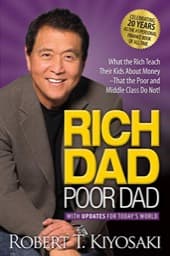
Rich Dad Poor Dad
The book that got millions of people thinking differently about assets, income and building wealth.
The Psychology of Money
Morgan Housel
The Psychology of Money
19 short stories on how people actually think and feel about money, not just the maths of it.
The Barefoot Investor
Scott Pape
The Barefoot Investor
Australia's best-selling money book ever. A simple system for accounts, budgeting, debt and a real emergency fund in one.
Some links above are affiliate links. If you buy through them, Snowball Invest may earn a small commission at no extra cost to you. We only recommend books we'd suggest anyway.
Sources
Was this article useful?
Put it to your own numbers
Every calculator runs entirely in your browser, with nothing stored. See what these numbers look like for your own situation.
Explore the calculators →General information only. This article is educational and does not constitute personal financial advice. It does not account for your circumstances. Consider your own situation and seek advice from a licensed adviser before acting. Read our full disclaimer.

Timothy Hirou Gaschereau
Founder of Snowball Invest, not a financial adviser.
I write about what I'm learning myself, because nobody ever taught us how to take control of our own money. It's a skill, not a mystery, and it's never too late to learn it. The best day to start was yesterday, the second best is today.
LinkedIn →Related articles

The $1000 Project by Canna Campbell: An Honest Review
Our honest review of The $1000 Project by Canna Campbell: the $1,000 parcel method, dividend investing, the strengths, the limits, and who it's for.

Buy Back Your Time by Dan Martell: An Honest Review
Our honest Buy Back Your Time review for Australians: Dan Martell's Buyback Rate, DRIP Matrix and delegation playbook, and what to know before you hire here.

The 4-Hour Work Week by Tim Ferriss: An Honest Review
Our honest 4-Hour Work Week review for Australians: Tim Ferriss's DEAL framework and mini-retirements, what's dated, and how the mindset applies here.