

Set for Life by Scott Trench: An Honest Review
Our honest Set for Life review for Australians: Scott Trench's three-stage FIRE plan, house hacking, what translates here, and what needs adapting.
 By Timothy Hirou GaschereauPublished
 9 min read
A genuinely useful mindset book for aspiring early retirees, with some real limitations for anyone outside the United States. Set for Life lays out a clear, three-stage roadmap from zero savings to financial independence, built around aggressive frugality, house hacking and income growth. It's part of our personal finance book reviews on Snowball Invest.
Quick answer
A clear, three-stage roadmap from zero savings to financial independence, built around aggressive frugality, house hacking and income growth. Best for young, single earners early in their careers who are open to radical lifestyle changes. The big caveat for Australians: it's deeply US-centric, and its signature strategy, house hacking, is far harder to pull off here than it sounds. Our rating: 3.5 out of 5.
Want to read Set for Life?
An aggressive playbook for building a big savings gap early and turning it into real freedom money. Read it with an Aussie lens.
In this guide
- →What the book is about: the three-stage plan and house hacking
- →The genuine strengths and the honest weaknesses
- →Who it's for, and who should skim it
- →What critics and r/financialindependence readers say
- →The Australian angle: house hacking vs rentvesting, super and ETFs
📖 What is Set for Life about?
Set for Life (2017) was written by Scott Trench, CEO of BiggerPockets, the US real estate investing platform and community. It's a practical guide for a median-income earner (Trench targets someone on around US$50,000 a year) to reach financial freedom in roughly a decade, starting from scratch, structured around three stages:
- Stage 1: Build your first $25,000. The hardest part. Slash the "big three" expenses (housing, transport and food) while saving aggressively, aiming for a solid emergency fund cushion that gives you options.
- Stage 2: House hack your way to $100,000. The book's centrepiece. House hacking means buying a multi-unit property or a home with spare rooms, living in part of it, and renting the rest out so tenants effectively cover your mortgage, combined with career advancement and side income.
- Stage 3: Invest the surplus into index funds and real estate. Once you have real runway, build passive income through low-cost index funds and further property until your portfolio replaces your salary.
The BiggerPockets connection matters: Trench used these strategies himself in Denver, and the book draws heavily on the community's real-world experience with house hacking and real estate investing.
⚖️ Strengths and weaknesses
What it gets right
- ✓A clear, actionable framework: concrete milestones ($25k, then $100k, then FI) rather than vague 'spend less and invest more' advice.
- ✓House hacking as a real wealth accelerator where it's feasible: cutting your biggest expense while building equity is a genuine shortcut most books skip.
- ✓An income-growth mindset, not just frugality: Trench is explicit that cutting costs alone won't get you there.
- ✓Accessible, no-nonsense writing that's honest about the sacrifices required, which makes it feel credible rather than preachy.
- ✓Strong community backing via the BiggerPockets ecosystem of forums, podcasts and people actually doing this.
Where it falls short
- ✕Heavily US-centric: US low-deposit loans, US tax rules, US property dynamics and US salary benchmarks throughout.
- ✕House hacking is much harder in Australia given high prices, stricter lending and no direct low-deposit multi-unit equivalent.
- ✕Demands extreme lifestyle sacrifice (saving 50%-plus, shared housing, cheap cars) that isn't for everyone.
- ✕Limited depth on investing mechanics beyond 'buy index funds and real estate'.
- ✕Squarely aimed at young, single, high-savings-capacity earners, so large chunks won't apply to everyone.
👤 Who should read it, and who should skip it?
Read it if you
- ✓Are in your 20s or early 30s, early in your career, and genuinely motivated to reach FI faster than average.
- ✓Are open to house hacking, or at least the principle of turning your housing cost into an income-producing asset.
- ✓Want a mindset shift around income growth, not just expense cutting.
- ✓Are new to FIRE and want a structured, stage-by-stage introduction.
Skip or skim it if you
- ✕Are already well-versed in the fundamentals (the first third will feel familiar).
- ✕Are a property investor wanting technical depth on Australian real estate.
- ✕Are at a life stage where extreme frugality isn't realistic.
- ✕Are hoping for an Australian-specific guide.
🔍 What do critics say?
Critical reception has been positive. Respected review outlets have recommended it as well-suited to career starters who aren't put off by financial risk, praising Trench's clearly articulated, practically grounded approach, while acknowledging some readers will find the plan too bold. US personal finance publications rate it highly, singling out Trench's honesty about the realities facing average earners and the book's application-oriented approach, and noting it's most valuable for readers starting with little or no net worth. The consensus: a strong, practical book for the right reader, but one that requires some self-awareness about whether you're actually that reader.
💬 What do readers say? Goodreads and Reddit
On Goodreads it holds around 4.2 out of 5 from thousands of ratings, with the majority giving it four or five stars. Across Reddit's financial independence communities the picture is similarly positive: r/financialindependence recommends it as a practical, no-fluff, staged entry point to FIRE, r/realestateinvesting cites it as a solid foundation for building the capital base to start investing, and r/fiaustralia acknowledges the US-centric limits but recommends it for its expense-reduction and income-growth mindset, which travels well.
The consistent thread across communities: readers find it motivating and practical, and appreciate that Trench doesn't sugarcoat the effort required. The most common gripe is simply that it's built for the US market.
🇦🇺 The Australian angle
The core principles (spend less than you earn, grow your income aggressively, invest the surplus in income-producing assets) are universal and translate perfectly. But the specifics need work:
- House hacking in Australia is a different story. It works in the US partly because low-deposit loans allow buyers to purchase multi-unit properties with a small deposit, and median prices in many US cities are a fraction of Sydney or Melbourne. Here you're looking at strict lending, a much higher deposit, and prices that make Trench's numbers look quaint. Not impossible, but significantly harder and more capital-intensive.
- The closer Australian equivalent is rentvesting: renting where you want to live while buying an investment property in a more affordable market. Not identical to house hacking, but the same underlying logic of separating where you live from where you invest.
- Then there's super. A large chunk of your retirement savings is locked in super until preservation age (currently 60 for most people). Aiming for FI in your 30s or 40s means you need a separate, accessible portfolio to bridge the gap, something Trench's plan doesn't account for, because it doesn't need to in the US.
- On investing, the local equivalents are well-established: ASX ETFs like VAS (Australian shares) and VGS (international shares) are the commonly cited options, offering broad diversification at low cost.
And a reminder: property carries real risk. Trench (and the BiggerPockets community) are bullish on real estate, but Australian markets have their own dynamics, including high prices, concentration risk and the possibility of corrections. For genuinely Australian FIRE mechanics, our Money School review and, on the rentvesting side, our Positively Geared review are strong companions.
💰 The verdict
Set for Life is a genuinely good book for the right reader. Scott Trench has built a clear, honest and motivating framework for reaching financial independence faster than average, and the income-growth mindset he promotes is something more personal finance books should include. For Australians, though, it's best treated as a mindset and framework book rather than a literal how-to: the house-hacking strategy needs significant adaptation for our market, the tax and lending sections don't apply, and the super system adds a layer of complexity the book doesn't address. Read it for the philosophy, the three-stage structure, and to get fired up about what's possible, then do the work of translating it to the Australian context. Our rating: 3.5 out of 5, recommended with caveats.
Want to read Set for Life?
Young, motivated and chasing FI fast? Grab a copy for the framework, then adapt it to the Australian rules.
SnowLetter
Australia's money news and our best reads, once a week.
❓ Frequently asked questions
Is Set for Life relevant for Australians?
+
Yes, with important caveats. The core principles (cut big expenses, grow your income, invest the surplus) apply universally. But the book's specific strategies, particularly house hacking using US low-deposit loans, US tax rules and US property dynamics, don't translate directly. Treat it as a framework book and adapt the ideas to the local context, including super, Australian lending rules and ASX-listed index funds.
What is house hacking and can I do it in Australia?
+
House hacking means buying a property, living in part of it, and renting out the rest so tenants cover most or all of your mortgage. In the US it's commonly done with small multi-unit properties using low-deposit government-backed loans. In Australia it's possible in principle (renting out spare rooms or a granny flat), but the high cost of entry and stricter lending make it much harder to replicate Trench's numbers. Rentvesting is often the closer Australian equivalent.
How does it compare to The Barefoot Investor?
+
Both are accessible personal finance books for everyday readers, but with different emphases. The Barefoot Investor is Australian-specific, covers super, and focuses on solid foundations through a simple bucket system. Set for Life is more aggressive, US-focused and built around the FIRE goal of early independence through house hacking and income maximisation. For an Australian beginner, Barefoot is probably the better starting point; Set for Life is a useful next step for going further, faster.
Is the book suitable for beginners?
+
Yes, it's written in plain language and doesn't assume prior financial knowledge, and the three-stage structure is easy to follow. That said, the strategies in the later stages require some financial literacy around property and investing, so complete beginners may want a foundational personal finance book first.
Does Scott Trench recommend index funds?
+
Yes. He advocates low-cost index funds as the primary vehicle for stock-market investing on the path to financial independence. He doesn't go deep on portfolio construction or fund selection, but the direction is clear: broad, diversified, low-fee index investing rather than stock picking. For Australians, ASX-listed ETFs like VAS and VGS are the commonly used local equivalents.
What's the main criticism of Set for Life?
+
The most consistent criticism is that it's heavily US-centric. The house-hacking strategy relies on US-specific lending products and US property conditions that don't exist here. Beyond that, some readers find the lifestyle sacrifices (saving 50%-plus, shared housing, cheap cars) unrealistic for people with families or other commitments, and the investing sections fairly surface-level.
📚 Get the book (and two FIRE companions)
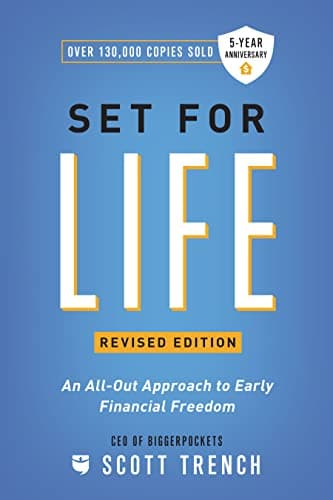
Set for Life
Scott Trench
Set for Life
Scott Trench lays out an aggressive playbook for building a big savings gap early and turning it into real freedom money. It leans US and property-heavy, so read it with an Aussie lens and lean on your super and local rules.
Money School
Lacey Filipich
Money School
Lacey Filipich shows how to buy back your time, not just budget your dollars, with a clear path from saving to financial independence. It is refreshingly Australian and genuinely doable, even if maths was never your thing.
Quit Like a Millionaire
Kristy Shen & Bryce Leung

Quit Like a Millionaire
A no-nonsense FIRE memoir from a couple who retired in their 30s. Shen takes you from growing up poor to hitting financial independence, with the actual maths.
Some links above are affiliate links. If you buy through them, Snowball Invest may earn a small commission at no extra cost to you. We only recommend books we'd suggest anyway.
Sources
Was this article useful?
Put it to your own numbers
Every calculator runs entirely in your browser, with nothing stored. See what these numbers look like for your own situation.
Explore the calculators →General information only. This article is educational and does not constitute personal financial advice. It does not account for your circumstances. Consider your own situation and seek advice from a licensed adviser before acting. Read our full disclaimer.

Timothy Hirou Gaschereau
Founder of Snowball Invest, not a financial adviser.
I write about what I'm learning myself, because nobody ever taught us how to take control of our own money. It's a skill, not a mystery, and it's never too late to learn it. The best day to start was yesterday, the second best is today.
LinkedIn →Related articles

Quit Like a Millionaire by Kristy Shen: An Honest Review
Our honest Quit Like a Millionaire review for Australians: Kristy Shen and Bryce Leung's FIRE strategy, the Yield Shield, what maps to super and the ASX, and what to skip.

Playing with FIRE by Scott Rieckens: An Honest Review
Our honest Playing with FIRE review for Australians: Scott Rieckens's FIRE memoir, what inspires, what's US-only, and how the mechanics change with super here.

Financial Freedom by Grant Sabatier: An Honest Review
Our honest Financial Freedom review for Australians: Grant Sabatier's income-first FIRE playbook, the savings-rate maths, the US-centric bits, and the super-bridge angle.