

Retirement Savings Calculator
Project how your current savings and contributions could grow by retirement, and roughly what income that might support.
Built and checked byTimothy Hirou GaschereauFigures verified at the source on
Your details
Projected savings at age 65
$703,163
Current savings
$20,000
Total contributions
$168,000
Investment return
$515,163
Using a 4% withdrawal rate
$28,127 / year
roughly $2,344 per month, before tax
That's about $11,852/year in today's dollars, what it would actually buy after 2.5% inflation.
This calculator gives an estimate only, assuming a constant annual growth rate. It does not account for taxes, fees or Age Pension entitlements. The today's-dollars income figure discounts your projected income by the inflation rate you entered. Not financial advice.
How to use this calculator
- 1. Enter your current age, target retirement age, and current retirement savings.
- 2. Enter how much you plan to contribute regularly, and the annual growth rate you expect.
- 3. The calculator projects your balance at retirement, plus a rough estimate of annual income using a 4% withdrawal rate.
Are you actually on track for retirement?
Most Australians have no real idea whether their super balance is where it needs to be. That's not a character flaw, it's just a planning gap, and it's exactly what this calculator is for. Enter your current balance, your age, your planned retirement age, your regular contributions and a return rate, and you'll get a projected nest egg in seconds. The benchmarks below tell you what that number actually means.
What does a comfortable retirement actually cost?
The most widely used yardstick is the Association of Superannuation Funds of Australia's (ASFA) Retirement Standard, updated every quarter. For the March 2026 quarter, ASFA puts the annual income needed for a comfortable retirement, for a homeowner aged 65 to 84, at $55,923 for a single person and $78,566 for a couple. A comfortable retirement covers a decent car, private health cover, regular meals out, and both domestic and the occasional overseas trip. A modest retirement covers the basics: essential health care, limited recreation, and infrequent dining out, and leans much more heavily on the Age Pension to fill the gap.
| Lifestyle tier | Annual income (single) | Annual income (couple) | Super needed at 67 (single) | Super needed at 67 (couple) |
|---|---|---|---|---|
| Comfortable | $55,923 | $78,566 | $630,000 | $730,000 |
| Modest | $36,434 | $52,473 | $110,000 | $120,000 |
Source: ASFA Retirement Standard, March 2026 quarter. Figures assume you own your home outright.
$630,000 for a comfortable single retirement is the number most planners work towards, but it's a today's-dollars figure for a homeowner retiring at 67. If you're still renting, or you're planning to retire earlier, your real target is higher. For the full breakdown of how these numbers are built and what changes them, our guide on how much super you actually need to retire in Australia walks through it.
How the Age Pension changes your number
The Age Pension isn't just a safety net for people with no savings, it's a meaningful income source for a large share of Australian retirees, including plenty with a solid super balance. From 1 July 2026 the maximum Age Pension is around $31,223 a year for a single person and $47,070 a year combined for a couple. Whether you get the full pension, a part pension, or nothing comes down to an assets test and an income test, with Centrelink paying whichever result is lower.
| Situation | Full pension if assets at or below | Part pension cuts off at |
|---|---|---|
| Single homeowner | $333,000 | $733,500 |
| Couple homeowner (combined) | $499,000 | $1,102,500 |
Source: Services Australia.
This calculator projects your own super in isolation, on purpose, so you can see what your savings alone are doing. If you want the combined picture, your super plus an estimated Age Pension entitlement, run the numbers through our Retirement Income & Age Pension Calculator once you have a projected balance from this one. For the full rules on rates and eligibility, see our Age Pension guide.
How your balance compares to the average Australian
Knowing the benchmark is one thing, knowing where you sit against other Australians your age is another, and often more motivating. The averages below are from ATO 2023-24 taxation statistics. They're mean averages, not medians, so a small number of very large balances pull the numbers up. Medians typically sit 30 to 40% lower.
| Age group | Average balance (male) | Average balance (female) | Combined average |
|---|---|---|---|
| 35 to 39 | $101,642 | $80,647 | ~$91,300 |
| 40 to 44 | $150,305 | $117,067 | ~$134,100 |
| 45 to 49 | $206,484 | $158,331 | ~$185,300 |
| 50 to 54 | $271,498 | $205,029 | ~$244,300 |
| 55 to 59 | $341,115 | $260,199 | ~$313,800 |
| 60 to 64 | $413,700 | $327,440 | ~$384,400 |
Source: ATO Taxation Statistics 2023-24.
Two things stand out. The gender gap is real and persists across every age group, women aged 60 to 64 average roughly $86,000 less than men in the same bracket. And even the average 60 to 64 year old male balance of $413,700 falls short of the $630,000 ASFA comfortable-single benchmark. That gap is exactly why running your own projection now, while there's still time to close it, beats hoping the average sorts itself out. See the full super balance benchmarks by age for more detail, including the youngest brackets.
What extra contributions actually do to your number
This is where the calculator earns its keep. Small changes to your contributions, made early, compound into very different outcomes. Take a 35-year-old with $91,000 in super (roughly the 2023-24 average for their age group), earning $90,000 a year, retiring at 67, a 32-year runway at a 7% nominal return.
| Scenario | Annual contributions | Projected balance at 67 |
|---|---|---|
| Super guarantee only (12%) | $10,800 | ~$1,983,000 |
| SG + $200/month extra | $13,200 | ~$2,248,000 |
| SG + $500/month extra | $16,800 | ~$2,645,000 |
A quick reality check on those numbers: they're nominal, meaning future dollars, not today's dollars. Thirty-two years of inflation at around 2.5 to 3% a year eats a big chunk of that headline figure, so the first scenario is closer to $900,000 to $1,000,000 in today's purchasing power, still well above the ASFA benchmark, just not quite as dramatic as it looks. Run the calculator again with a 4 to 5% return instead of 7% to get a rougher but more honest read on real purchasing power.
The extra contributions still matter, especially if you're starting later, earning less, or carrying a smaller balance than this example. Concessional contributions, including salary sacrifice, are taxed at 15% inside super rather than your marginal rate of 30% or higher, and that tax saving compounds right alongside your balance. Just keep an eye on the 2026-27 concessional contributions cap of $32,500, which covers your employer's super guarantee plus any salary sacrifice or personal deductible contributions combined.
Four mistakes that quietly wreck a projection
- 1. Ignoring inflation. A 7% nominal return is closer to 4 to 5% in real terms right now, and the ASFA benchmarks are in today's dollars. Compare a nominal projection to them directly and you'll overestimate your future purchasing power.
- 2. Getting too optimistic on returns. ASIC's MoneySmart guidance suggests 6 to 7% for a balanced super fund as a reasonable long-run assumption. Plugging in 9 or 10% because your fund had a great couple of years can overstate a 30-year projection by 20 to 30%.
- 3. Forgetting fees compound too. A 1% annual fee gap on a $300,000 balance can cost more than $100,000 over 20 years, because fees shrink your compounding base every single year. Check your fund's total annual fee on your statement, and see our Net Fees Calculator to see the damage over your own timeline.
- 4. Starting extra contributions too late. An extra $200 a month from age 35 beats $400 a month from age 50, because those earlier dollars get 15 more years to compound. If you've been meaning to top up your super, the maths rewards doing it now, not once you feel more comfortable.
Super numbers worth knowing for 2026-27
- Super guarantee rate: 12% of ordinary time earnings, with no further scheduled increases.
- Concessional contributions cap: $32,500 a year, covering employer super guarantee, salary sacrifice and personal deductible contributions combined.
- Non-concessional contributions cap: $130,000 a year, with a bring-forward rule allowing up to $390,000 across three years.
- Transfer Balance Cap: $2.1 million, the most you can move into the tax-free retirement phase.
- Preservation age: 60, for anyone born after 30 June 1964.
- Age Pension qualifying age: 67, for anyone born on or after 1 January 1957.
FAQ
How much super do I need to retire comfortably in Australia?
According to the ASFA Retirement Standard (March 2026 quarter), a single homeowner needs around $630,000 in super at age 67 to fund a comfortable retirement, and a couple needs $730,000 combined. That funds an annual income of $55,923 for a single person and $78,566 for a couple. These figures assume you own your home outright and will get at least a partial Age Pension. If you're renting, you'll need more.
What is the ASFA comfortable retirement standard right now?
For the March 2026 quarter, ASFA sets a comfortable retirement income at $55,923 a year for a single homeowner and $78,566 a year for a couple. The modest standard is $36,434 for a single and $52,473 for a couple. ASFA updates these figures quarterly to track the cost of living, so treat them as a current snapshot rather than a fixed number.
Does this calculator include the Age Pension?
No, and that's deliberate. This calculator only projects the savings and contributions you enter, so you can see exactly what your own money is doing. Once you have a projected balance, run it through our Retirement Income & Age Pension Calculator to see the combined picture, your super plus an estimated Age Pension entitlement based on the assets and income tests.
What is the average super balance by age in Australia?
Based on ATO 2023-24 taxation statistics, combined average balances run roughly: 35 to 39 ($91,300), 40 to 44 ($134,100), 45 to 49 ($185,300), 50 to 54 ($244,300), 55 to 59 ($313,800), and 60 to 64 ($384,400). These are mean averages, pulled upward by a small number of very large balances, so the typical (median) balance is meaningfully lower. There's also a persistent gender gap of around $86,000 in the 60 to 64 bracket.
How much does salary sacrifice actually change my retirement balance?
A lot, especially if you start early. In our worked example, a 35-year-old on $90,000 contributing super guarantee only projects to around $1.98 million by 67 (nominal, at a 7% return). Adding $200 a month in salary sacrifice lifts that to around $2.25 million, and $500 a month gets you to around $2.64 million. Salary sacrifice is also taxed at 15% inside super instead of your marginal rate, which adds a tax saving on top of the extra contributions.
What super balance do I need at 67 to retire?
ASFA's March 2026 quarter benchmark is $630,000 for a single homeowner and $730,000 for a couple, for a comfortable retirement. For a modest retirement, the targets drop to $110,000 (single) and $120,000 (couple), because modest-lifestyle retirees lean much more heavily on the Age Pension. These are today's-dollars figures, so if you're decades from retirement, your nominal target will need to be higher to account for inflation.
How long will my super actually last once I retire?
It depends on your balance at retirement, how much you draw down each year, your investment return, and how long you live. As a rough guide, a $630,000 balance drawing $55,923 a year at a 5% return would last roughly 20 to 25 years, taking a 67-year-old well into their late 80s. Even a partial Age Pension on top extends that considerably. This calculator gives you the starting balance, a licensed adviser can help model a proper drawdown strategy from there.
What is the super guarantee rate right now?
The super guarantee (SG) rate is 12% for 2026-27, the final step in a decade-long schedule of increases with no further rises legislated. Your employer must pay 12% of your ordinary time earnings into your nominated super fund. From 1 July 2026, Payday Super also requires employers to pay it each payday rather than quarterly, which helps your balance compound a little sooner.
What are the concessional contribution caps for 2026-27?
The concessional contributions cap for 2026-27 is $32,500 a year. That covers everything before tax: your employer's super guarantee, any salary sacrifice, and personal contributions you claim a tax deduction on. Go over the cap and the excess is taxed at your marginal rate, less a 15% offset. If your total super balance is under $500,000, you may be able to carry forward unused cap space from the previous five years.
How much do investment fees really cost me over time?
More than most people expect. A 1% annual fee difference on a $300,000 balance can cost over $100,000 across 20 years, because fees shrink the amount left to compound every year. As an example, $300,000 growing at 7% for 20 years reaches roughly $1.16 million, while the same balance at 6% (after a 1% fee drag) reaches roughly $963,000, a $197,000 gap from one percentage point. Check your fund's total annual fee on your statement, or run your own numbers through our Net Fees Calculator.
What is the Transfer Balance Cap?
The Transfer Balance Cap is $2.1 million from 1 July 2026, up from $2.0 million the year before. It's the most you can move from your accumulation super account into the retirement phase, where investment earnings are tax-free. Anything above the cap has to stay in accumulation (taxed at 15%) or be withdrawn. The cap is indexed in $100,000 steps when CPI conditions are met.
What growth rate should I use in this calculator?
7% is a reasonable standard assumption for a balanced super fund, in line with ASIC's MoneySmart guidance. But it's worth running a second pass at 4 to 5% to get a rougher sense of real purchasing power after inflation, since the calculator's output is a nominal (future dollars) figure and the ASFA benchmarks are in today's dollars. A growth or high-growth option might justify 7.5 to 8%, with more short-term volatility to match, while conservative options warrant something closer to 4 to 5%.
What is the 4% withdrawal rate this calculator uses?
It's a commonly cited rule of thumb suggesting you could withdraw around 4% of your balance in the first year of retirement, adjusting for inflation after that, with a reasonable chance the money lasts several decades. This calculator uses it to turn your projected balance into a rough annual income figure. It's a simplification for a quick estimate, not a guarantee or a full drawdown strategy.
Related reading

Superannuation for the Self-Employed: What You Need to Know
Why super isn't compulsory for sole traders, the real gap this creates, how the tax deduction works, and how to actually build the habit.

How to Find and Consolidate Lost Super
Real ATO figures on lost and unclaimed super, why it goes missing, how to find it through myGov, and the insurance check to do before consolidating.

Super Co-Contribution: The Free Government Top-Up Most People Miss
How the super co-contribution actually works, the exact income thresholds, and why it's one of the most underused benefits in super.
Where these numbers come from
Every rate and threshold in this calculator was read off the official page, not copied from another calculator. Check them yourself, they change.
📚 Recommended reading
Retirement Made Simple
Noel Whittaker

Retirement Made Simple
Australia's godfather of personal finance demystifies super, the pension and making your savings last. The plain-English retirement handbook every Aussie should read before they stop working.
Super Made Simple
Noel Whittaker
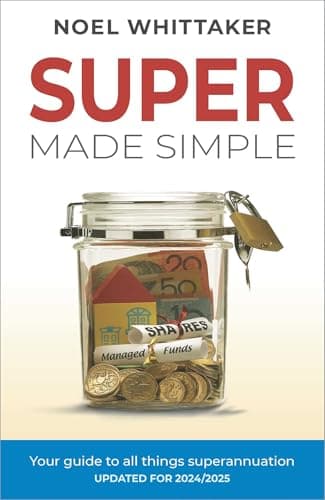
Super Made Simple
A focused, up-to-date guide to actually understanding your superannuation, from one of Australia's most trusted finance writers.
Some links above are affiliate links. If you buy through them, Snowball Invest may earn a small commission at no extra cost to you. We only recommend books we'd suggest anyway.
SnowLetter
Australia's money news and our best reads, once a week.
Disclaimer
The results provided by this calculator are estimates only, based on the assumptions you enter, and are not a prediction or financial advice. Actual retirement outcomes depend on many factors not captured here, including inflation, fees, investment sequencing and legislative change. Consider speaking with a licensed financial adviser before making any financial decision.