

Superannuation for the Self-Employed: What You Need to Know
Why super isn't compulsory for sole traders, the real gap this creates, how the tax deduction works, and how to actually build the habit.
 By Timothy Hirou GaschereauPublished
 8 min read
Nobody pays a sole trader's super for them, which is exactly why it's the single most commonly skipped part of running a business for yourself, right up until retirement is a lot closer than it used to be. This is part of a wider guide to retirement and FIRE on Snowball Invest.
Quick answer
Self-employed Australians aren't legally required to pay themselves superannuation, unlike employees, who receive a compulsory 12% Superannuation Guarantee from their employer. Personal contributions are entirely voluntary, but they're tax-deductible up to the concessional cap, effectively taxing that income at 15% instead of your marginal rate.
In this guide
- →Why it's genuinely not compulsory, and the real gap that creates
- →How to contribute, claim the deduction, and the current contribution caps
- →Making it an actual habit against irregular self-employed income
- →Catching up on skipped years, plus a much bigger one-off lever tied to selling the business
🚫 It's genuinely not compulsory
There's no Superannuation Guarantee obligation attached to genuine self-employment income, no employer is required to contribute on your behalf, because there isn't one. Whatever ends up in super comes entirely from contributions you choose to make yourself, which means, unlike employees, there's no default mechanism quietly building a balance in the background while you focus on running the business.
📉 The gap this actually creates
The absence of compulsion shows up clearly in the numbers. ASFA research has found that around one-fifth of self-employed Australians have no superannuation at all, out of roughly 1.3 million sole traders nationally, and those who do have super tend to carry balances around 50% lower than employed people of the same age.
The gap isn't a reflection of self-employed people being worse at managing money, it's a structural consequence of removing the default mechanism that quietly builds most employees' balances without any active decision required. ASFA has advocated for extending compulsory super to self-employed workers, and its own member research found 78% support for the idea, though no such requirement currently exists.
💵 How to contribute, and the tax deduction
Personal super contributions can generally be claimed as a tax deduction, up to the concessional contributions cap, which effectively moves that portion of business income into super's 15% tax environment instead of being taxed at your marginal income tax rate. To claim the deduction, a valid "notice of intent to claim" needs to be lodged with your super fund before you claim it on your tax return, and before you withdraw or roll over the contribution.
💼 Salary & Take-Home Pay Calculator
See what a personal super contribution actually costs against your take-home income.
Super isn't the only gap self-employed Australians tend to leave open, most also have no employer-funded safety net if they can't work at all. Our income protection for the self-employed guide covers that side of it.
📏 The contribution caps
| Cap | 2025-26 | 2026-27 |
|---|---|---|
| Concessional (before-tax, tax-deductible) | $30,000 | $32,500 |
| Non-concessional (after-tax) | $120,000 | $130,000 |
The same caps apply whether the contribution comes from an employer's Superannuation Guarantee or your own personal contribution as a self-employed person, there's no separate, lower cap just because you're contributing it yourself. If your income sits below the relevant threshold, it's also worth checking whether a government co-contribution applies on top.
🔁 Making it an actual habit
Treating a super contribution as a genuine cost of running the business, the self-employed equivalent of the 12% an employer would otherwise pay, tends to work better than contributing only whatever's left over after everything else. For irregular income, contributing a percentage of what's actually received each quarter, rather than a fixed amount assuming steady pay, adapts more naturally to how self-employed income actually arrives.
A lump-sum top-up before 30 June, once the full financial year's income and tax position are clearer, is also a common pattern, particularly for anyone whose income varies significantly month to month.
⏪ Catching up on skipped years
Anyone who's gone several years without contributing much isn't necessarily stuck using only the current year's cap. If your total super balance is under $500,000, unused concessional cap amounts from the previous five financial years can be carried forward and contributed on top of the normal annual cap in a single year, a genuinely useful mechanism for a self-employed person who had a lean year or two and then a strong one.
🔍 How to Find and Consolidate Lost Super
Worth checking before setting up a new contribution habit, in case an old account already exists.
🏷️ Selling the business one day: a bigger lever than annual caps
🎯 The essential: A business owner selling up at retirement can potentially move far more into super than any annual cap allows, through a concession most self-employed people have never heard of.
Annual contribution caps are the main lever for most people, but a business owner planning to eventually sell has access to something considerably larger. Under the small business CGT concessions, an eligible small business owner can contribute proceeds from selling an active business asset, the business itself, in many cases, directly into super without those contributions counting against the usual annual concessional or non-concessional caps at all.
Two specific concessions do the heavy lifting: the retirement exemption allows up to $500,000 over a lifetime to be contributed this way, and the 15-year exemption, for an asset owned at least 15 years by an owner aged 55 or over who's retiring, can exempt the entire capital gain with no dollar cap at all. Both require notifying the receiving fund on a specific CGT cap election form so the contribution is correctly excluded from ordinary caps, and both come with detailed eligibility rules around business turnover and asset value thresholds that make this a genuine case for professional advice rather than a DIY calculation, but for a small business owner with little in super because the business itself has been the retirement plan, it's often the single largest contribution opportunity they'll ever have.
Annual concessional cap
every year
Retirement exemption
once, lifetime
15-year exemption
sell after 15+ yrs
SnowLetter
Australia's money news and our best reads, once a week.
❓ Frequently asked questions
Do sole traders have to pay themselves super?
+
No. There's no Superannuation Guarantee obligation on income you earn as a genuine sole trader or self-employed contractor, unlike the compulsory contributions an employer must pay employees. Contributing is entirely voluntary.
Can I claim a tax deduction for super contributions I make myself?
+
Yes, personal contributions can generally be claimed as a tax deduction up to the concessional contributions cap, effectively taxing that portion of income at 15% instead of your marginal rate, provided you lodge a valid notice of intent with your fund before claiming it.
What if my business income is irregular?
+
Contributing a percentage of income when it's actually received, rather than a fixed monthly amount, tends to work better for irregular income than trying to match an amount that assumes steady pay. Topping up with a larger contribution before 30 June, once full-year income is clearer, is a common pattern too.
Is there a minimum amount I should contribute as a self-employed person?
+
There's no legal minimum, but treating a contribution as a genuine cost of running the business, the equivalent of the 12% Superannuation Guarantee an employer would otherwise pay, is a reasonable benchmark to aim for rather than contributing only whatever happens to be left over.
📚 Recommended reading
Making Money Made Simple
Noel Whittaker

Making Money Made Simple
Australia's classic, comprehensive money guide covering tax, super and investing, updated for today.
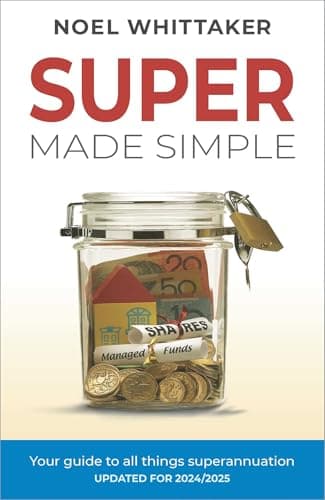
Super Made Simple
Noel Whittaker
Super Made Simple
A focused, up-to-date guide to actually understanding your superannuation, from one of Australia's most trusted finance writers.
The Millionaire Fastlane
MJ DeMarco
The Millionaire Fastlane
DeMarco torches the slow-and-steady retirement dream and argues for building wealth through business instead. Loud, opinionated, and genuinely motivating.
Some links above are affiliate links. If you buy through them, Snowball Invest may earn a small commission at no extra cost to you. We only recommend books we'd suggest anyway.
Sources
- 1. Super for self-employed people, Moneysmart, Australian Securities and Investments Commission
- 2. Super for sole traders and partnerships, Australian Taxation Office
- 3. Extend compulsory super to all self-employed workers: ASFA, Super Review
- 4. Small business retirement exemption, Australian Taxation Office
Was this article useful?
Put it to your own numbers
Every calculator runs entirely in your browser, with nothing stored. See what these numbers look like for your own situation.
Try the Super Contributions calculator →General information only. This article is educational and does not constitute personal financial advice. It does not account for your circumstances. Consider your own situation and seek advice from a licensed adviser before acting. Read our full disclaimer.

Timothy Hirou Gaschereau
Founder of Snowball Invest, not a financial adviser.
I write about what I'm learning myself, because nobody ever taught us how to take control of our own money. It's a skill, not a mystery, and it's never too late to learn it. The best day to start was yesterday, the second best is today.
LinkedIn →Related articles
How to Reactivate a Cancelled ABN in Australia
Your ABN was cancelled? Here is exactly how to reactivate an ABN in Australia step by step through the Australian Business Register, and what to sort out after.

How to Pay Yourself as a Sole Trader in Australia
As a sole trader you take drawings, not a wage. How paying yourself actually works, why you are taxed on profit, super, and setting money aside for tax.
How to Invoice as a Sole Trader in Australia
What a valid sole trader invoice must include, the difference between a regular invoice and a tax invoice, the no-ABN withholding rule, and how to get paid faster.