
Children's Savings Account Australia: What Parents Need to Know
Everything Australian parents need on children's savings accounts: how bonus rates work, the $416 tax threshold, and how to use one to teach kids about money.
 By Timothy Hirou GaschereauPublished
 9 min read
A children's savings account is one of the simplest ways to give your child a head start, and one of the best hands-on money lessons available. This guide covers how they work, the tax rules parents often miss, and how to turn a bank account into a real teaching tool. It is part of our wider guide to saving and budgeting on Snowball Invest. This is general information only, not personal financial advice.
Quick answer
A children's savings account is one of the simplest ways to give your child a head start, and most are free to open with no monthly fees. Bonus interest rates are common but come with conditions (usually growing the balance each month), so check they suit your child's habits. Tax on interest is only a concern if your child earns more than $416 in interest a year, which most kids with small balances will not hit. For larger sums or longer horizons, other structures like investment bonds may be worth exploring.
In this guide
- →Why a dedicated account beats a wallet or piggy bank
- →How base and bonus rates work, and the conditions that trip families up
- →What actually matters when choosing an account
- →The $416 tax threshold and the whose-name-is-it question
- →When a savings account is not enough for larger sums
🌱 Why open one?
🎯 The essential: A real account with a real balance makes money tangible in a way abstract conversations cannot.
Compound interest rewards patience: a small amount saved at age five has more than a decade to grow before school finishes. Beyond the maths, birthday money, pocket money and gifts from grandparents need somewhere safe to live. A dedicated account keeps that money separate, visible and growing, rather than disappearing into a wallet.
⚙️ How it works
Most kids' accounts follow the same structure: a base rate you earn no matter what, plus a bonus rate that kicks in when you meet monthly conditions. The bonus rate is where the real return lives. Typical conditions include growing the balance by at least one dollar each calendar month, making no withdrawals, or a minimum deposit. Miss the condition and you earn only the base rate that month.
A few other things worth knowing: almost all children's accounts charge zero monthly fees, most run from birth to age 17 or 18, and app access keeps kids engaged because they can watch the balance grow. For younger children (generally under 14) a parent usually needs to operate the account.
🔍 What to look for
- A realistic bonus condition. Grow the balance every month is achievable for most kids; make five card transactions is not, for a seven-year-old.
- No monthly fees. Non-negotiable. Small balances and fees are a bad combination.
- No or very low minimum opening balance. Some accounts open with $1 or $0.
- Online or app access, because visibility keeps kids motivated.
- Parental controls and joint access, especially for younger children.
- The TFN question. You do not have to provide a Tax File Number, but without one the bank withholds tax at the top marginal rate on interest. For most families, providing the child's TFN is the right move.
🏦 Types of account in Australia
The big four (CommBank, NAB, ANZ, Westpac) all offer dedicated youth saver accounts. CommBank's Youthsaver is a widely recognised example: a base rate plus a bonus when the balance grows, with no monthly or withdrawal fees. Online banks like ING often offer competitive rates on similar products, since lower overheads let them pass on better rates, though they lack branches.
The key trade-off: big banks offer branch access, familiarity and integrated family banking; online banks often offer higher rates. Neither is universally better. Rates change frequently, so compare current rates directly on the bank's website or via Moneysmart before you open anything.
🧾 The tax trap parents miss
This is the section most parents skip. Interest on a savings account is unearned income, which is different from earned income (money a child receives for actual work, taxed at normal adult rates including the $18,200 tax-free threshold). For unearned income, the ATO applies penalty rates to minors to stop parents shifting investment income into a child's name.
| Interest earned | Tax treatment |
|---|---|
| $0 to $416 | Tax-free |
| $417 to $1,307 | 66% on the amount above $416 |
| Above $1,307 | 45% on the total amount |
For most children with small balances this is not an issue. To earn $416 in interest at around 5%, a child would need a balance of roughly $8,300, far more than most kids' accounts hold. But if your child has received a significant inheritance or large gift, be aware of the threshold.
Whose name matters too. In the child's name with their TFN, the interest is assessed as the child's income and the minor rates apply. In your name on behalf of the child, the interest is technically your income at your marginal rate. If your child's interest is well under $416 a year, the child's name is usually simpler. For larger amounts, speak to an accountant.
🧠 The real win: teaching kids
A savings account is one of the most effective hands-on money lessons available. The first time a child sees interest appear without doing anything, something clicks. That is compound interest made real. Linking the account to a specific goal, a toy, a school trip, a new bike, makes it even more motivating.
A simple framework that works well is Spend, Save, Give: dividing any money received into three buckets, with the savings account as the physical home for the Save bucket. As children get older, you can introduce what interest is, why the bank pays it, and how leaving money alone longer earns more.
🧮 Budget Calculator
Model a regular deposit and watch how consistent small amounts add up over the years.
📈 When a savings account is not enough
A savings account is a great starting point, but for larger sums or long horizons it may not be enough. If your child has received $20,000 or more, an account earning 4 to 5% may barely keep pace with inflation over 15 years, so growth assets are worth considering.
Investment bonds are one structure worth knowing about: earnings are taxed inside the bond at a maximum of 30% rather than the minor penalty rates, and after 10 years withdrawals are generally tax-free. Shares and ETFs held in trust are another option, with more tax and admin complexity. None are one-size-fits-all, so for a meaningful sum a conversation with a financial adviser is worthwhile. For most families starting with small regular deposits, a straightforward savings account is exactly the right tool.
SnowLetter
Australia's money news and our best reads, once a week.
❓ Frequently asked questions
Can I open a savings account for a newborn?
+
Yes. Most children's savings accounts in Australia can be opened from birth. A parent or guardian opens and operates the account on the child's behalf until the child is old enough (usually around 14) to manage it themselves.
Do kids pay tax on savings account interest in Australia?
+
Only if the interest exceeds $416 in a financial year. Below that, no tax applies. Above it, the ATO's minor penalty rates kick in (66% on the amount between $417 and $1,307, then 45% above $1,307). For most children with modest balances, this threshold is not reached.
What happens to the account when my child turns 18?
+
Most youth saver accounts automatically convert to a standard adult savings account when the child turns 18. The bank usually notifies you in advance, and your child is then subject to the same terms as any adult account holder.
Should the account be in my name or my child's name?
+
For most families with small balances, the child's name with the child's TFN is simpler and often more tax-efficient given the $416 tax-free threshold. If the account is in your name, the interest is your income and taxed at your marginal rate. For larger amounts, an accountant can help.
Can my child access the money themselves?
+
It depends on the account and the child's age. For children under 14, a parent or guardian typically controls it. From around 14 to 17, many accounts let the child make deposits and withdrawals, sometimes with parental oversight. Check the specific account's terms.
📚 Recommended reading
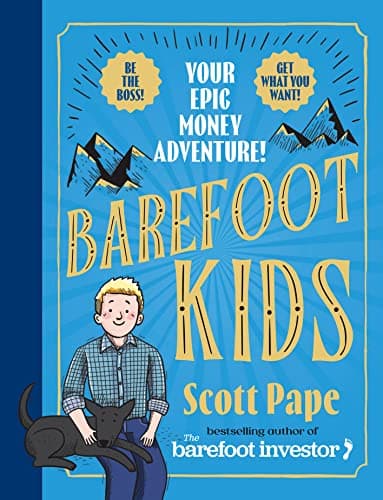
The Barefoot Kids
Scott Pape
The Barefoot Kids
From the guy behind The Barefoot Investor, this one turns your kids into little money machines with real projects, stickers and stories. Aussie parents made it a number 1 bestseller for a reason.
Money School
Lacey Filipich
Money School
Lacey Filipich shows how to buy back your time, not just budget your dollars, with a clear path from saving to financial independence. It is refreshingly Australian and genuinely doable, even if maths was never your thing.
The Barefoot Investor for Families
Scott Pape

The Barefoot Investor for Families
Scott Pape takes his mega-selling Barefoot system and points it at raising money-smart kids, with age-by-age jobs, pocket money and jam-jar tricks. If you want your kids to grow up good with money, this is the Aussie classic.
Some links above are affiliate links. If you buy through them, Snowball Invest may earn a small commission at no extra cost to you. We only recommend books we'd suggest anyway.
Sources
Was this article useful?
Put it to your own numbers
Every calculator runs entirely in your browser, with nothing stored. See what these numbers look like for your own situation.
Explore the calculators →General information only. This article is educational and does not constitute personal financial advice. It does not account for your circumstances. Consider your own situation and seek advice from a licensed adviser before acting. Read our full disclaimer.

Timothy Hirou Gaschereau
Founder of Snowball Invest, not a financial adviser.
I write about what I'm learning myself, because nobody ever taught us how to take control of our own money. It's a skill, not a mystery, and it's never too late to learn it. The best day to start was yesterday, the second best is today.
LinkedIn →Related articles

25 Money Saving Tips Australia: A Practical Guide
25 practical money saving tips for Australians: cut grocery bills, compare energy plans, ditch bank fees and audit subscriptions without a lifestyle change.

How to Save Money as a Student in Australia
A practical guide to saving money as a student in Australia: Youth Allowance, concession cards, cheap food, textbook hacks, fee-free banking and housing tips.

How to Track Your Spending in Australia (And Stick With It)
Learn how to track your spending in Australia with a simple four-step method, easy categories and habit tips that actually stick past the two-week mark.