

The Almanack of Naval Ravikant: An Honest Review
Our honest Almanack of Naval Ravikant review: Naval's wealth-and-happiness philosophy, the leverage and specific-knowledge ideas, and why Aussies need the mechanics elsewhere.
 By Timothy Hirou GaschereauPublished
 9 min read
The Almanack of Naval Ravikant is a genuinely interesting mindset book, but it is not a personal finance manual. Go in expecting actionable steps for building wealth and you'll be disappointed; go in curious about the philosophy behind wealth creation and you'll find plenty to chew on. It's part of our personal finance book reviews on Snowball Invest.
Quick answer
A short, quotable collection of Naval Ravikant's thinking on wealth and happiness, compiled by Eric Jorgenson from Naval's tweets, podcasts and interviews. Best for anyone curious about the mindset behind building wealth, especially career-focused Australians in their 20s to 40s. Skip it if you want a step-by-step plan with Australian tax, super or investing specifics. Our rating: 4 out of 5.
Want to read The Almanack of Naval Ravikant?
Naval's collected wisdom on leverage, specific knowledge and building assets that earn while you sleep. Also free online.
In this guide
- →What the book is about: wealth, leverage and happiness as a skill
- →The genuine strengths and the honest weaknesses
- →Who it's for, and who wants the mechanics instead
- →What critics and r/financialindependence readers say
- →The Australian angle: universal mindset, zero local mechanics
📖 What is The Almanack of Naval Ravikant about?
This isn't a traditionally written book. Eric Jorgenson spent years following Naval Ravikant's public output, then curated the best of it (tweets, podcast appearances, interviews) into a single volume, lightly organised into two parts: Wealth and Happiness. Naval is a serial entrepreneur and investor, best known as co-founder of AngelList, with early investments in companies including Twitter and Uber. The full text is freely available at navalmanack.com, with no paywall. At roughly 240 pages it reads fast.
The book is built around a handful of big ideas:
- Seek wealth, not money or status. Wealth is assets that earn while you sleep (businesses, investments, intellectual property); money just transfers time and wealth; status is your rank in a hierarchy. Chasing wealth is positive-sum; chasing status is zero-sum.
- Build specific knowledge. Develop a skill set that can't easily be taught or copied, the thing that feels like play to you but looks like work to everyone else.
- Take on accountability and use leverage. Four kinds of leverage: labour, capital, code and media. Code and media are "permissionless": you don't need anyone's approval to write software, publish or record, and they work for you at near-zero marginal cost.
- Play long-term games with long-term people. Compounding works in relationships and reputation, not just investment accounts, the same logic behind why boring long-term investing beats frantic trading.
- Productise yourself, and treat happiness as a skill. Stop selling hours, start selling outcomes; and practise happiness (much of it drawing on Stoic and Buddhist ideas about the gap between what you have and what you want).
⚖️ Strengths and weaknesses
What it gets right
- ✓Concise and quotable: at ~240 pages it doesn't overstay its welcome, with ideas worth sitting with.
- ✓Free online: you can read the whole thing at navalmanack.com right now.
- ✓A useful reframe of wealth versus status, which most people conflate.
- ✓The happiness section is genuinely thoughtful and avoids the toxic positivity of most self-help.
- ✓Easy to dip into: open it anywhere and find something worth thinking about.
Where it falls short
- ✕Abstract and aphoristic rather than practical: memorable maxims, not always actionable.
- ✕No step-by-step finance guidance: nothing on budgeting, investing, debt or an emergency fund.
- ✕US and tech-startup flavoured: Naval's frame is Silicon Valley, so adapt the principles rather than copy the playbook.
- ✕Repetitive: the same core concepts resurface without always adding depth.
- ✕Little new if you already follow Naval's tweets and podcasts, since it's compiled from public material.
- ✕Some passages read like motivational slogans that wobble under scrutiny, with limited acknowledgement of the advantages that shaped Naval's path.
👤 Who should read it, and who should skip it?
Read it if you
- ✓Are curious about the mindset and philosophy behind building wealth, not just the mechanics.
- ✓Are open to rethinking how you view work, time and leverage.
- ✓Want a short book you can finish in an afternoon.
- ✓Are building side income, a freelance career or a small business and want a framework for scale.
- ✓Enjoy Naval's podcast appearances and want his ideas in one place.
Skip it if you
- ✕Want concrete Australian guidance on super, ETFs, franking credits or tax.
- ✕Prefer evidence-based books with data, case studies and citations.
- ✕Find aphorisms frustrating without supporting context.
- ✕Already follow Naval closely (you've likely heard most of this on the podcasts).
🔍 What do critics say?
Critical reception is more mixed than the high reader score suggests. The most common critique is that the book is a collage rather than a coherent work: Jorgenson assembled Naval's ideas without probing them or building much structure around them, so it can read like an extended, loosely stitched blog post. Lines like "avoid business magazines and business classes" appear without any analysis of where the view comes from or when it might fail, and several passages function as slogans that sound strong in isolation but weaken the moment you push on them. More positive reviewers rate it very highly as a curated introduction to Naval's thinking, with the main concession being that it's repetitive. The honest summary: readers who wanted a rigorous, analytical work are disappointed; readers who wanted a curated intro are largely satisfied.
💬 What do readers say? Goodreads and Reddit
On Goodreads it holds around 4.4 out of 5 from tens of thousands of ratings, a remarkably positive distribution for a book with that many reviews. Common praise: concise, highly quotable, a good introduction to Naval's thinking, and useful reframes around wealth, equity and leverage, with the happiness section pleasantly surprising readers who expected a pure finance book.
On Reddit (r/books, r/financialindependence, r/Entrepreneur) the tone is favourable but measured: valued as a philosophical complement to practical investing content, particularly its emphasis on owning equity rather than trading time for money, with the recurring caveat that it's repetitive and reads more like a curated thread than a book. The advice: pair it with more operational, tactical material.
🇦🇺 The Australian angle
The core philosophy, building assets that earn while you sleep, is universal. An Australian freelancer building a productised service, a tradie who creates an online course, or a professional who builds a content business is applying exactly the leverage principles Naval describes, and the happiness section is just as relevant here (Australians are not immune to deferring satisfaction until the next pay rise or property purchase).
But the honest caveat: the book contains zero concrete financial mechanics. There's no mention of superannuation, ETFs, franking credits, negative gearing or the First Home Super Saver Scheme. Naval's context is Silicon Valley, so treat the principles as a mental framework and adapt them locally. To get real traction, pair it with practical Australian resources on ASX ETFs, super strategy and budgeting. The Almanack gives you the mindset; you still need the mechanics, which is where our Psychology of Money review and Barefoot Investor review point you next.
💰 The verdict
The Almanack of Naval Ravikant is a useful mindset book, and it was never trying to be a personal finance manual. Read it as a philosophical companion to practical money management, not a replacement for it. The ideas around specific knowledge, leverage and long-term thinking are genuinely worth absorbing, the happiness section is more thoughtful than most self-help, and the price is hard to argue with (it's free). The weaknesses are real: it's abstract, occasionally repetitive and deeply rooted in a Silicon Valley context that doesn't map perfectly onto Australian careers and markets. But for readers early in their wealth-building journey, or who have the mechanics sorted and want to think more clearly about the bigger picture, it's worth an afternoon of your time. Our rating: 4 out of 5.
Want to read The Almanack of Naval Ravikant?
Want the mindset behind wealth, not the spreadsheet? Read it free online or grab a copy for the shelf.
SnowLetter
Australia's money news and our best reads, once a week.
❓ Frequently asked questions
Is The Almanack of Naval Ravikant worth reading?
+
Yes, with realistic expectations. It's a short, thought-provoking book about the mindset behind wealth and happiness. It won't teach you how to invest, manage a budget or navigate Australian tax, but it will challenge how you think about work, leverage and what you're actually optimising for.
Is the book available for free?
+
Yes. The full text is freely available online at navalmanack.com, where compiler Eric Jorgenson released it as a public good. You can buy a paperback or eBook too if you'd rather own a copy.
What is Naval's main message about wealth?
+
That wealth comes from owning assets that generate value without your constant presence, not from trading hours for dollars. He emphasises building specific knowledge, taking on accountability, and using leverage (especially code and media) to multiply your output. It's a philosophical framework rather than a step-by-step plan.
Is this book suitable for Australians?
+
The mindset principles are universal and apply well to Australian professionals. The examples and context are firmly Silicon Valley, and there's nothing about super, ETFs, Australian tax or local conditions. Treat it as a mental framework, then pair it with Australian-specific finance resources.
How long does it take to read?
+
Most readers finish it in two to four hours. At roughly 240 pages, in a format that's more curated quotes and short passages than dense prose, it's one of the faster reads in the personal finance and self-improvement space.
What should I read after it?
+
For more mindset and behaviour, The Psychology of Money by Morgan Housel is a natural next step. For habits, Atomic Habits by James Clear pairs well. For practical wealth-building, reach for Australian-focused guides covering ETFs, super and long-term portfolio construction, since the Almanack deliberately skips all of that.
📚 Get the book (and two grounded companions)
The Almanack of Naval Ravikant
Eric Jorgenson
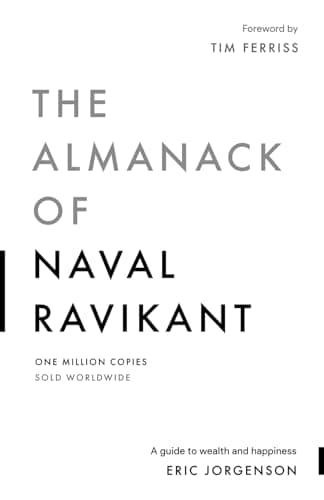
The Almanack of Naval Ravikant
Naval Ravikant's collected wisdom on wealth and happiness, curated into one short, quotable book. Big-picture mindset on leverage and building assets that earn while you sleep, not a step-by-step money plan.
The Psychology of Money
Morgan Housel
The Psychology of Money
19 short stories on how people actually think and feel about money, not just the maths of it.
Atomic Habits
James Clear
Atomic Habits
Tiny changes, remarkable results. Clear shows how 1 percent improvements compound, and the same system that fixes your gym routine works on your saving habits too.
Some links above are affiliate links. If you buy through them, Snowball Invest may earn a small commission at no extra cost to you. We only recommend books we'd suggest anyway.
Sources
Was this article useful?
Put it to your own numbers
Every calculator runs entirely in your browser, with nothing stored. See what these numbers look like for your own situation.
Explore the calculators →General information only. This article is educational and does not constitute personal financial advice. It does not account for your circumstances. Consider your own situation and seek advice from a licensed adviser before acting. Read our full disclaimer.

Timothy Hirou Gaschereau
Founder of Snowball Invest, not a financial adviser.
I write about what I'm learning myself, because nobody ever taught us how to take control of our own money. It's a skill, not a mystery, and it's never too late to learn it. The best day to start was yesterday, the second best is today.
LinkedIn →Related articles

Atomic Habits Summary: The Four Laws, Explained Properly
The four laws of behaviour change, habit stacking, the two minute rule and identity based habits, distilled. Plus what each one looks like applied to your money.

Never Split the Difference Review: Does It Work in Australia?
Chris Voss's negotiation book is genuinely useful for pay rises, rent and car yards. The catch is that his most theatrical tactics land badly in an Australian room.

Rich Dad's Guide to Investing Review: Read It Critically
The reframe is genuinely useful: investing is a plan, not a product. The structures, the tax and the investor categories are American, and a lot of it does not cross the Pacific.