

Capital Gains Tax on Property: The Plain-English Guide
Capital gains tax on property in Australia: the main residence exemption, the 6-year rule, the 50% discount, and how to calculate your CGT, with a worked example.
 By Timothy Hirou GaschereauPublished
 10 min read
Try it yourself
Selling an investment property is exciting right up until someone mentions capital gains tax. Suddenly the numbers get a lot less fun. The good news: CGT on property is not as complicated as it sounds. This guide covers everything from the basic definition through to a full worked example with real dollar figures. It's part of our property and debt series, and it's general information only, not tax advice.
🎯 The essential: CGT is the tax on the profit you make when you sell an asset, added to your taxable income. Your main residence is generally exempt. Investment properties are taxed, but if you hold for more than 12 months you get a 50% discount, and the 6-year absence rule can keep a former home exempt even while rented out.
What is capital gains tax and when does it apply to property?
Capital gains tax (CGT) is not a separate tax. It's the tax you pay on the profit (the “capital gain”) you make when you sell or dispose of an asset. That gain gets added to your taxable income for the year, and you pay tax on it at your marginal rate. A CGT event happens when you sell or transfer a property, gift it, have it compulsorily acquired, or receive an insurance payout for a destroyed property.
Investment properties, holiday homes (even if never rented), vacant land, and commercial property are all subject to CGT. Your main residence (the home you actually live in) is generally exempt, with some important conditions we cover next.
The main residence exemption: your home is (usually) CGT-free
If a property was your main residence for the entire time you owned it, you pay zero CGT when you sell it. To qualify for the full exemption, the property must have been your main residence for the whole ownership period, not have been used to produce income during that time, and be on land of 2 hectares or less.
Renting out a room means you used part of the property to produce income, so you lose a proportional slice of the exemption (the ATO calculates this on a floor-area basis). Simply claiming running costs for a home office does not trigger a CGT liability on its own. And you can only have one main residence at a time, with one exception: if you buy a new home before selling your old one, you get a 6-month overlap where both can be treated as your main residence.
The 6-year absence rule: renting out your former home
This is one of the most useful CGT rules in Australia, and a lot of property owners don't know it exists. If you move out of your home and rent it out, you can continue to treat it as your main residence for CGT purposes for up to 6 years. That means if you sell within that window, you could pay zero CGT even though you were renting it out the whole time.
Conditions: the property must have been your main residence before you moved out, you must not have another main residence during the absence, and you must be an Australian resident for tax purposes when you sell.
If you move back in and it becomes your main residence again, the 6-year clock resets, giving you a fresh 6 years from the next time you move out. After 6 years without moving back, a partial (pro-rata) exemption applies for the portion of time the property wasn't covered.
How to calculate capital gains tax on an investment property
Here's the step-by-step process the ATO uses.
- Step 1: Work out your capital gain. Capital gain = capital proceeds (sale price) minus cost base.
- Step 2: Build your cost base. Purchase price, stamp duty at purchase, legal fees, agent commissions on sale, and capital improvement costs (a new kitchen, an extension). It does NOT include ongoing repairs, council rates, mortgage interest, or property management fees, which are deductible against rental income each year, often as part of a negative gearing strategy.
- Step 3: Apply the 50% CGT discount if you held the property for more than 12 months.
- Step 4: Add the discounted gain to your taxable income for the year.
- Step 5: Pay tax at your marginal rate. There is no special CGT rate.
- Why sellers need a capital gains withholding clearance certificate
A full worked example
Here's a realistic scenario using 2024-25 ATO tax rates.
| Item | Amount |
|---|---|
| Purchase price (January 2018) | $620,000 |
| Stamp duty + legal fees at purchase | $28,000 |
| Capital improvements (new kitchen) | $22,000 |
| Agent commission + legal fees on sale | $19,000 |
| Cost base total | $689,000 |
| Sale price (March 2025) | $950,000 |
| Capital gain | $261,000 |
| 50% CGT discount (held 7+ years) | -$130,500 |
| Taxable capital gain | $130,500 |
Add that $130,500 gain to an existing taxable income of $90,000 and your total becomes $220,500. Tax on $220,500 at 2024-25 resident rates is around $65,363, versus around $17,788 on the $90,000 alone. So the extra tax attributable to the gain is about $47,575 (before the Medicare levy) on a $261,000 gross gain. This is illustrative only; your situation will differ. Run your own numbers with our capital gains tax calculator.
The 50% CGT discount explained
The 50% CGT discount is available to individuals (Australian residents) and trusts (it flows through to individual beneficiaries). It's not available to companies (no discount at all), and super funds get a reduced 33.33% discount. To qualify, you must have held the asset for more than 12 months before the CGT event, that's 12 months plus one day at minimum. The discount applies after you offset any capital losses: losses first, then discount. The order matters.
How capital losses work
A capital loss happens when you sell an asset for less than its cost base. Capital losses can only offset capital gains, not ordinary income like wages or rent. You offset current-year losses against current-year gains first, and any unused losses carry forward indefinitely with no time limit. For example, a $20,000 share loss in the same year as a $130,500 discounted property gain brings your net taxable gain down to $110,500. Timing your asset sales strategically (with a tax agent's help) can make a real difference.
What is and is not exempt from CGT on property
| Property type | CGT applies? | Notes |
|---|---|---|
| Main residence | No (fully exempt) | Must be your main residence the entire period, not income-producing |
| Main residence with rental income | Partial exemption | Pro-rata based on floor area and/or period rented |
| Former home under 6-year rule | Exempt (if conditions met) | No other main residence during absence; sold within 6 years |
| Investment property | Yes | 50% discount if held 12+ months |
| Holiday home | Yes | Even if never rented out |
| Vacant land | Yes | No exemption unless it becomes your main residence |
| Pre-CGT property (before 20 Sep 1985) | No (fully exempt) | CGT does not apply to pre-CGT assets |
The bottom line: your home is usually CGT-free, but investment property is taxed on the profit, softened by the 50% discount and everything you can legitimately add to your cost base. Keep meticulous records from day one, know whether the 6-year rule applies to you, and get advice before you sell (and ideally before you buy). For related reading, see our guides on a depreciation schedule and how you hold the title.
Moved out of your home and rented it? You may keep the exemption for years: see the CGT 6-year rule. Inherited a property instead? See CGT on inherited property.
Selling shares instead of property? The CGT rules are similar but not identical: see capital gains tax on shares.
SnowLetter
Australia's money news and our best reads, once a week.
❓ Frequently asked questions
Do I pay CGT if I sell my home?
+
Usually no. If the property was your main residence for the entire time you owned it and you did not use it to produce income, the main residence CGT exemption applies and you pay nothing. Partial exemptions apply if either of those conditions was not fully met.
What if I lived in the property for only part of the time I owned it?
+
You get a partial exemption. The CGT is calculated on a pro-rata basis: the proportion of time (and, where relevant, floor area) the property was not your main residence is subject to CGT. The 50% discount still applies if you held it for more than 12 months.
Does CGT apply if I inherit a property?
+
Inheriting a property is generally not itself a CGT event. CGT applies when you later sell the inherited property. The cost base and any exemptions depend on when the deceased acquired the property and whether it was their main residence. Pre-CGT assets (acquired before 20 September 1985) have special rules. This area can get complex quickly, so a tax agent is worth consulting.
Can I avoid CGT by buying another property?
+
No. Reinvesting the proceeds into another property does not defer or eliminate CGT. Australia does not have a rollover relief equivalent to the US 1031 exchange for residential investment properties. The only exception is compulsory acquisition, where rollover relief may be available.
What records do I need to keep for CGT purposes?
+
Keep everything: the original contract of sale, settlement statements, receipts for stamp duty, legal fees, and any capital improvements, plus the sale contract and agent invoices. The ATO requires records for 5 years after you lodge the return that includes the CGT event. For property held for many years, that means keeping documents from the original purchase date.
Is CGT different for a company or trust owning property?
+
Yes, significantly. Companies pay no CGT discount at all: the full capital gain is taxed at the company tax rate. Trusts can access the 50% discount, but it flows through to individual beneficiaries. Superannuation funds get a 33.33% discount. The structure you use to hold property has a big impact on your CGT outcome, which is why getting advice before you buy is smarter than getting it after.
📚 Recommended reading
The Barefoot Investor
Scott Pape

The Barefoot Investor
Australia's best-selling money book ever. A simple system for accounts, budgeting, debt and a real emergency fund in one.
The Armchair Guide to Property Investing
Ben Kingsley & Bryce Holdaway
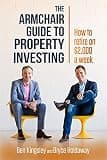
The Armchair Guide to Property Investing
Two of Australia's most trusted property voices lay out a plain-English roadmap to building a portfolio on an average income. Practical, local, and refreshingly free of get-rich-quick hype.
Making Money Made Simple
Noel Whittaker

Making Money Made Simple
Australia's classic, comprehensive money guide covering tax, super and investing, updated for today.
Some links above are affiliate links. If you buy through them, Snowball Invest may earn a small commission at no extra cost to you. We only recommend books we'd suggest anyway.
Sources
This article is general information only, not financial or tax advice. CGT rules, thresholds and tax rates change, and your circumstances are unique. Consult a registered tax agent and check the latest ATO guidance before making decisions about selling property.
Was this article useful?
Put it to your own numbers
Every calculator runs entirely in your browser, with nothing stored. See what these numbers look like for your own situation.
Try the CGT on Property calculator →General information only. This article is educational and does not constitute personal financial advice. It does not account for your circumstances. Consider your own situation and seek advice from a licensed adviser before acting. Read our full disclaimer.

Timothy Hirou Gaschereau
Founder of Snowball Invest, not a financial adviser.
I write about what I'm learning myself, because nobody ever taught us how to take control of our own money. It's a skill, not a mystery, and it's never too late to learn it. The best day to start was yesterday, the second best is today.
LinkedIn →Related articles

The CGT 6-Year Rule: Keep Your Main Residence Exemption When You Move Out
Moved out and renting your old home? The capital gains tax 6-year rule could save you thousands. How it works, who qualifies, and the traps to avoid.
Capital Gains Tax on Inherited Property in Australia
Inheriting property does not trigger CGT, but selling it might. The 2-year rule, cost base, pre-CGT property and the main residence exemption, explained.

Airbnb and Short-Term Rental Income Tax in Australia
Every dollar of Airbnb income is taxable in Australia. What to declare, deductions you can claim, and the CGT trap that catches hosts when they sell.