

What is Positive Gearing?
Quick answer
A property is positively geared when the rent it earns is more than all the costs of holding it, leaving a net profit. That profit counts as assessable income and gets taxed at your marginal rate. It's the mirror image of negative gearing, the property pays you, instead of you topping it up.
How it works
Take the rent a property earns for the year and subtract every deductible expense: loan interest (usually the biggest one), council and water rates, landlord insurance, property management fees, repairs and maintenance, depreciation, strata or body corporate fees, and land tax. If what's left is a positive number, the property is positively geared, and that leftover amount is added to your other income at tax time.
Positive vs negative gearing
They're opposite ends of the same idea. A positively geared property earns more than it costs, so you get a cash surplus and a bit more taxable income. A negatively geared one costs more than it earns, so you're topping up the shortfall, but the loss can reduce your taxable income under current rules. Neither is automatically the better strategy, it depends on your income, your tax bracket, and how much cash flow you actually need day to day. Our Negative Gearing Calculator is a useful way to model either scenario for a property you're considering.
Tax on the profit
Net rental profit is ordinary assessable income. It gets added to everything else you earn and taxed at your marginal rate, there's no discount or special treatment for it the way there is for capital gains. For 2026-27, Australian resident tax rates are 0% up to $18,200, 15% from $18,201 to $45,000, 30% from $45,001 to $135,000, 37% from $135,001 to $190,000, and 45% above that, plus the 2% Medicare levy on top.
Worked example: a property collects $35,000 in rent for the year, with $28,000 in allowable deductions (interest, rates, insurance, management fees, repairs, depreciation, strata and land tax), leaving a net rental profit of $7,000. If you're in the 30% bracket, that's $2,100 in tax, for a net gain of $4,900 after tax.
A few myths worth clearing up
"Positive gearing is always better." Not necessarily. Higher-income earners in the 37% or 45% brackets often get a bigger tax benefit from a negatively geared loss than the after-tax profit from a positively geared property.
"It doesn't build wealth." It does, the surplus cash can be reinvested, used to pay down debt faster, or saved toward your next deposit.
"A property is fixed as one or the other." It isn't. Rising rents and a shrinking loan balance both push a property toward positive territory, plenty of investors start out negatively geared and drift into positive gearing over time.
📚 Recommended reading
Positively Geared
Lloyd Edge
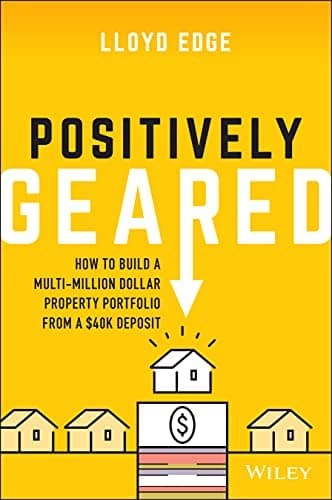
Positively Geared
How to build a positive cashflow property portfolio that funds the life you want, not just a mountain of debt. Lloyd Edge went from music teacher to property strategist, so the advice is grounded in the real Aussie market.
Rethink Property Investing
Scott O'Neill & Mina O'Neill

Rethink Property Investing
A practical playbook for building a commercial and residential portfolio that actually pays you cashflow, written by two Aussies who retired in their early 30s. Straight talk, real numbers, no fluff.
Some links above are affiliate links. If you buy through them, Snowball Invest may earn a small commission at no extra cost to you. We only recommend books we'd suggest anyway.
🏠 Negative Gearing Calculator
Model the annual profit or loss, tax impact and cash flow on your own property scenario.
Negative gearing, in full
The full picture on negative gearing, including how it contrasts with positive gearing.
Frequently asked questions
Is positive gearing the same as positive cash flow?
Related but not identical. Cash flow is a pure cash-in-versus-cash-out measure, while gearing is a tax concept that includes non-cash deductions like depreciation. A property can be positively geared on paper while roughly cash-flow neutral in real life, or the other way around.
Do I have to declare the profit?
Yes. Net rental profit is declared in your annual tax return and flows into your total assessable income, taxed the same as your salary or any other income.
Can a property become positively geared over time?
Yes, and it's common. As rent rises and your loan balance shrinks through repayments, a property that started out negatively geared can gradually shift into positive territory.
Related terms
Sources
Disclaimer
This page is general information only, not financial or tax advice. Tax rates and thresholds are set by the government and can change, always confirm current figures at ato.gov.au or with a registered tax agent before making a decision about an investment property.