

The Subtle Art of Not Giving a F*ck by Mark Manson: An Honest Review
Our honest review of Mark Manson's bestseller through a money lens: not a finance book, but its values-over-status message is a real antidote to lifestyle inflation.
 By Timothy Hirou GaschereauPublished
 8 min read
Short verdict: it's a good book. Not a finance book, not even close. But for anyone who's ever bought something they didn't need to impress someone they don't like, the core message lands hard enough to be worth a few hours of your time. It's part of our personal finance book reviews on Snowball Invest.
Quick answer
A punchy, occasionally profane mindset reset that won't teach you about superannuation, but might stop you blowing your savings on things you don't actually care about. Best for people questioning lifestyle inflation, status spending or what "enough" really means. Skip it if you want Australian financial mechanics or a step-by-step money plan. Our rating: 4 out of 5.
Want to read The Subtle Art of Not Giving a F*ck?
Not a money book, but a blunt, funny case for caring about the right things, and a surprisingly good antidote to lifestyle inflation.
In this guide
- →What the book is about: choosing your values, and the 'backwards law'
- →The genuine strengths and the honest weaknesses
- →Who it's for, and who should skip it
- →What critics and readers say
- →The Australian angle: values, 'enough', and a higher savings rate
📖 What is The Subtle Art of Not Giving a F*ck about?
Published in 2016, Mark Manson's bestseller hit number one on the New York Times list and hasn't really left the cultural conversation since. The core argument is deceptively simple: you have a limited number of things you can genuinely care about, so you'd better choose them deliberately. Spend your attention on the wrong things and you'll chase metrics that don't actually matter to you. The key ideas:
- You can't care about everything. The skill is choosing what deserves your energy.
- Pick good values. Measuring yourself against superficial markers like wealth, status or follower counts sets up a miserable treadmill; choose values within your control and genuinely meaningful.
- Take responsibility for your problems, even when they aren't your fault, because waiting for someone else to fix your life is a losing strategy.
- The "backwards law": the desire for more positive experience is itself a negative experience. Chasing happiness directly tends to push it further away.
- Embrace problems and limitations: a meaningful life isn't one without problems, it's one with problems worth having.
- You are not special: entitlement to a great outcome without the work and trade-offs is a recipe for resentment.
None of this is a personal finance framework, there's nothing on ETFs, super or a household budget. But the values-over-metrics thinking maps directly onto how people relate to money. If your value is "accumulate status symbols," your spending reflects that. If it's "financial independence and time with my family," your spending looks completely different. That's why this book belongs on a personal finance reading list, even if it doesn't know it's there.
⚖️ Strengths and weaknesses
What it gets right
- ✓Cuts through toxic positivity: refreshingly blunt about problems and discomfort being real and unavoidable.
- ✓The values-over-metrics framework is genuinely useful for spending: name what you value and it's easier to spot a status-impulse purchase.
- ✓Readable and funny: you'll get through it in a few sittings, and the examples land more often than they miss.
- ✓Challenges the 'more equals better' script that quietly drives so much overspending.
- ✓Useful for anyone stuck in an 'I'll be happy once I earn X' loop.
Where it falls short
- ✕Not a finance book: zero Australian financial mechanics, no super, ETFs or budgeting.
- ✕The crude style and profanity aren't for everyone.
- ✕US-centric and heavily anecdotal, with references that don't always translate.
- ✕Repetitive in the second half, circling ideas established early.
- ✕The ideas aren't entirely new: it's an accessible repackaging of Stoicism, Buddhism and existentialism.
👤 Who should read it, and who should skip it?
Read it if you
- ✓Are questioning lifestyle inflation, status spending or what 'enough' actually means for you.
- ✓Find yourself in an 'I'll be happy when I earn X' loop and can't break out.
- ✓Find mainstream self-help too saccharine or vague to be useful.
- ✓Want a short, readable book that challenges the cultural script around wealth and success.
Skip it if you
- ✕Want practical, step-by-step Australian money guidance (budgeting, super, investing).
- ✕Are sensitive to crude language or find the edgy tone gimmicky.
- ✕Are already well-versed in Stoic philosophy and don't need a pop repackaging of it.
🔍 What do critics say?
Critics broadly welcomed it as an in-your-face, funny guide to living with integrity and finding meaning in sometimes-uncomfortable places. It doesn't pull punches and it isn't trying to make you feel good in a shallow way. It reached number one on the New York Times bestseller list and has spent years in the cultural conversation since, which isn't accidental: the bluntness is the point, and it clearly resonated.
💬 What do readers say?
On Goodreads it holds around 3.9 out of 5 from well over a million ratings, a substantial sample and a rating that's solid without being inflated. The consistent praise centres on the core message (deliberately choose what you care about rather than letting culture or advertising choose for you) and the direct, no-nonsense tone, which readers who've waded through saccharine self-help find a relief.
The criticisms are just as consistent across r/books and r/selfimprovement: the hype sets expectations too high, the provocative style can feel like a gimmick a few chapters in, the ideas are closer to repackaged Stoicism than anything new, and the second half repeats itself. Both sides have a point: the book is good, just not life-changing for everyone, and the hype has probably oversold it to some readers.
🇦🇺 The Australian angle
Here's where it gets relevant for a money site. At its core, the book is an argument against measuring your life by external, superficial metrics: wealth, status, possessions, other people's approval. That's the engine behind lifestyle inflation, status purchases and the very human tendency to upgrade your spending every time your income rises. For Australians thinking about their finances, the values-over-metrics argument translates directly:
- Choosing good values over status metrics supports a higher savings rate. If you genuinely don't care about the newest car or the biggest house on the street, you free up a real chunk of income.
- Defining "enough" is a financial act. Knowing what's actually enough for a good life, rather than chasing an ever-receding horizon, is one of the most powerful things you can do for your long-term position.
- Anti-consumerism isn't frugality for its own sake. The argument isn't "buy nothing", it's "buy things that align with what you actually value", which is more sustainable and honest than pure deprivation.
The book has zero Australian financial mechanics, so treat it as the mindset layer, not the strategy layer. Once you've done the values work, our Your Money or Your Life review and Die With Zero review take the "enough" idea and apply it directly to money.
💰 The verdict
The Subtle Art of Not Giving a F*ck is one of the better personal development books of the past decade, not because it's revolutionary, but because it's honest and readable in a genre that's often neither. Manson takes ideas that have been around for centuries (Stoicism, Buddhist non-attachment, existentialist responsibility) and makes them accessible without dumbing them down too much. It won't teach you how to build a share portfolio or maximise your super, but it might help you figure out why you keep spending money on things that don't actually make you happy, and that's a more useful starting point than most people realise. Read it on a weekend, then go sort out your finances. Our rating: 4 out of 5.
Want to read The Subtle Art of Not Giving a F*ck?
Tired of spending to impress? Grab a copy, do the values work, then put the mindset to use on your money.
SnowLetter
Australia's money news and our best reads, once a week.
❓ Frequently asked questions
Is The Subtle Art of Not Giving a F*ck a finance book?
+
No. It's a general self-help and mindset book with no financial content, no investment advice and no Australian guidance. Its relevance to personal finance is indirect: the values framework helps you think more clearly about spending, lifestyle inflation and what you're actually trying to achieve with your money.
What is the main message?
+
You have a limited amount of attention and energy, so choose deliberately what you care about. Measuring yourself against superficial values like status, wealth or other people's approval leads to a miserable treadmill. Choosing values that are within your control and genuinely meaningful is the path to something better.
Is it worth reading?
+
For most readers, yes. It's short, readable, and cuts through a lot of the toxic positivity that dominates mainstream self-help. The core ideas aren't entirely new and the second half can feel repetitive, but the overall message is solid and the delivery is genuinely funny in places.
How does it relate to money and personal finance?
+
The values-over-metrics framework applies directly to spending. If you measure your life by status symbols, your spending chases those symbols indefinitely; if you can identify what you actually value, your spending becomes clearer and more intentional. It also challenges the assumption that more money and more stuff equals a better life, a useful shift for building long-term financial health.
Is it suitable for Australian readers?
+
The core ideas are universal, so yes. The examples and cultural references are heavily American, which can be a mild irritant, but it doesn't undermine the central argument. Just be aware there's nothing Australia-specific: no super, no local tax context, no financial mechanics.
What pairs well with it for personal finance?
+
Your Money or Your Life (for the 'enough' framework applied to finances), Die With Zero (a provocative take on spending and life satisfaction), and The Psychology of Money (a readable, values-aware approach to investing). Manson's book works best as the mindset foundation, with the others adding the financial mechanics on top.
📚 Get the book (and two money companions)
The Subtle Art of Not Giving a F*ck
Mark Manson
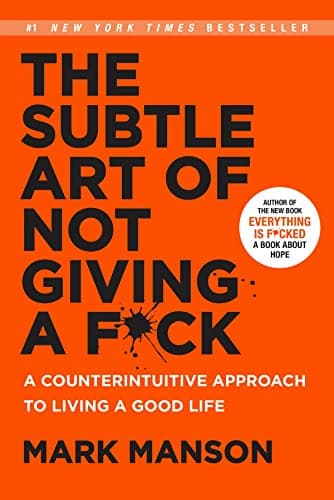
The Subtle Art of Not Giving a F*ck
Not a money book, but a blunt, funny case for caring about the right things. Its values-over-status message is a surprisingly good antidote to lifestyle inflation and impulse spending.
Your Money or Your Life
Vicki Robin
Your Money or Your Life
The book that basically kicked off the FIRE movement, reframing money as 'life energy' you trade your hours for. The nine-step program is pure gold, just swap the US retirement-account chapter for super.
Die With Zero
Bill Perkins
Die With Zero
Stop hoarding cash for a someday that never comes. Perkins makes the case for spending on experiences while you are still young enough to enjoy them.
Some links above are affiliate links. If you buy through them, Snowball Invest may earn a small commission at no extra cost to you. We only recommend books we'd suggest anyway.
Sources
Was this article useful?
Put it to your own numbers
Every calculator runs entirely in your browser, with nothing stored. See what these numbers look like for your own situation.
Explore the calculators →General information only. This article is educational and does not constitute personal financial advice. It does not account for your circumstances. Consider your own situation and seek advice from a licensed adviser before acting. Read our full disclaimer.

Timothy Hirou Gaschereau
Founder of Snowball Invest, not a financial adviser.
I write about what I'm learning myself, because nobody ever taught us how to take control of our own money. It's a skill, not a mystery, and it's never too late to learn it. The best day to start was yesterday, the second best is today.
LinkedIn →Related articles

Atomic Habits Summary: The Four Laws, Explained Properly
The four laws of behaviour change, habit stacking, the two minute rule and identity based habits, distilled. Plus what each one looks like applied to your money.

Never Split the Difference Review: Does It Work in Australia?
Chris Voss's negotiation book is genuinely useful for pay rises, rent and car yards. The catch is that his most theatrical tactics land badly in an Australian room.

Rich Dad's Guide to Investing Review: Read It Critically
The reframe is genuinely useful: investing is a plan, not a product. The structures, the tax and the investor categories are American, and a lot of it does not cross the Pacific.