

Profit First by Mike Michalowicz: An Honest Review
Our honest Profit First review for Australians: Mike Michalowicz's take-profit-first bank-account system, what it skips, and how to adapt it for GST and the ATO.
 By Timothy Hirou GaschereauPublished
 9 min read
If your business makes decent money but there never seems to be any left over, Profit First is written for exactly that feeling. Mike Michalowicz's fix is almost annoyingly simple: take your profit first, before you pay for anything else, and force the business to run on what remains. It's one of the most practically useful reads for small business owners who are perpetually busy but broke. It's also US-centric and stretches a single idea across a lot of pages. Here's the honest take, part of our personal finance book reviews on Snowball Invest.
Quick answer
A behaviourally smart, practically simple cash system that will change how most small business owners think about money, as long as you adapt it for Australia. Best for sole traders, side hustlers and small business owners drowning in cash-flow chaos. Skip it if you want a complete financial strategy, Australian tax guidance, or you already run tight, disciplined books. Our rating: 4 out of 5.
Want to read Profit First?
The take-profit-first system for small business owners who are tired of being busy but broke. Simple, behavioural and genuinely useful, once you adapt it for GST and the ATO.
In this guide
- →What the book is about: the formula flip and the multi-account system
- →The genuine strengths and the honest weaknesses
- →Who it's for, and who's already past it
- →What critics and r/smallbusiness readers say
- →The Australian angle: bank fees, GST and the Tax account
📖 What is Profit First about?
The core idea is a single formula flip. Traditional accounting says Sales minus Expenses equals Profit, which means profit is whatever happens to be left over at the end (often nothing). Michalowicz argues you should turn it around: Sales minus Profit equals Expenses. You take your profit first, off the top, and then run the business on what's left. It's the personal-finance "pay yourself first" rule pointed at a business. The main mechanics:
- Multiple bank accounts: money lands in an Income account, then gets divided into Profit, Owner's Pay, Tax and Operating Expenses. You can only spend what's actually sitting in each account.
- A fixed rhythm: twice a month you move money from Income into the other accounts by set percentages, so allocation becomes a habit rather than a decision.
- Parkinson's Law: just as work expands to fill the time available, expenses expand to fill the money available. Shrinking the Operating Expenses account forces the business to run leaner.
- Serving smaller plates: his phrase for the same idea. Give yourself less to spend and you'll find a way to make it work, the same reason envelope budgeting works for households.
The system is deliberately low-tech. No fancy software, no finance degree, just a few accounts, a rhythm and some discipline. One important caveat: the book is US-centric. The tax percentages, banking norms and every reference to the IRS do not translate directly to Australia. More on that below.
⚖️ Strengths and weaknesses
What it gets right
- ✓Behaviourally smart: it uses Parkinson's Law and the envelope method to force discipline without relying on willpower.
- ✓Simple to start: a few bank accounts and a spreadsheet, no accounting software or consultant required.
- ✓Shifts the owner mindset: paying yourself first, before suppliers and the tax office, is a genuine reframe.
- ✓Works for lumpy income: the percentage-based allocation scales with whatever actually comes in, which suits freelancers and side hustlers.
- ✓Readers genuinely love it: consistently strong ratings and a lot of 'this finally made me profitable' stories.
Where it falls short
- ✕The multi-account setup is fiddly in Australia, where the big banks often charge a monthly fee per account.
- ✕US-centric throughout: IRS rules and US tax percentages need active translation for Australia.
- ✕Repetitive and self-promotional, with a fair bit of pointing towards the author's consulting ecosystem.
- ✕It's a cash-allocation discipline, not a strategy: it won't fix bad pricing, thin margins or a broken model.
- ✕Real admin overhead: frequent transfers and reconciling several accounts adds time, especially at BAS time.
👤 Who should read it, and who can skip it?
Read it if you
- ✓Run a small business or side hustle and keep reaching month-end wondering where the money went.
- ✓Have never paid yourself consistently, or GST catches you out every quarter.
- ✓Want a simple, physical system that forces cash discipline without much willpower.
- ✓Have irregular income and want an allocation method that scales with it.
You can probably skip it if you
- ✕Already run disciplined books with a good accountant reviewing the numbers.
- ✕Want help with pricing, business structure or Australian tax specifics (the book has none).
- ✕Run a stable, already-profitable business where the extra accounts are just overhead.
- ✕Prefer to manage the same discipline with a single account and a spreadsheet.
🔍 What do critics say?
Accountants who've reviewed the system tend to acknowledge its behavioural value while flagging the same limitation: it's a budgeting tool, not true accounting. It doesn't replace your reporting, your BAS obligations or a qualified accountant. Several describe it as emergency triage, highly effective for an owner in cash-flow crisis, but closer to unnecessary overhead once the fundamentals are solid. The multiple accounts can also create bookkeeping friction when you're reconciling against a profit and loss statement in Xero or MYOB. And because the whole system is about cash allocation, it does nothing to fix the underlying issues of weak pricing, high cost of goods or unsustainable margins. If the model is broken, splitting the cash into buckets won't save it.
💬 What do readers say? Goodreads and Reddit
On Goodreads it holds a strong rating of around 4.3 out of 5 from tens of thousands of ratings, with most readers landing on four or five stars. That's an enthusiastic result for a business book at that volume. On Reddit (r/smallbusiness, r/Entrepreneur, r/Bookkeeping) the sentiment is mixed but practically positive: the fans consistently say it enforced cash discipline they couldn't maintain on their own, and made them actually aware of profit in a way spreadsheets never did. Some report moving from steady losses to consistent profitability after adopting a fixed profit allocation.
The criticism clusters on two points: some readers find the account-splitting is unnecessary overhead when a single account and a spreadsheet would do the same job, and others feel the core idea is stretched thin across the book. Both are fair. The consensus: read it for the system and the mindset, not for a page-turner.
🇦🇺 The Australian angle
This is the part most Australian readers actually need. The bank-account allocation concept works here, but a few things need adapting.
- Watch the bank fees. The big four often charge a monthly account-keeping fee per account, so running five or more of them can quietly cost real money. Look for banks or neobanks that let you open multiple free or low-fee accounts.
- GST comes out first. This is the most important adaptation. If you're registered for GST, the 10% you collect on invoices isn't yours, it belongs to the ATO. Strip that out (ideally into a dedicated GST/BAS account) before you run any Profit First percentages, or every allocation will be off.
- The Tax account maps to GST and income tax. Use it for your BAS obligations and for income tax. Sole traders pay personal income tax rates, not company rates, so don't copy the book's US percentages. Register for GST once your turnover hits $75,000, per the ATO.
- Keep business and personal money separate. Sole traders have no legal separation between the two, which makes mixing money easy and messy. The dedicated-accounts structure actually helps by making the separation physical and visible.
There's a broader wealth angle too: a business that reliably pays you frees up money you can then put towards your own goals. If you want to go deeper on the small-business systems side, our E-Myth Revisited review is a natural companion, and for the "pay yourself first" idea that Profit First borrows, see our Richest Man in Babylon review.
💰 The verdict
This Profit First review lands at 4 out of 5. The book is genuinely worth reading for most small business owners and sole traders, especially anyone who has never had a consistent system for managing cash. The core idea, paying yourself first and constraining expenses to what remains, is behaviourally sound and simple to put into practice, and it doesn't need expensive software or a finance background. The limits are real too: it's a US book, so the tax and banking specifics need active translation, it's a cash-management discipline rather than a business strategy, and the multi-account setup adds admin that some businesses will find more trouble than it's worth. The honest recommendation: read it, implement the core idea with Australian adaptations, and pair it with a good accountant who knows the local tax landscape. Used that way, it's one of the more useful business books you'll pick up this year. Our rating: 4 out of 5.
Want to read Profit First?
Busy but broke? Grab a copy, set up the accounts, and start taking your profit first.
SnowLetter
Australia's money news and our best reads, once a week.
❓ Frequently asked questions
Is Profit First worth reading for Australian small business owners?
+
Yes, for most. The core system, allocating income across dedicated bank accounts before expenses get paid, is practical and behaviourally effective. The main caveat is that the book is written for the US market, so tax percentages and banking references need adapting. Pair it with Australian-specific guidance and an accountant who knows the local landscape.
What are the Profit First bank accounts?
+
The standard setup is five accounts: Income (all revenue lands here), Profit, Owner's Pay, Tax, and Operating Expenses. On a set rhythm you move money from Income into each of the others by percentage, and you only spend what's in the relevant account. Australian implementations usually add a dedicated GST/BAS account.
Does the Profit First system work for sole traders?
+
Yes, and it's particularly well-suited to sole traders with irregular income, since the percentage-based allocation scales with whatever comes in. The key Australian adaptation is stripping GST out of your gross income before running the allocations, and using personal income tax rates (not company rates) to size your Tax account.
How does Profit First handle GST in Australia?
+
It doesn't, specifically. The book was written for the US and never mentions GST. If you're registered, the 10% you collect on invoices isn't your money, it belongs to the ATO. Australian practitioners recommend adding a GST/BAS account and setting that portion aside before running any other Profit First percentages. The ATO requires businesses with turnover of $75,000 or more to register for GST and lodge a BAS.
What's the difference between Profit First and normal accounting?
+
Normal accounting tracks every transaction and produces reports (profit and loss, balance sheet, cash flow). Profit First is a cash-allocation habit, not accounting. It doesn't replace your bookkeeping software, your BAS obligations, or your accountant. Think of it as a behavioural layer on top of your existing setup that forces you to allocate cash on purpose instead of spending whatever's in the account.
What should I read after it?
+
Good follow-ups include The E-Myth Revisited by Michael Gerber (building systems so the business runs without you) and The Richest Man in Babylon (the pay-yourself-first idea that Profit First borrows and applies to business). For the Australian mechanics, the ATO and business.gov.au are the practical starting points.
📚 Get the book (and two companions)
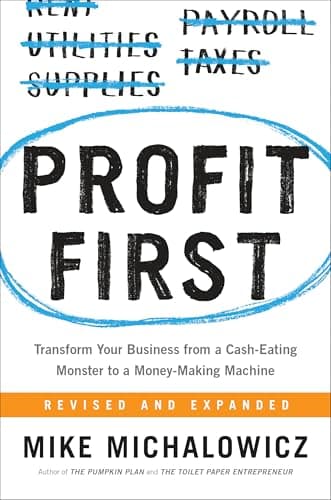
Profit First
Mike Michalowicz
Profit First
A behaviourally smart cash system for small business owners: pay yourself profit first, then run on what's left. Simple and practical, just adapt the bank accounts and tax buckets for GST and the ATO.
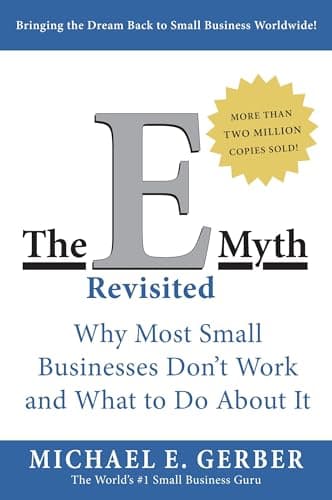
The E-Myth Revisited
Michael E. Gerber
The E-Myth Revisited
The small-business classic on why being great at your craft doesn't mean you can run a business built on it. Work on it, not in it. Repetitive, but the systems lesson is timeless.
The Richest Man in Babylon
George S. Clason
The Richest Man in Babylon
The original pay-yourself-first playbook, dressed up as ancient Babylonian parables. Almost a century old and the advice still lands.
Some links above are affiliate links. If you buy through them, Snowball Invest may earn a small commission at no extra cost to you. We only recommend books we'd suggest anyway.
Sources
Was this article useful?
Put it to your own numbers
Every calculator runs entirely in your browser, with nothing stored. See what these numbers look like for your own situation.
Explore the calculators →General information only. This article is educational and does not constitute personal financial advice. It does not account for your circumstances. Consider your own situation and seek advice from a licensed adviser before acting. Read our full disclaimer.

Timothy Hirou Gaschereau
Founder of Snowball Invest, not a financial adviser.
I write about what I'm learning myself, because nobody ever taught us how to take control of our own money. It's a skill, not a mystery, and it's never too late to learn it. The best day to start was yesterday, the second best is today.
LinkedIn →Related articles

Buy Back Your Time by Dan Martell: An Honest Review
Our honest Buy Back Your Time review for Australians: Dan Martell's Buyback Rate, DRIP Matrix and delegation playbook, and what to know before you hire here.

The 4-Hour Work Week by Tim Ferriss: An Honest Review
Our honest 4-Hour Work Week review for Australians: Tim Ferriss's DEAL framework and mini-retirements, what's dated, and how the mindset applies here.

The $100 Startup by Chris Guillebeau: An Honest Review
Our honest $100 Startup review for Australians: Chris Guillebeau's lean side-hustle playbook and 'convergence' idea, what it skips, and how it applies here.